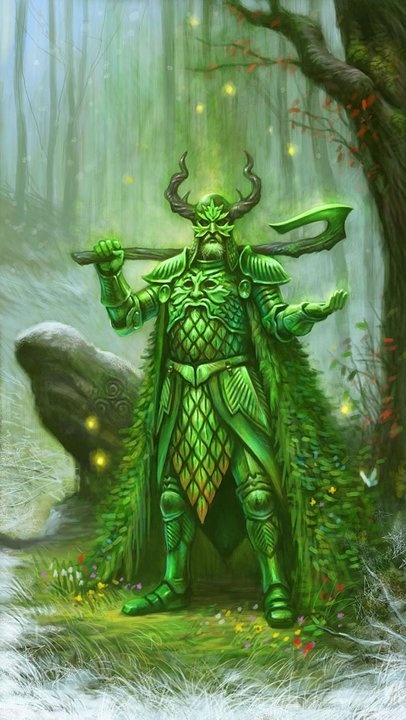
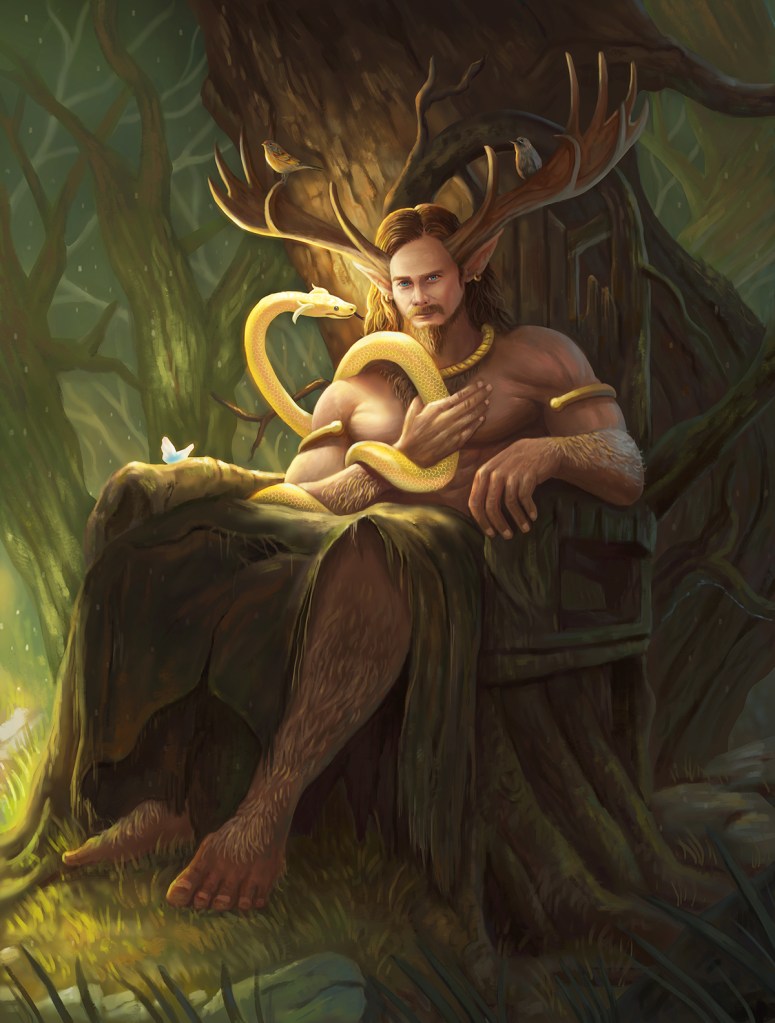
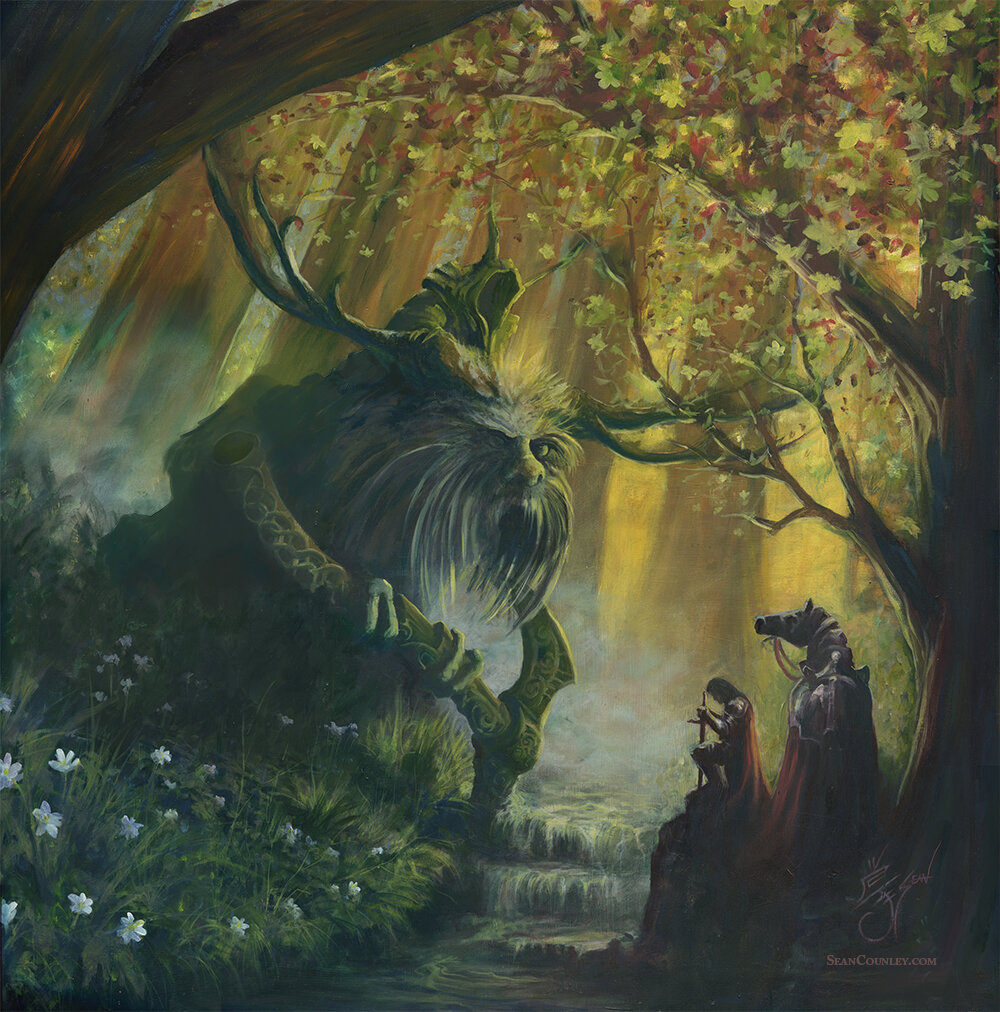
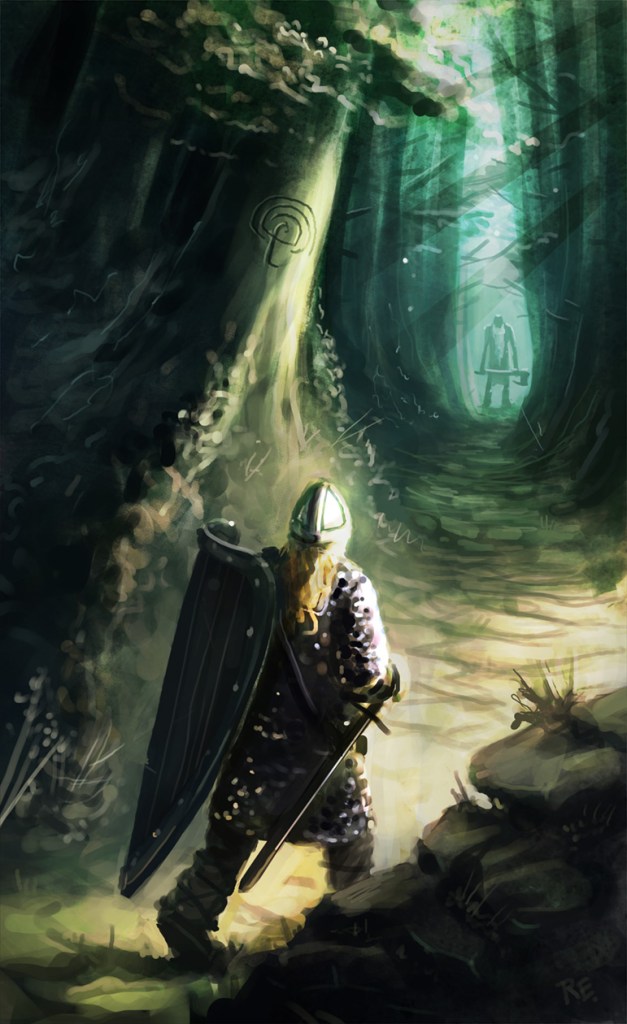
“With the opening of any Arthurian book begins a new adventure!”
~ Helen Borrello, Professor of Arthurian Literature (my college professor!)
(To listen to this blog post as a Spotify podcast episode, click here!)
Why Arthurian legend?
Arthurian legend is an entire world in itself.
Little kids really do still play “pretend”, pretending to be a cool king who pulls a sword out of a stone. Or a badass wizard with amazing powers. Students study the literature in school. Historians delve into ancient manuscripts and Romano-British excavations to find any clue to a real Arthur. Fantasy authors pour out novels every year of a fascinating new retelling of the legend. New movies and fantasy TV series are booming now more than ever, with subtle ties to Arthuriana. Shakespeare even drew inspiration from a few of the tales. Hell, even “Sonic the Hedgehog” has a video game based on the Knights of the Round Table.
Arthurian legend is not dead. It is alive now more than ever. Perhaps it’s because we, as a society, need it now more than ever. We need stories of justice; of righting the wrongs of greedy kings and granting mercy even to those who don’t always deserve it, so that they may learn and live more wholesome lives. Stories of true, honest to goodness chivalry, where heroic knights treat women with an almost incomprehensible respect. Where women make the most of their situations and find their way to freedom, vocality and happiness in a world where such things were rare to come by. Stories of danger and adventure, of bravery and sacrifice, of love and wisdom and victory against all odds. Stories of magic.
Thus, I’ve decided to start an Arthurian blog!! *cough* *finally* I’ve been meaning to do this for a long time, if only to get some topics off my chest that keep me awake at night. Everything from ancient texts, to more recent books, to movies, travel, to discussions about romance, revenge, portrayal and adaptation… The list goes on! So if you think you might be interested, I’d be honored if you’d be so kind as to give this page a follow! (I’d be eternally grateful. Having these sort of conversations with oneself only goes so far.)
I’m an actor, fantasy writer, studier of medieval British history and culture, and an overall Arthurian fanatic. So I hope to keep these posts interesting, and while I by no means call myself anywhere near an expert, I pledge to at least remain mildly entertaining. 🙂
For more, follow my Arthurian podcast, “Of Swords and Magic”, on SoundCloud or Podomatic, and follow me on Instagram @ofswordsandmagic.podcast for more updates! More posts to come soon! Until then, brush up your Arthuriana…there’s a lot of legend out there!
Happy March, friends! Hope everyone is having a wonderful new year so far. 🙂
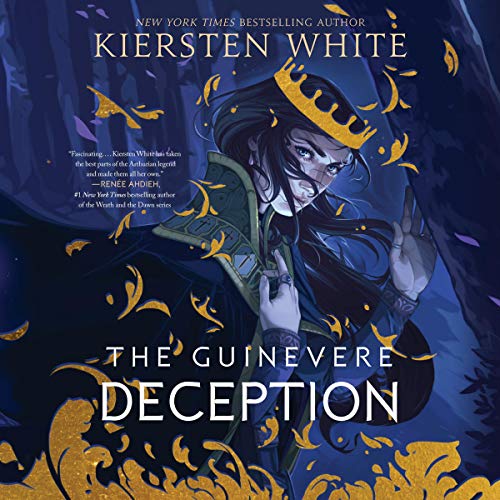
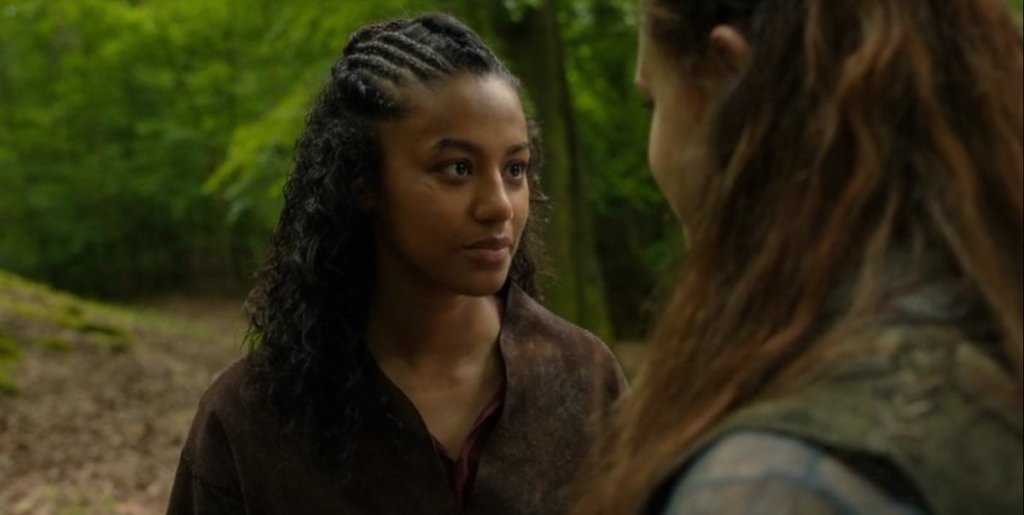
I just recently finished reading Kiersten White’s The Guinevere Deception and I found it so very enjoyable! It’s a quick read, a lot of fun, surprisingly inclusive and a super interesting twist on the Legend. Here’s a quick, spoiler-free review. (For those who’ve read it and want to talk about it, feel free to comment your thoughts on the book or message me privately on IG! I’d love to talk about it!!)
To me, this book is a joy! From what I’ve read online, it’s not exactly everyone’s cup of tea. It is a bit of a slow-burn, it’s fairly light-hearted compared to other fantasy novels (which isn’t always what readers are looking for) and it’s clear that it’s the first book in a series. While it certainly stands well on it’s own, you can tell that the biggest, juiciest stuff likely comes in later in the trilogy. (That’s not to say that juicy stuff didn’t happen throughout the book! Also, I personally found it heart-wrenching at times! Not sure how others didn’t.)
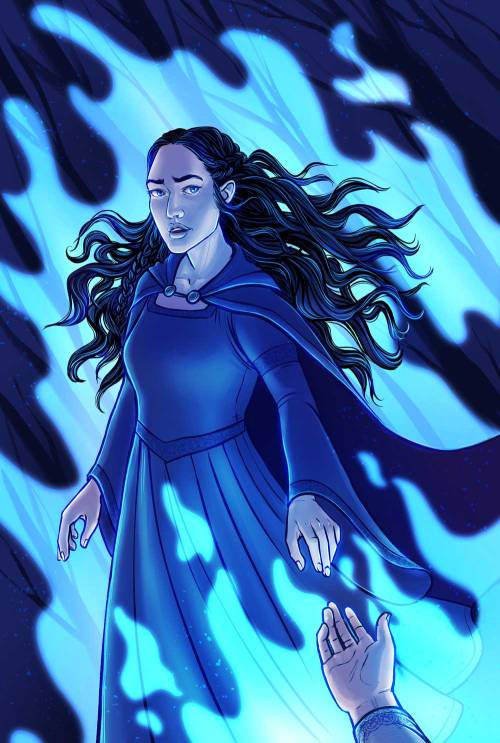
Anyway, I was deeply invested the whole time. Without spoiling anything, I can say that the premise is this: Guinevere, as we know her, is dead. And a forest sorceress has been tasked by Merlin to replace her. She must pretend to be the Guinevere we know and love…and use her magic to keep Arthur safe from evil. Even though magic is forbidden in Camelot. And keep from actually becoming Guinevere, herself. The book’s aura is deep, dark, beautiful (like a forest) and yet full of warmth. Arthur is just as Arthur-ey as he can get; sweet, warm, focused, strategic, genuine and unfortunately, romantically distant at times. And “Guinevere”, whoever she really is, is still Guinevere in many ways. I was telling a friend that this book sort of reminds me of Miles Morales in the Spider-Man universe. (Yes, I’m a huge Spidey fan.) Spider-Man: Into the Spider-Verse stars Miles Morales as Spider-Man. He’s not Peter Parker. He’s his own character; a mixed black and Puerto Rican kid from Brooklyn, named Miles. But he’s still Spider-Man. He still has a tragic backstory. He’s still a little awkward and nerdy, and passionate about science. He’s got a good heart and a brave spirit, and a calling for seeking justice when needed. And he still wears the suit (albeit a different color) and fights crime. Into the Spider-Verse pays homage to Spider-Man, as a character; as an idea. The Guinevere Deception does the same. It’s a love letter to Guinevere, as a character, while still giving the protagonist her own identity in many ways. She’s a follower of the Old Ways; a black-haired witch with a giant fear of water and a sense of justice that cannot be ignored, no matter who makes what rules. But she’s still Guinevere; elegant, graceful, intelligent and witty, soft and demure at times, and entirely focused on her duty to Camelot and to Arthur. And still a woman who wants to be loved.
A few last notes about it: There is major LGBTQ+ representation, which for some reason I didn’t expect. This was the first modern Arthurian retelling I’ve read with such a level of representation, so it took me surprise and honestly almost made me tear up. As someone in the LGBTQ+ community, the fact that they didn’t shy away from it and used some of the Legend’s main characters for this made my heart so warm and sparkly. And I thought it worked really well.
The language was also beautiful and there were SO many great quotes that I made a list on my phone and wrote some of them down. For pagans and witchy folk, the book also delves deep into knot magic, which from what I know was a big part of pre-Christian practices in Britain, especially in Cornwall. Also, there may or may not be quite a plot twist. Or two. A “deception”, if you will.
Anyway, it was a super enjoyable take on the Legend and for those looking for a fun but deeply mysterious and darkly magical read, I highly recommend it. I genuinely can’t WAIT to read the rest of the series. ❤
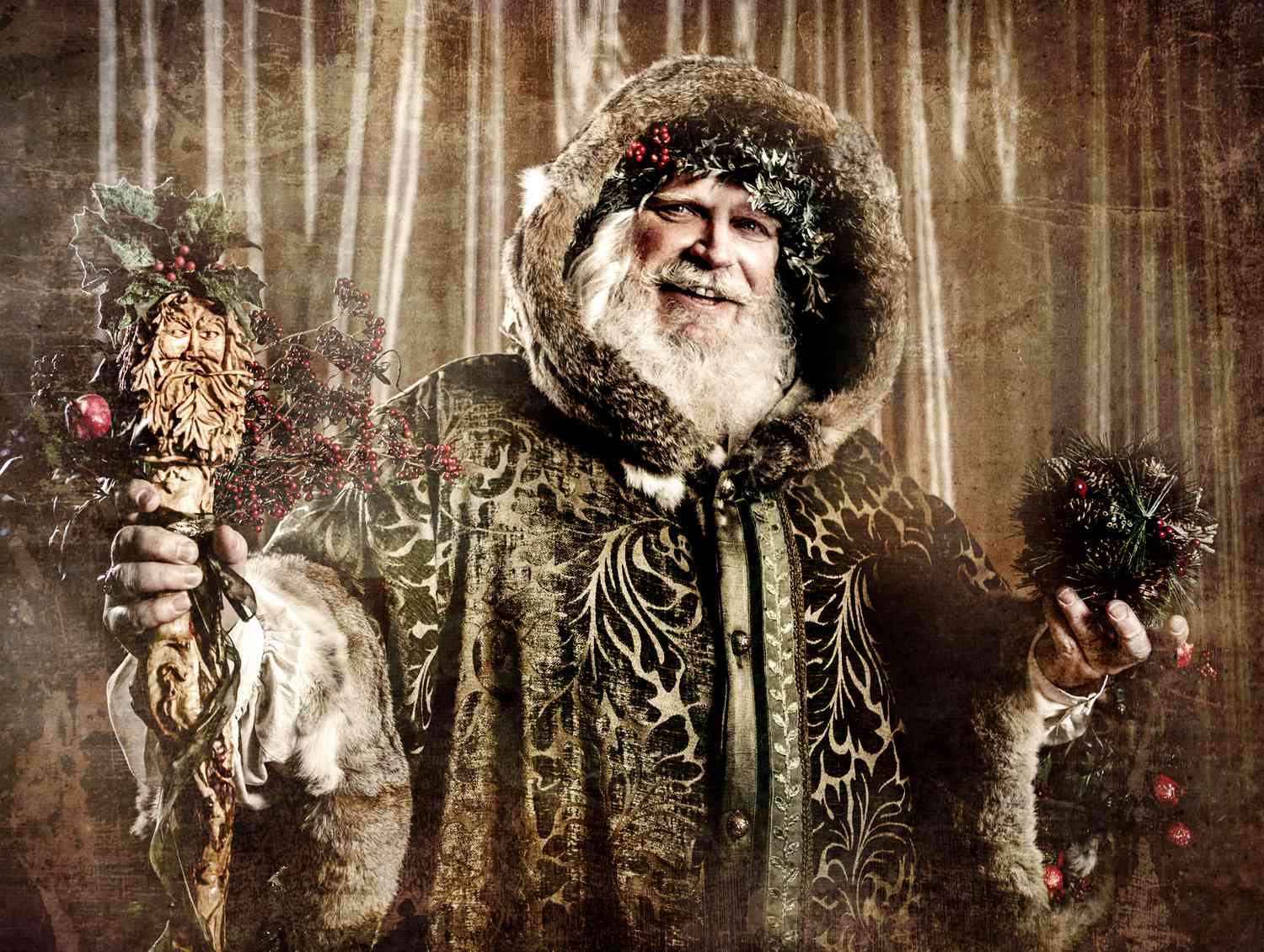
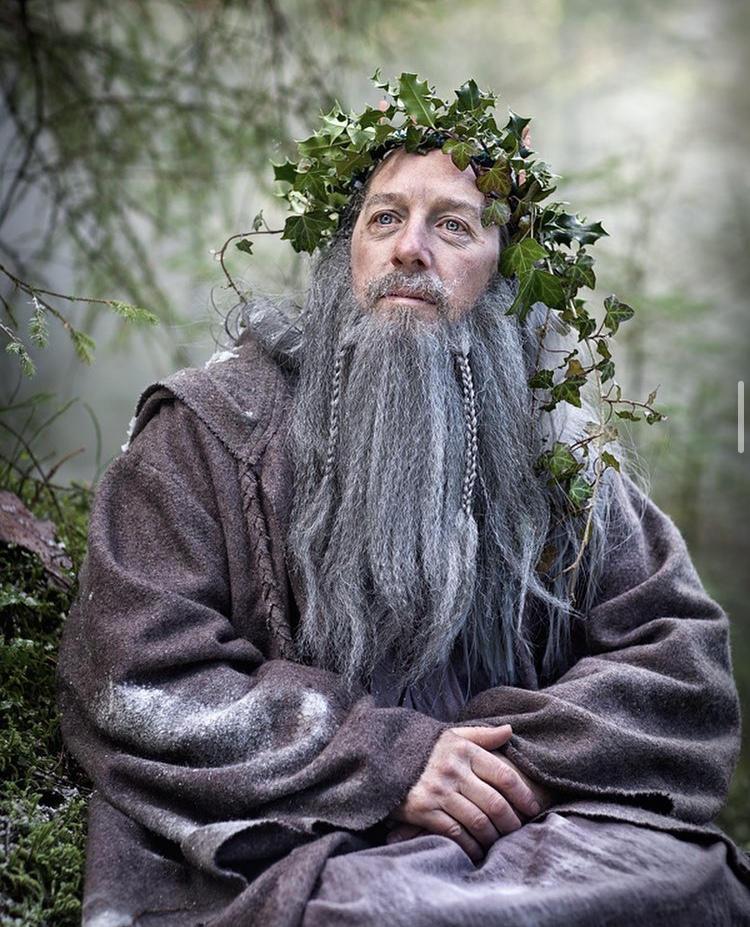
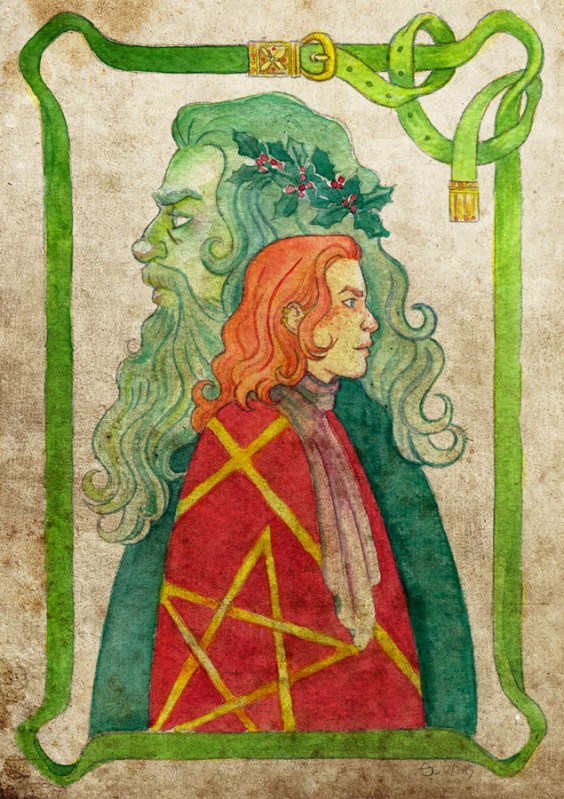
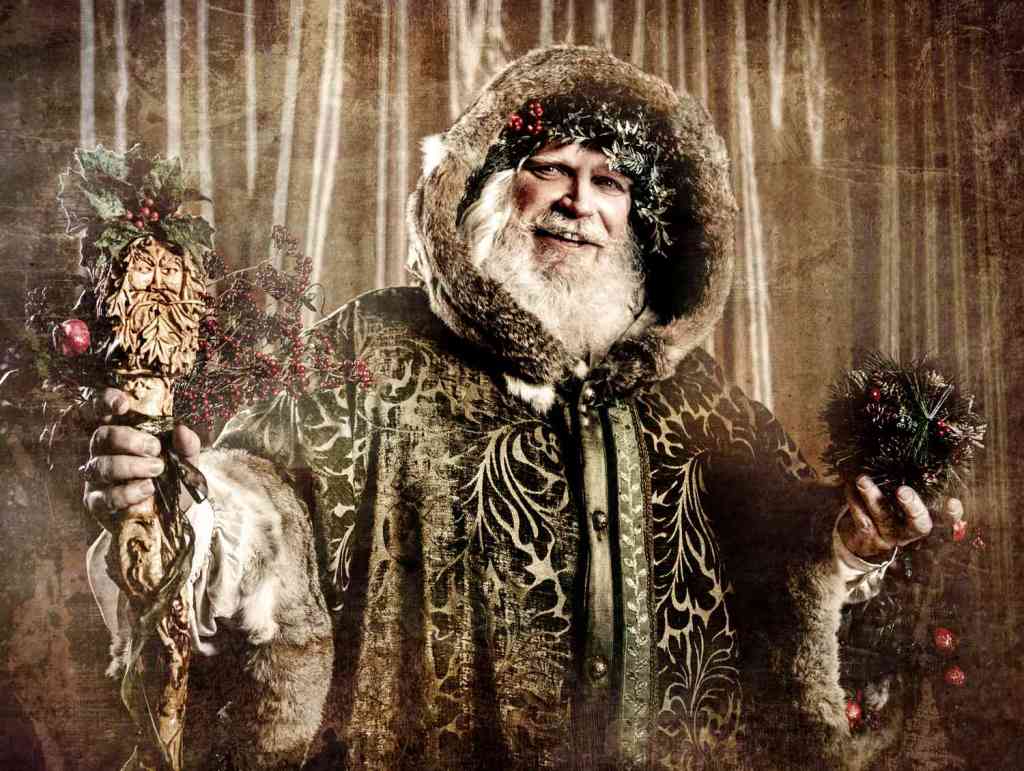
Have you ever thought about the connection between the Green Knight and Santa Claus? This is just a quick little thought that’s run through my mind many a Christmas now so I figured I’d share this year! 🙂
Photo: IG: @carriangelphotography
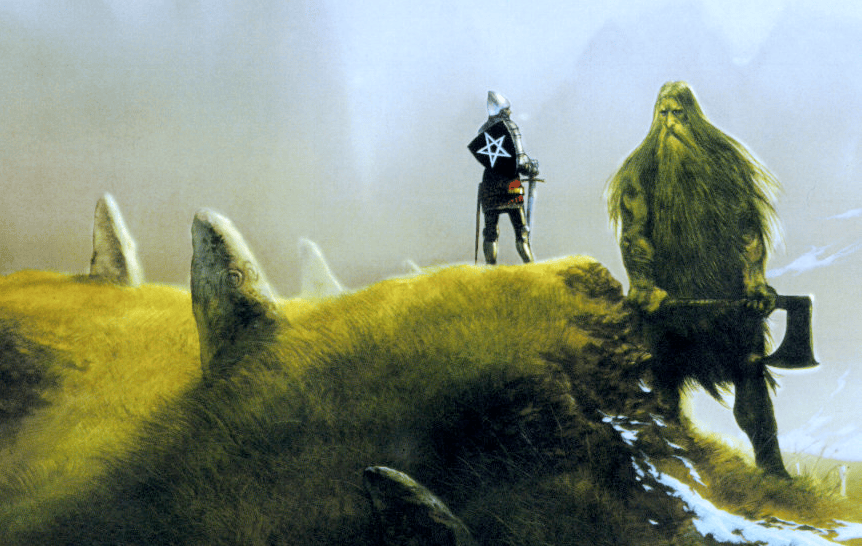
The Green Knight can be said to have connections to the Celtic figure of the Holly King, who has many similarities to Father Christmas and be even be his source of inspiration. The Holly King is thought to have been known by the ancient Celtic peoples, particularly in British lore, though he may have gone by a different name and is especially revered in modern neopagan traditions. Nonetheless, assumed to be an inspiration for the figure of Father Christmas (right along with Grandfather Frost in Russian traditions, Odin in Scandinavian traditions, Saturn in the Roman pantheon, Father Time, and other all-father winter figures), the Holly King was a sort of father figure, too. An older, wiser spirit representing the dying of the year. He was both mysterious and jolly of spirit, just like Father Christmas– and just like the Green Knight. (Yes, those of you who have only read Part 1 of Sir Gawain and the Green Knight and think he’s the villain, you would be incorrect; he can, in fact, be quite jolly!)
Mistletoe and Holly
Photo: Trooper3d on Flickr
For a very simple parallel, the colors and what they represent are the same. (Christmas colors! There’s a reason for this other than festivity, though.) The Green Knight is not only entirely green, in addition to his green armor, but he also carries with him a sprig of mistletoe; a major symbol associated with Father Christmas, who wore a sprig of mistletoe in his cap. For the Celts, mistletoe offered protection from evil. People would place a sprig above their front doors and in windows to keep spirits with malicious intent at bay. In fact, the Green Knight says when he first barges into Camelot, “Be assured by this hollen stem here in my hand that I mean no menace,” and later, “I’m clothed for peace, not kitted out for conflict.” His mistletoe was, therefore, a symbol that he came in peace. (Sort of.) Mistletoe is also a symbol of peace in regards to Father Christmas’ symbology, so much so that it’s became a symbol of both Christmas and winter romance, inviting lovers to kiss underneath its deep green leaves.
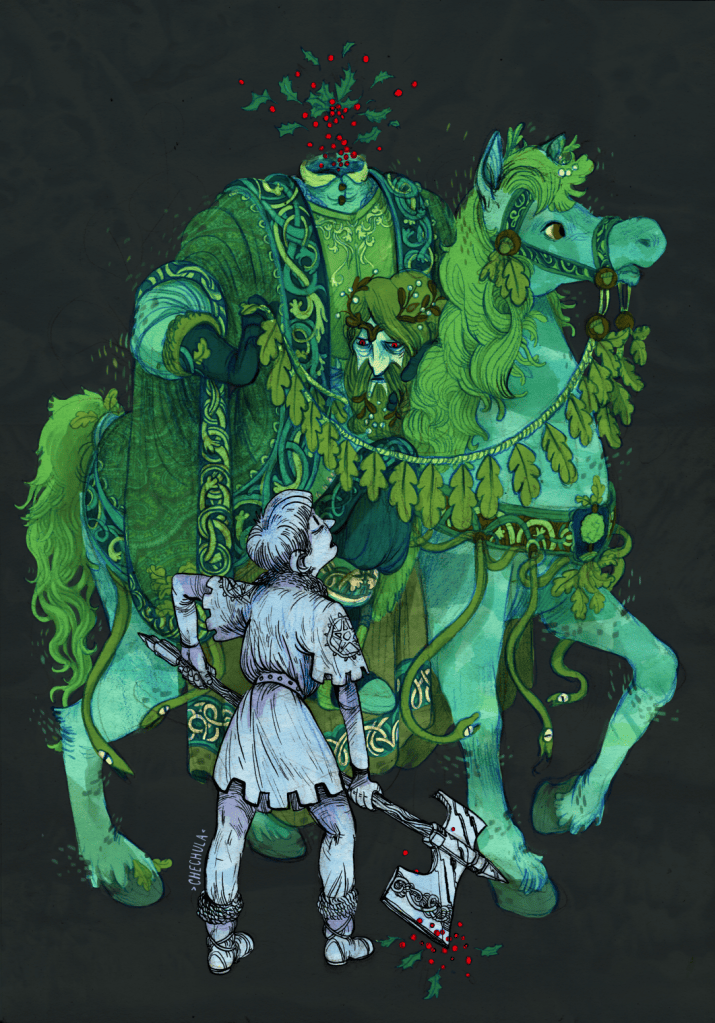
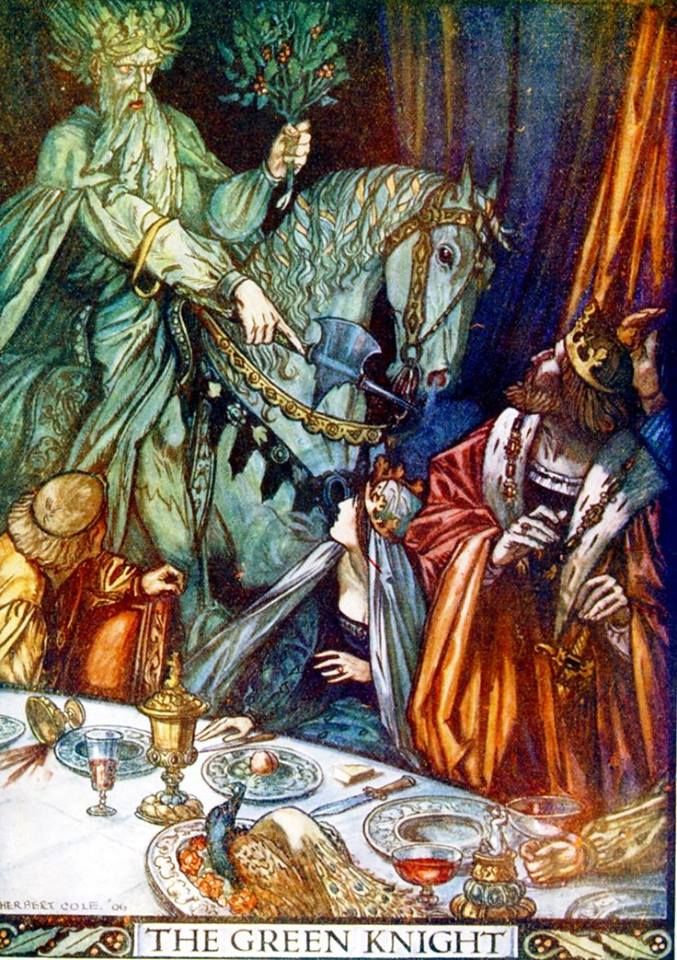
Photo: Checula on TumblrPhoto: Sir Gawain and the Green Knight front cover, artist unknown
The color green also represents life and the natural world. At the time when Sir Gawain and the Green Knight was written, Britain was heavily Christian. A green man walking into anyone’s house in today’s time would be absolutely unbelievable but at least we could rack our brain trying to come up with some ridiculous scientific reason that made it possible. Back then, anything outside of society’s walls (AKA the woods, forests, wilderness) represented the unknown. That included scandalous affairs that happened within the trees beyond the sight of others, as well as faerie business beyond explanation. When the Green Knight entered Camelot, everyone immediately associated him with the Otherworld and faerie magic. This is perhaps part of the reason why greenery has become so associated with Christmas. Aside from the famous tradition of decorating the Yule tree, for which the idea was to bring “life” indoors in a time of death, winter was also a time of darkness and mystery. In addition to fear, there was still yet a sort of magic and wonder to this darkness, and in medieval times, it was probably the one time of year when magic and wilderness was revered instead of frowned upon or shunned. Thus, when Christianity adopted the Holly King (amongst other pre-Christian winter father-like figures) and made him Father Christmas, they kept his sense of mysterious magic by giving him mistletoe and holly as a few of his iconic symbols. Holly is also associated with the Green Knight, as in some versions, it states that he wears a “crown of holly”. He’s also painted wearing a holly wreath in several pieces of popular Arthurian art. And Santa often is, too!
Photo: Internet
Reindeer
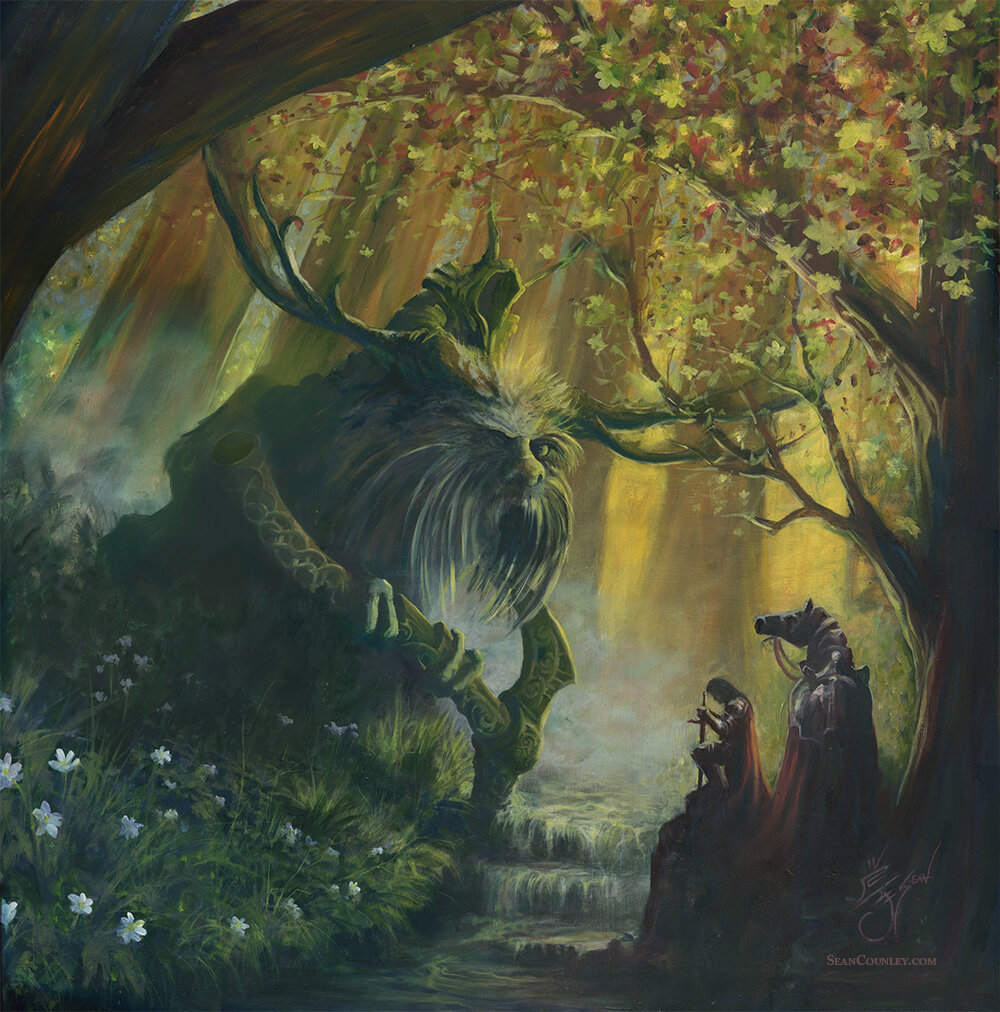
Santa Claus rides a sleigh of eight beautiful reindeer, right? Ironic that the deer was one of the most revered animals by the Celts, representing wisdom, integrity, spirituality and honor. (All things Santa Claus represents. Maybe not the spirituality part but belief in something magical, at least.) The deer, or the stag, was also the symbol of Herne or Cernunnos, Celtic god of forests and the hunt. Who else is often depicted with green skin and mistletoe, and antlers to represent the natural world? Cernunnos. And the Green Knight. And what does the Green Knight do in his “Christmas game” that he forces Gawain to play? Hunt. He may not fly a sleigh of reindeer but the connections are all there! (In fact, I think the Green Knight’s green horse (who never asked to be green) would get along swimmingly with Rudolph. Outcast buddy-bonding.) Anyway, the Holly King was also thought by some to pull a chariot of eight deer, similarly to how Odin rides an eight-legged horse, or Thor who pulls a chariot of goats. Or Santa who pulls a magic flying sleigh of reindeer. (Fun thought for fellow pagans: the fact that the Santa/the Holly King has eight deer can also represent the eight Wheel of the Year festivals!)
It’s also ironic that the deer represents integrity and honor, which the Green Knight is on a constant hunt to find in Britain’s warriors. As “Bertilak” (the Green Knight’s human form), he rewards Gawain’s courage and honorable behavior with gifts; a giant feast every night, the largest piece of game from the day’s hunt, the most comfortable guest bed in the manor, joyful company and of course, the famous axe. These are all gifts he gladly gives Gawain to reward his being brave enough to actually go out after him, amidst the harshest winter weather, simply for integrity and goodness’ sake. Father Christmas, too, rewards good behavior. He travels the entire world in search not only of children in need but good children he can reward with gifts for their good behavior. In SGGK, the theme of temptation also comes into play with the scandalous goings-on that take place (or almost do) between Gawain and the Green Knight’s “wife”. The Green Knight knew of this affair all along and even planned it with his wife, as a test of Gawain’s honor. The same goes with the magic green belt with which the wife tempted Gawain, vowing that it would save his life. But wearing the belt would mean cheating his way through a deal with the Green Knight. Cheating his way through life. Of course, he takes the belt anyway. And when Gawain admits to all of this, overcome with shame, the Green Knight blesses him and lets him go home to Camelot, safe and unharmed, knowing that the lesson he learned that Christmas was one that would last him a lifetime. He even gifts him the belt. In this way, the Green Knight truly represents truth, honor and goodness. The same way Father Christmas represents everything that is good and full of kindness and mercy.
Photo: Sigune. IG: @ms_sigune. Follow her Gawain comic at https://gawaincomic.com! I’m a big fan!
Holly King vs. Oak King
For a slightly more complex connection: As the lore goes, on Yule Night or the Winter Solstice, the Holly King searches for his brother, the Oak King, in want of battle. The two have a mighty duel and in the end, the Oak King wins, bringing with him the start of the light half of the year. (Spring and summer.) Likewise, on the Summer Solstice, they fight once more, and the Holly King wins, bringing about the start of autumn and winter; the dark half of the year. All this is to say that the Holly King spends Yuletide in search of battle or a challenge, to promote strength, integrity and honor. The Green Knight does the same on Christmas Eve, traveling far and wide in search of someone honorable enough to accept his challenge. Once again, Father Christmas also travels the world this time of year in search of good children he can reward with gifts for their kind and noble behavior. ❤️ Also, unrelated to Santa Claus but on this note, Gawain could represent the Oak King! (Bright, summery, full of ambition and optimism and youthfulness.) Makes sense that he would fight with the Holly King each Yule. Just a quick thought for any Arthurianists who enjoy the Oak King vs. Holly King lore!
Spirit
Photo: Internet, photography unknown
Last but nowhere near least, Santa Claus is known for his hearty laugh, his rosy red cheeks and jolly red nose, a winter white beard and his jolly spirit that’s powerful enough to make children believe in him. The Green Knight was known for this, too. In his human form as Bertilak, he is literally the epitome of ole St. Nick. Big, hearty laugh, warm smile to warm the soul, booming voice, giant presence, big belly that shakes with joy when he laughs, bushy white beard the color of snow, handsome features that makes him joyful to look at, and a mysterious twinkle in his eye. A twinkle that might hint there’s something more to him than what appears. He might not come down your chimney– he’ll barge through your front door instead and scare the living bejesus out of everyone– but he’ll do it for the spirit of the season! Even as the Green Knight, in his true wild form, he is larger than life, full of winter greenery and magic, prepared to pose a challenge of honor and reward the warrior if worthy enough.
All in all, the Santa Claus we know and love can be connected in some ways to the Green Knight, whom we also know and love, for different reasons. Though perhaps those reasons aren’t so different, after all. They both are father figures with Christmas magic. Santa Claus somehow visits every house in the entire world, all in one night. With a magic sleigh of flying reindeer, with whom he lives in the coldest place on earth. The Green Knight lives in the hardest place to find in all Britain, shapeshifts into any being of his choosing and is a wild, eternal spirit that cannot die. (At least not by beheading!) There’s certainly mystical winter magic between the both of them enough to enchant children (and adults) for all time. ❤️
Anyway, thank you for listening to my Yuletide rambling! If I don’t pop on here anymore before Christmas, I hope everyone has a most magical Christmas and a beautiful, blessed Yule and Solstice!
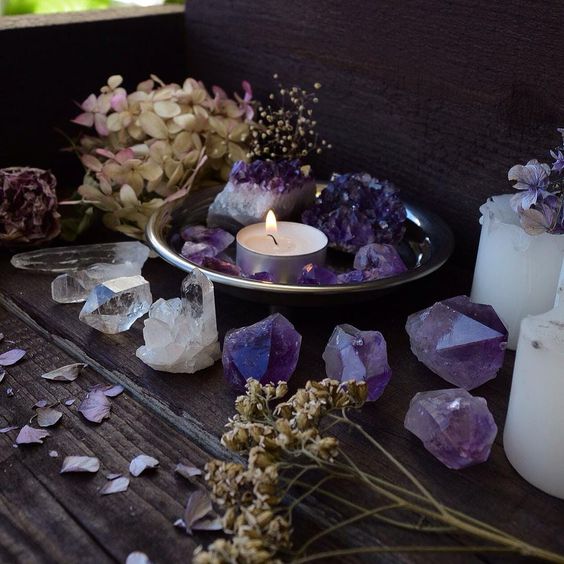
Happy spooky season! Seeing as it’s prime time for witchy, pagan and spiritual folk, it seemed like a good time to talk about a fun topic I’ve always wanted to delve into– the Divine Arthuriana. ❤ Particularly via crystals for the moment, since many of us are decking our Samhain altars or Halloween tables with herbs and crystals for this delightfully spiritual October. (But you don’t have to be pagan or into witchcraft for this post– it’s for anyone interested in crystals and Arthurian legend. 🙂 ) I’m still learning about crystals, myself. But over the last year or two, I’ve been collecting more of them and enjoying their properties as I educate myself on such matters (thanks to my dear friend, Maddy Tamms! Follow her on Instagram at @maddytamms!) For those like me who practice a mostly Celtic spirituality not only inspired by nature and Celtic paganism but also by Arthurian legend, here are some crystals to add to your collection! I find that these particular crystals embody different energies associated with Arthurian figures, just as crystals often connect us to different deities. (Disclaimer: I’m not an expert on crystals, nor am I an expert in Celtic or other pagan spirituality. This is just based off of my personal spiritual experience and love of the Legend. ❤ )
The characters of Arthurian legend have been woven into stories for centuries. Their names are spoken continuously in our households, in English classes, in films and books, on merchandise, on our tongues when speaking with friends. That’s a lot of energy! On a spiritual/metaphysical level, we’ve given these figures our energy over many centuries, just as one does deities, and when you think about it, that gives them power. Power used in such a way makes them “real”, in a sense. I personally have felt Guinevere’s feminine comfort in springtime, Morgan’s darkness in the whisper of autumn winds, Gawain’s bright boldness in summer, Arthur’s protective warmth in winter. Crystals are a great and simple way of keeping this energy with us wherever we go. So next time you feel the urge to connect to the Divine Arthuriana– perhaps in the coming days leading up to All Hallow’s Eve– try some of these! We’ll look at Arthur, Morgan and Guinevere this time but there’s plenty more to come if y’all are interested in this!
GUINEVERE
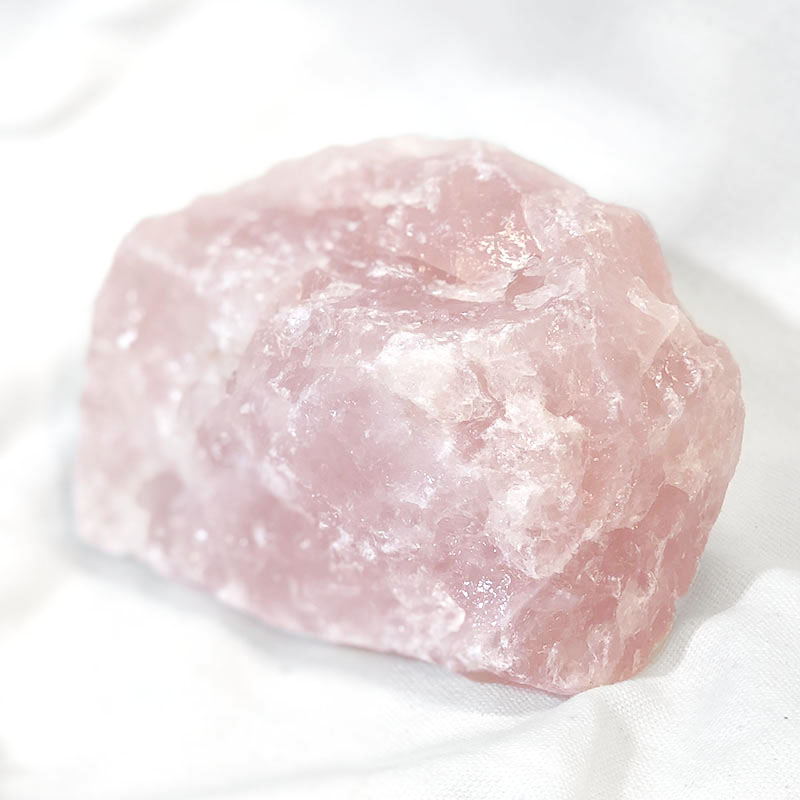
Rose Quartz
Perhaps the most obvious choice of crystals for Guinevere is rose quartz. Associated with divine femininity, love, romance and passion, rose quartz sounds like a stone made solely for Guin. Our High Queen as a divine figure is a goddess of love, beauty, inner peace, springtime, flowers and female empowerment. Rose quartz has a light, feminine energy that can be used to open up the heart chakra, aid in relationships and self-love and provide a beautiful, peaceful aura perfect for inner healing.
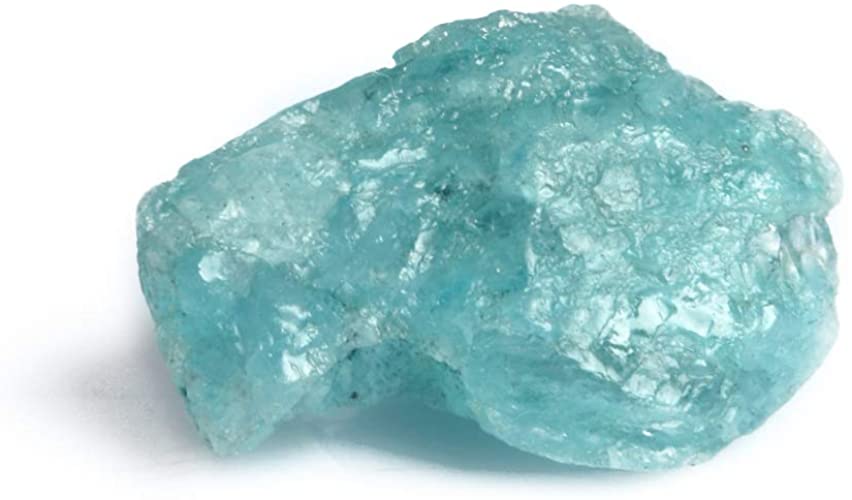
2. Aquamarine
Aquamarine is a courage stone with a calming aura, used mostly for reducing anxiety and fear. Aquamarine’s light blue hue connects one to the throat chakra and aids in speaking your truth, despite tense situations. Guinevere’s courage as queen in a man’s world comes through with this beautiful stone. I think she would have loved this stone and would have made great use of it during diplomatic dinners and high-stake events (like the many that marked her life!) She might have made daily use of it by keeping one tied on her wrist as a bracelet or perhaps as the centerpiece of a dainty ring. You can do the same and invite her divine aura into yours through this water-based stone. It helps one go with the flow, adapt easily to difficult situations and keep the crown steady on one’s head. ❤
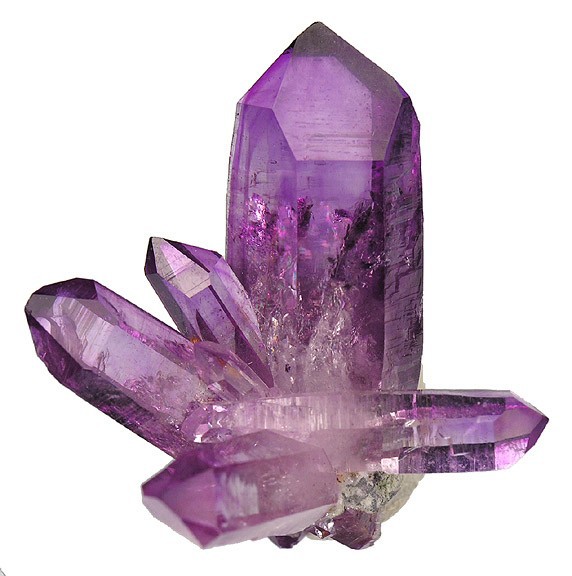
3. Amethyst
Another calming stone is amethyst. Often seen as a relaxing crystal connected to feminine energy, this soothing beauty can be easily associated with Guinevere. (Maybe it’s just me but I love to picture Guin with amethyst earrings, or an amethyst stone in her golden crown.) Let amethyst slow your heart rate, ease your body and relax your mind, so you can de-stress and better focus on your royal duties.
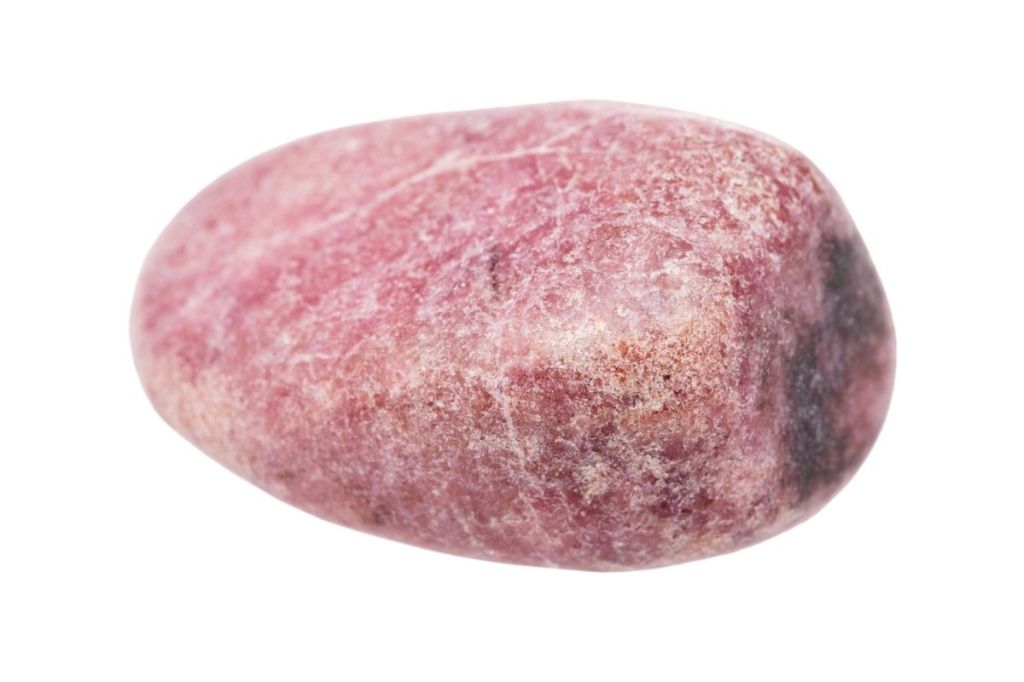
4. Rhodonite
If ever there was a crystal made specially for Guinevere, it would be rhodonite. This stunning rose-pink healing stone is a hug for the heart chakra. It heals inner wounds from the past and gently pushes you to work with your emotions so that you stay true to your heart. It also encourages mutual understanding and the ability to embrace compromise, so it works perfectly as an aid in relationships. (This would have worked well for Guinevere’s relationship with both Lancelot and Arthur!) Rhodonite’s darker swirls can also be said to connect you to your root chakra, grounding you when your surroundings may feel chaotic. Physically, it’s said to act as an energy boost for your body after physical and emotional trauma, becoming an aid for the circulatory system. So it would definitely come in handy after being kidnapped by Lord Maelegant or being trapped in a tower for two months or, in many versions, almost getting burned at the stake. Homegirl went through a lot, okay? And though perhaps not to that degree today, we as women still do. But we can come out on top through self-healing. Channel your inner Guinevere by wearing rhodonite as a necklace or meditating with it on your chest to open up your heart chakra. Looking at Guinevere as a divine figure, she would encourage us to do so. Use rhodonite to allow yourself to fall better in tune with your heart. ❤
ARTHUR
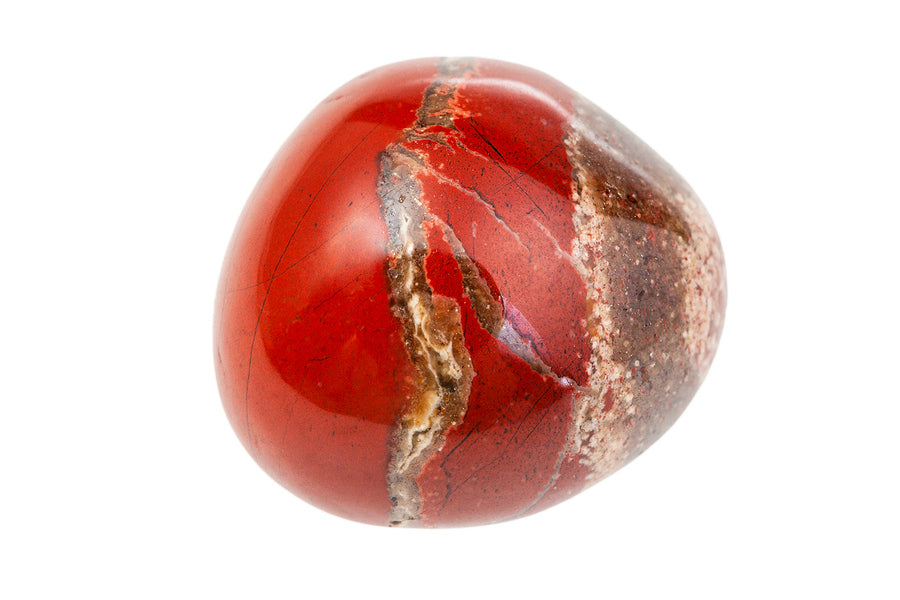
1. Red Jasper
Our legendary High King can be seen as a divine figure called upon for hope, courage, decision-making and ambition. Bro pulled a sword out of a stone, was told he now runs all of Britain, and had to get cool with that quick because invaders crept in every corner of the island. Sounds like a panic attack on a silver platter. But he said, “Nah, I got this,” and with Merlin’s help, took care of business like a boss. We can turn to Arthur for inspiration with big decisions, big transitions/life changes, or just general courage. One crystal that will definitely get that ball rolling is red jasper.
Its fiery red color, alone, reminds one of the lava-like breath of a dragon. (A Pendragon, to be exact!) Red jasper is soaked in ambitious energy and has a long history with warriors. (I feel like Kai, Arthur’s foster brother, would vibe with this stone, too, for that reason.) Its lush red hue is also the color of the red dragon on the Welsh flag, typically thought to be the symbol of the Pendragon. A lovely coincidence, no? Bottom line is: this fiery crystal will make you feel like you, too, could pull a sword out of stone. Wear it as a necklace or pendant to give you a little extra drive.
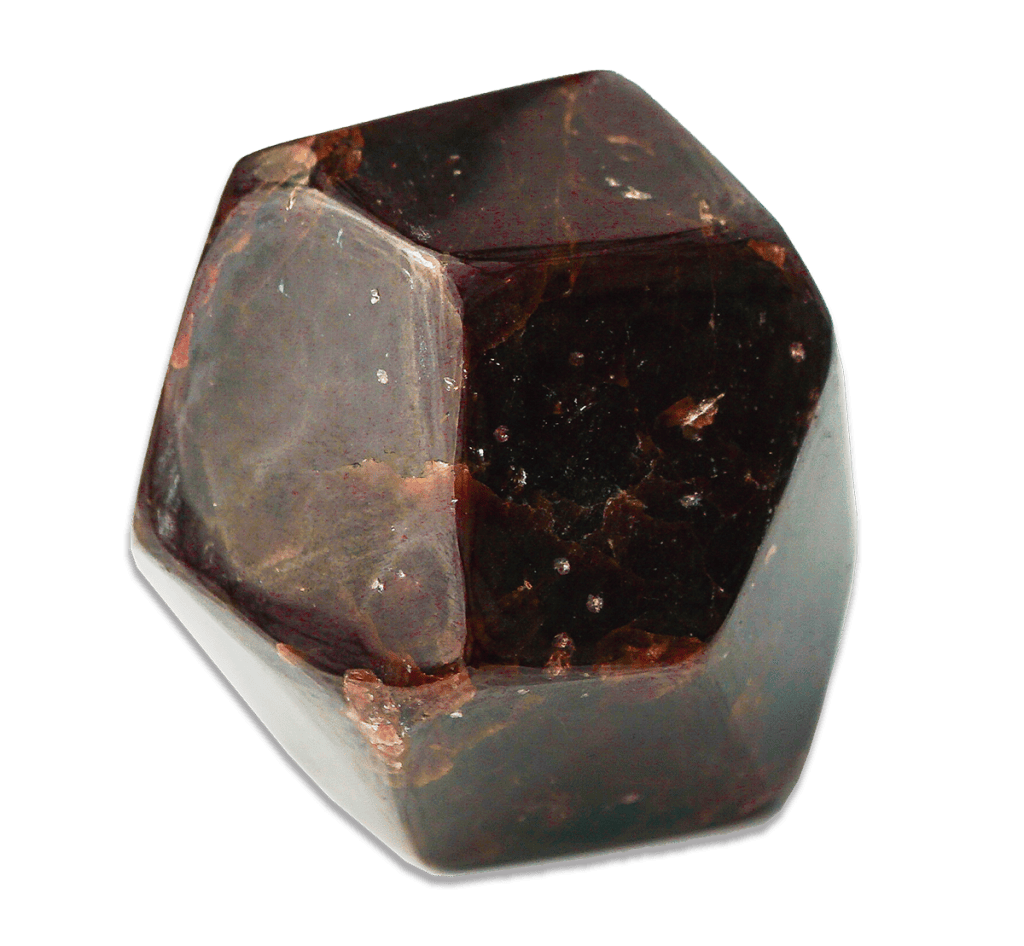
2. Garnet
Garnet is an inspiration stone, doubling as the birthstone for Capricorn. (Arthur’s astrological sign seeing as he was born on the winter solstice!) As a Capricorn, Arthur is extremely organized, works efficiently, is just and fair, and finds most joy in prosperity and success– not just for himself but for his people. Garnet is a powerful positivity stone that grounds and encourages a flow of energy to each of these traits. Use it to get that energy cranking and those creative juices flowing!
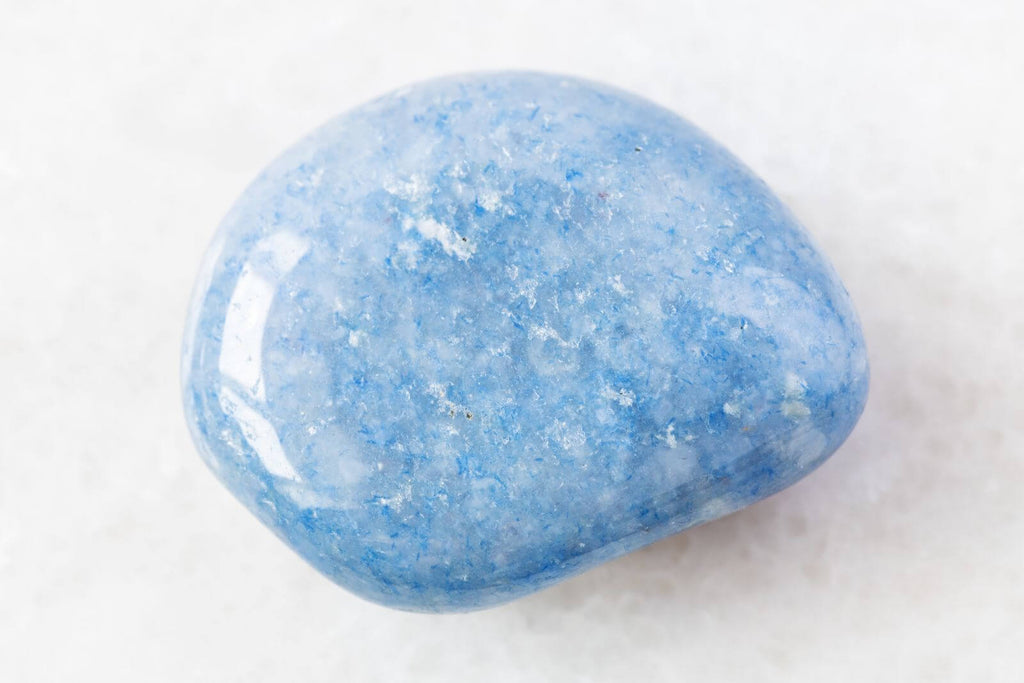
3. Blue Aventurine
Blue Aventurine is a calming stone that works with the heart and mind to promote logical, rational thoughts in chaotic situations. Washed in a lightly masculine energy, blue aventurine aids those in leadership positions. In the workplace, it helps when approaching new projects with calm and confidence, and provides focus for performances or public speaking. (Perfect for a commoner-turned-king.) It’s said to be ideal for managers, teachers and those in authoritative positions, as it encourages vision, inspiration, and effective communication. I like to think Merlin would have given Arthur a blue aventurine pendant to wear under his shirt during war councils and diplomatic meetings. ❤ Invoke Arthur’s divine energy by keeping blue aventurine on a desk, at the workplace or simply on your person during high-stress or high-productivity days. (I keep one in my purse.)
MORGAN
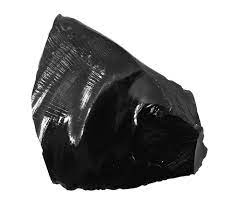
Obsidian
It’s almost Halloween, so I have to do Morgan! The great thing about her is that when looking at her as a divine figure, she can be seen in many ways, for she has a number of faces. The fae woman, the queen, the witch, the priestess, the sorceress, even the goddess. Obsidian is perfect for those that prefer a darker Morgan but it could technically be all-encompassing of her many sides. It’s a grounding stone that aids in protection. Ideal for our great sorceress who often delved into darker arts, obsidian blocks and transforms negative energy. It’s made from volcanic glass, carrying with it the raw energy of a volcano, and has a smooth, dark and dreamy look, aesthetically perfect for Morgan. It’s also a Scorpio stone! (We believe Morgan is a Scorpio in this house.) Whether your favorite version of Morgan le Fay is an Avalon spirit loyal always to Arthur, a faery woman more supernatural than human, or a dark witch after the crown of Camelot, Morgan can almost always be associated with the Otherworld and magic. And for that, it seems right to call this black volcanic glass her primary stone. No matter the story, I could totally see her wearing an obsidian crystal necklace or wearing an obsidian ring on her finger as a daily part of her wardrobe.
Obsidian is also a clarity stone with the ability to release emotional, physical, and spiritual blockages, drawing out stress and tension. (Much needed for Morgan, no matter how she’s depicted.) Also ideal for a sorceress, it’s used in meditation and dream work. It can even be used in weaponry! Obsidian was crafted in swords and daggers in its heyday, and was once considered just as valuable as gold. I could definitely see Morgan carrying around an obsidian knife with her on her belt, couldn’t you? *Insert heart eyes*.
Anyway, keep black obsidian by your bedside to ward off nightmares or wear it as jewelry to keep you grounded, clear-headed and protected as you go about your daily work. Keep some on your altar, table, or simply on your person to tap into Morgan’s energy as a dark and encouraging divine figure. ❤
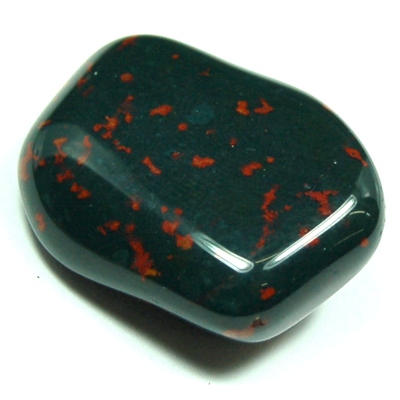
2. Bloodstone
Bloodstone is a dark green vitality stone (almost black), with light swirls of red. It’s used for protection and grounding, strengthening the lower chakras, but also used for vitalization. Physically, it aids the circulatory system, strengthens the immune system and regulates the heart, getting blood flowing and pumping properly. (Because of this, it’s also great for menstrual flow and ease in cramps! As someone with ovarian cysts, ladies, I can personally say that it actually does help a little! It’s also said to help greatly with childbirth.) From blood flow to strengthening bone marrow and even upping the purification levels in your blood, this stone is known for its iron-rich connection to the life force that sweeps through all of us. This works well for the darker versions of Morgan, who might have used bloodstone as a motivation stone, both physically and emotionally.
Spiritually, it can act as a mood stabilizer and creates easier access to the darker (or less explored) parts of oneself, to better get to your core and strengthen it. Now, for those seriously into the craft, I’ll say that I personally feel like Morgan wouldn’t likely dabble in blood magic the way she would dream magic, elemental magic, divination or any other sort of Celtic magic. BUT the protective and vitalizing, fiery energy of bloodstone, I’m sure, would have drawn her to it. It was once considered a warrior’s stone, especially by the Greeks, so it has associations with war and the battlefield. And if Morgan couldn’t be on the battlefield with Arthur in the end (as she’s usually not), she would likely have used bloodstone in her craft during those last dark hours. Whether used to fight for or against Arthur in the final battle of Camlann, one could definitely see her using bloodstone to magically tie herself to the battlefield in those final moments and be part of Arthurian Britain’s grand finale from wherever stance she takes. Also, remember how I said this stone is a combo of two different stones? It’s a mix of dark green chalcedony and red jasper– and red jasper is one of Arthur’s stones! How ironic that this witchy stone she might carry around in her dress has hints of Arthur’s energy in it. As if he’s always there with her. (I’m not crying, you are.) Use bloodstone to get your blood flowing, your heart strong and to screw your courage to the sticking point!
3. Iolite
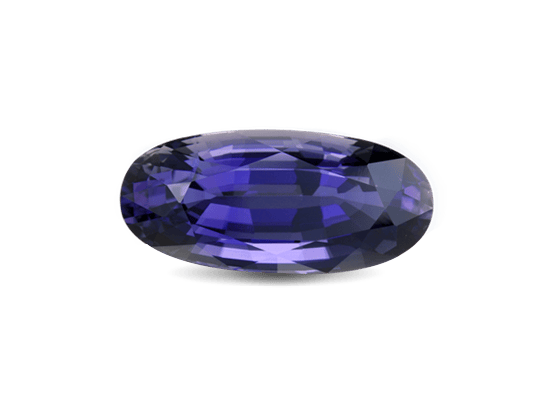
Beautiful, violet Iolite is a perfect stone for tapping into the energy of Morgan as an Avalon priestess or fae queen. Deep, lavish purple but able to take on several different hues depending on lighting, Iolite is a higher-chakra vision stone that exudes clear communication and cosmic connections, aiding in soul exploration. Physically, it detoxifies the body, especially the liver, aids in digestion, helps get rid of migraines and combats insomnia. (As someone prone to nightmares, Morgan would appreciate this.) Spiritually, it aids in self-discovery, independence, and healing from codependency. Serving as a sort of compass, Iolite protects travelers (both physical and spiritual), guides them through stormy shores, and helps them navigate the depths of their souls. It’s a stone also known for bringing you back from the edge of disorientation and planting you firmly in your own body, so that you can better journey into your soul’s depths and reorient everything. This vision stone helps you get to know yourself better so that you can stand strong, true and independent in your power, ridding yourself of fears and insecurities. Something incredibly useful for a wise-woman or priestess of Avalon whose job is to heal others. It’s a helpful stone for those who may feel as if certain events in life have ripped them apart and scattered the pieces (*cough* Morgan). Iolite will help you recover those missing pieces. ❤ It serves as a gentle reminder that we are the masters of our own choices and can steer our own destiny. And out of the entirety of the Legend, Morgan is one of the main few characters that embodies this. It’s one of the main things she stands for, no matter how she’s depicted. (It also just gives general Morgan vibes with the dark purple hue lol.) Keep Iolite under your pillow to sweep you into a restful sleep, or use it in shadow work/meditation to allow access to your deepest depths and take your soul on a beneficial journey.
4. Phantom Quartz
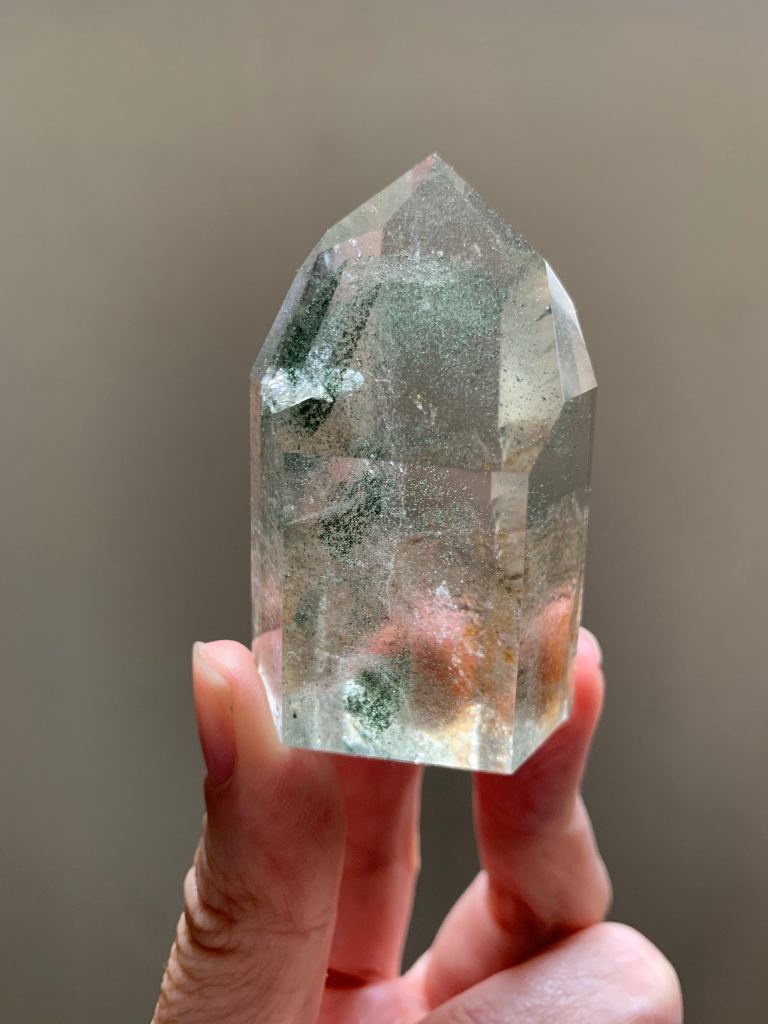
Lastly, for those that enjoy Morgan as a villain and dark witch figure… I mean, c’mon, it’s called “phantom quartz”. This is a unique form of quartz with a smoky appearance caused by the specks of other minerals floating in its interior (those are the “phantoms”), giving it a mysterious air that has entranced people for centuries. It symbolizes the cycle of life and death and acts as a great tool for in work delving into past lives, spiritual growth and transformation. It encourages us to look within ourselves and accept our journey through life. It’s also a trauma-release stone. Perfect for someone whose father was murdered by a cruel king (who was at the time magically disguised as her father, then married her mother and forbade the Old Ways), whose half-brother got the crown she was promised since she was a child simply because he pulled a magic sword out of a stone, and who endured loveless (and often abusive) relationships throughout her life. My girl deserves a break, okay, and this stone offers some help in that department. It also cleanses the aura and brings clarity of thought. Phantom quartz teaches us that the first step in letting go of past trauma and healing emotional wounds is leaving behind the ego (*cough* evil Morgan) and allowing the soul to learn and grow from the experience. This is a hard lesson for our favorite enchantress to learn– but so is any emotional healing for anyone.
Phantom quartz’s sacred medicine is full of wisdom from millions of years of evolution on the earth’s crust. Let it heal you and open you up to the self-truths you may need to face in order to move forward in peace and joy. It’s perfect for shadow work in the darkening mists of October, leading into the dark half of the year. Morgan can also be associated with The Morrígan, the ancient Celtic goddess of war and death. Call upon this dark goddess side of Morgan for help in reaching deep into the shadows of yourself and putting the harmful energies that no longer serve you to death. This is where the transformation comes in. Let that harmful energy die with the dying leaves that currently fall to the earth, ready to get crunched under your boots. Make room for positive, healing energy by purging yourself of this. Morgan as a witch or dark goddess figure is perfect for such spiritual work. She will strengthen you and rebuild you (with a very intimidating no-BS attitude, so be prepared). Phantom quartz is almost a guaranteed way to tap into her energy and call her spirit forward to aid you in this. Speaking from personal experience, it’s always a hard journey but one immensely needed to grow as a person. Try taking it this fall. ❤
I hope these work well for you! These crystals are known to work pretty efficiently and have greatly positive results if you put in the intentional work, from what I’ve experienced. It’s all about the energy you bring to the table. (Intention is everything!) Keep some of them with you next time you’d like to try invoking Divine Arthuriana. And let me know if y’all are interested in this– if so, I’ve got plenty more for next time! Until then, remember to breathe, practice gratitude, enjoy this deliciously spooky season, and let the Divine Arthuriana inspire you this gorgeous autumn!
Greetings, friends! I’m back and very sorry for such a long hiatus! As some of you know, things got a bit hectic this spring and summer for personal reasons– one of which was because I was overseas for a while, earning a teaching certification! (If anyone needs help learning English as a second language, hit me up! Not joking at all lol. Email me at laurenbertini@me.com) But I finally have a bit more time to get back into the subject that makes me happiest.
The TEFL certification I earned had to be acquired through a month-long course…which happened to be in Italy! So, of course I had to do a little digging while I was there and discover what remnants of Arthuriana still lie in the ancient castles and chapels of Italia. After all, the biggest real link we have to an actual historical Arthur-figure is either through the Roman warrior, Lucius Arturius Castus or Romano-British military leader, Ambrosius Aurelianus– though I found practically nothing in Rome. (The locations associated with Ambrosius are all in north Wales.) Most of my finds were in Tuscany or up north, close to Austria. While I personally didn’t get to travel to too many of these places– and we know Arthur wasn’t very fond of visiting Italy for various reasons– there is certainly plenty of Arthurian art in Italy and an obvious huge impact of the legend on the Italians over the centuries! For any Arthurianists planning to visit Italy anytime soon, I highlysuggest checking out some of these locations on your next trip!
The Sword of Galgano – Chiusdino, Tuscany
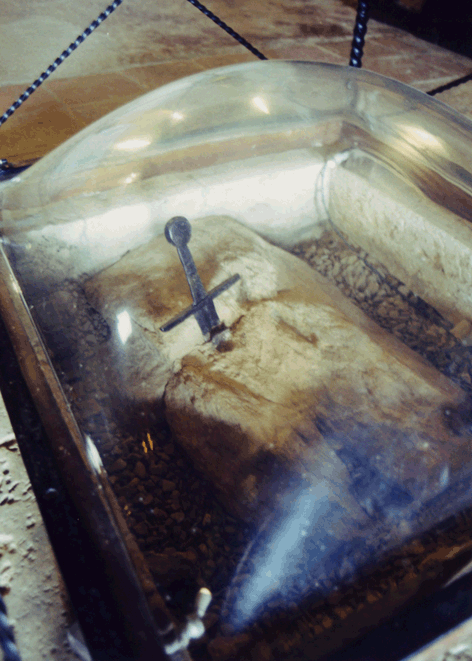
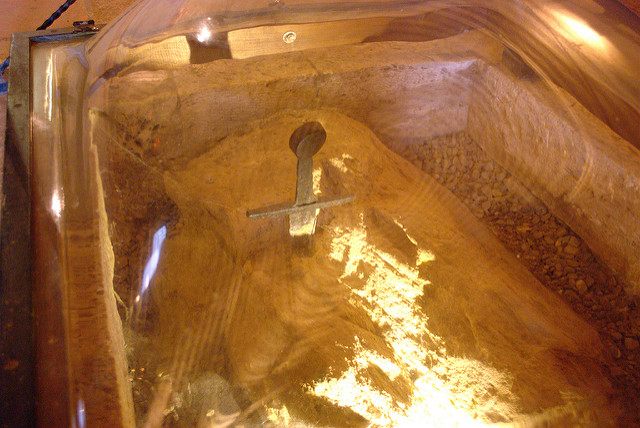
The Sword of Galgano. Photo: Internet
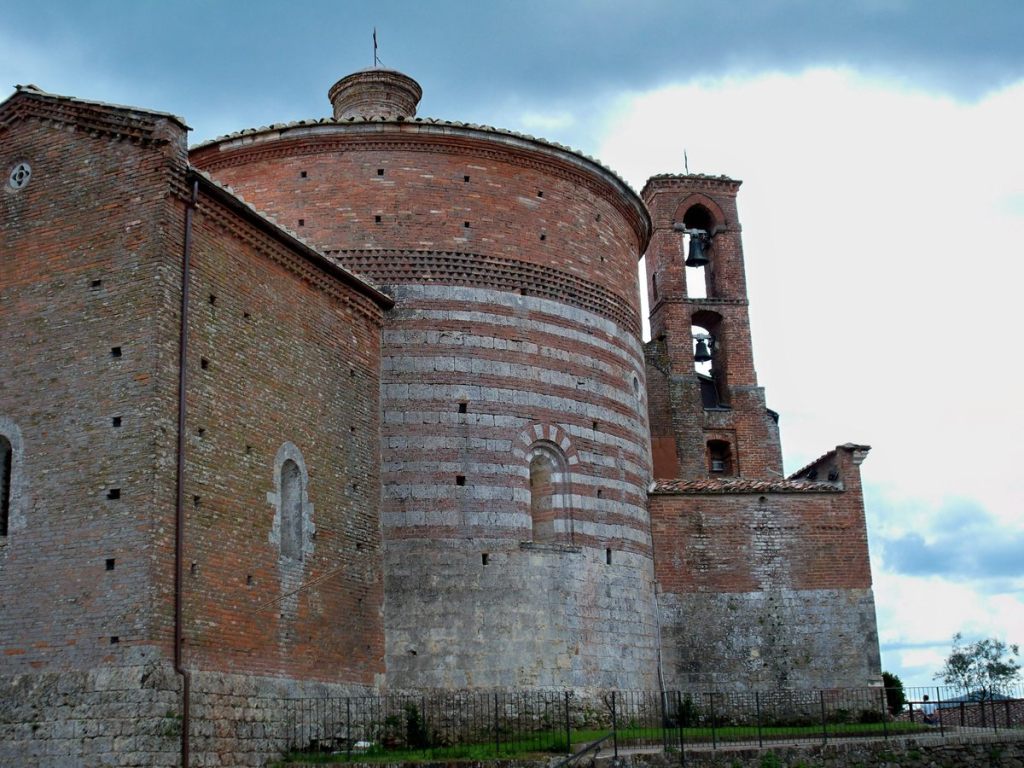
Did you know the real Excalibur is in Italy? Well, at least it’s the real one according to Tuscans. Either way, it’s a real sword that dates back to the 12th century, stuck in stone, okay? And the story comes with Sir Gawain’s Italian counterpart! Nestled in the hills of Tuscany is a sleepy, little medieval town called Chiusdino, wherein lies Montesiepi Chapel, part of the Rotonda di Montesiepi. In the late 12th century, a wealthy knight named Galgano Giudotti lived in this town and was known for his violent and merciless approach to both his work and personal life. He was an aggressive knight without a trace of kindness. But it’s believed that one night, the Archangel Michael visited him and insisted he change his ways. The visitation was so frightening that the very next morning, Galgano plunged himself into Christianity and turned away from violence forevermore. Despite the opposition of his family and friends, he became a hermit and lived out his days in peaceful solitude, devoted only to God.
It was shortly after he made this change that he was instructed by a mysterious voice to climb the hill of Montesiepi and bring his sword with him. There, he saw a round temple (the rotonda) where Christ stood, surrounded by Mary and all his disciples. (It’s giving “knights of the Round Table”, right?) He also found a large rock there and, in the name of God, officially gave up his life of violent knighthood by thrusting his sword into the rock to stay forevermore. Not only was it a sacrifice but once stuck in the stone, it became a sort of symbol of the cross. Exactly like Arthur’s sword in the stone. ❤
The Sword of Galgano. Photo: unknown.Rotonda di Montesiepi. Photo: unknown.
Some people (Tuscans, mostly) even say that the Sword of Galgano is thought to have been the first (valid) depiction/motif or story of a sword in a stone, and certainly one of the only few real ones that exist in the world. Ironically enough, the first written tales of a sword in the stone from Robert de Boron date back to the 12th century– the same time Galgano lived, seeing as we have records of his life in 1180! (What a giant surge of Arthuriana there was in the 12th century! Robert de Boron’s French Merlin poem– the first literature featuring the sword in the stone– also Geoffrey of Monmouth’s History of the Kings of Britain, Chretién de Troyes’ romances, this, other Italian sculptural additions to cathedrals and so much more! Anyway, I digress.)
Galgano is also thought to be Gawain’s Italian counterpart, seeing as Gawain’s name in Italian is “Galgan” or “Galganus”. Close enough to Galgano! It can definitely be argued that this could have been a source of inspiration for Gawain’s English/French name. Also, Gawain is a warrior known to be rather hot-headed; in some versions, he’s brash, crude and violent. Then, after the fall of Camelot, guess who becomes a hermit/saint, gives up his sword, and lives in a chapel forever, devoted solely to God? You guessed it. The similarities are there!
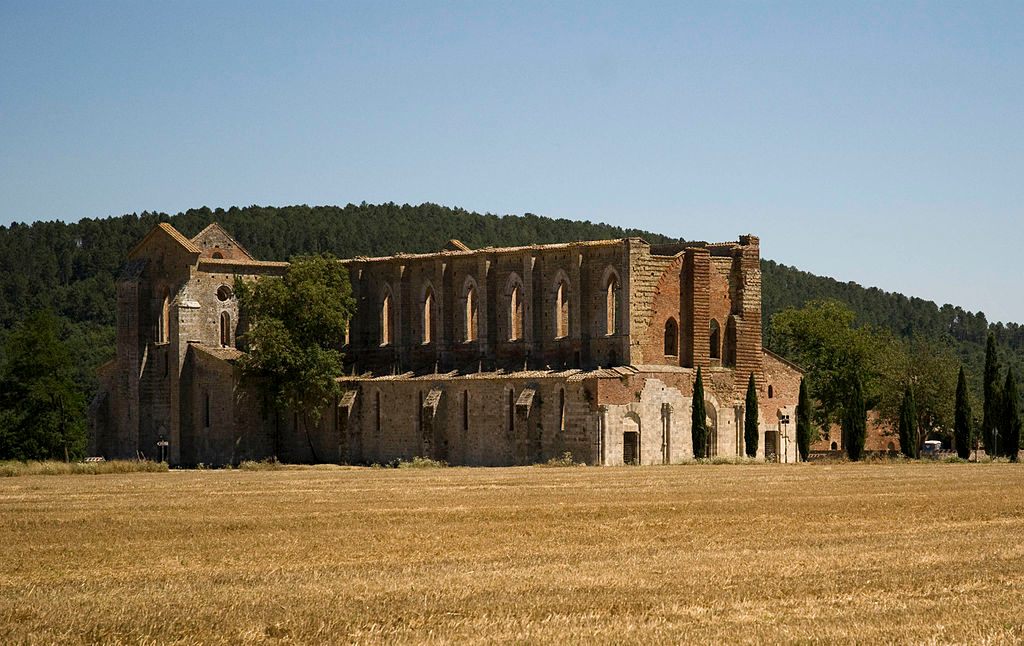
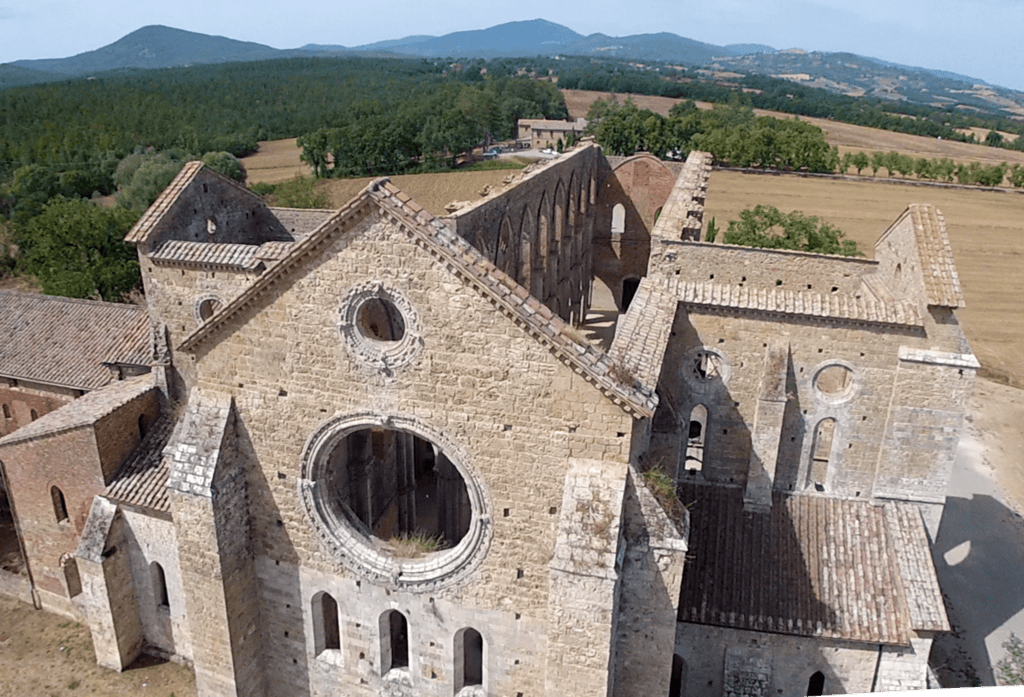
San Galgano Abbey. Photo by Vignaccia.San Galgano Abbey. Photo byMassimo Civitelli
Today, you can still find the Sword of Galgano, who has earned the title of saint, in Montesiepi Chapel. While there, walk a few steps over through the massive and breathtaking San Galgano’s Abbey! It’s gorgeous and haunting and an icon in the world of the medievalist. It stands majestically in this same little area of Chiusdino, surrounded by the landscape of Siena’s mountains. If you’re headed to Tuscany, this one cannot be missed!
Modena Archivolt – Modena Cathedral, Modena
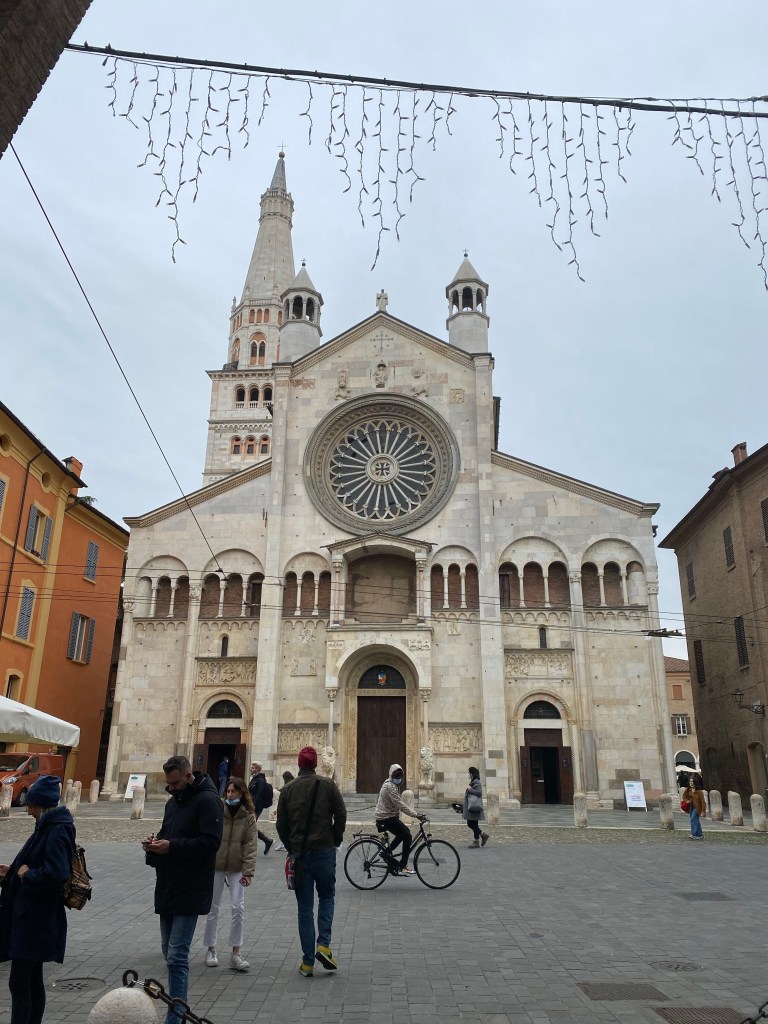
Modena Cathedral. Photo: getbacklauretta.com
The Italians loved Lancelot. It’s no wonder. Just like the French, to suffer in the name of love was seen as the most romantic thing of all. Otherwise, what’s the point? They loved his confidence, ideals and adventures. Besides, what says “Italian man” more than insisting you’re the only man for your dream woman and claiming that you’ll literally die if you can’t lie with her again? Or fighting any man to the death that dares look at her the wrong way? Or fainting at the mere mention of her name? Well, okay, maybe that’s more of a medieval Frenchman thing but nonetheless– French and Italian passion go hand in hand!
So it’s no surprise that the Italians told his stories over and over again in the valleys of rolling hills and sun-warmed piazzas. And while they preferred short prose and poems, they loved best the story of Lancelot’s sword bridge adventure– which was circulating Europe even before Chretiéns Knight of the Cart! Soon, Italy put their own spin on the tale, having Arthur join Lancelot to save Guinevere from Dolorus Tower, where Mardoc (Melegeant) kept her captive. That’s why this very scene is featured on one of Italy’s more popular cathedrals.
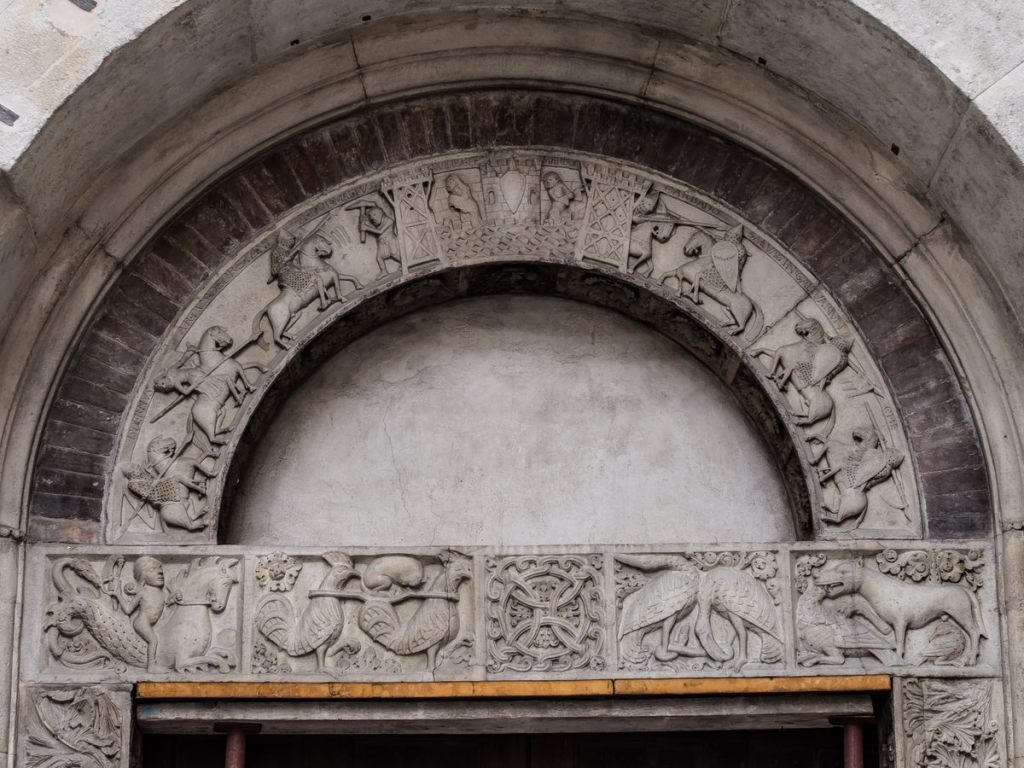
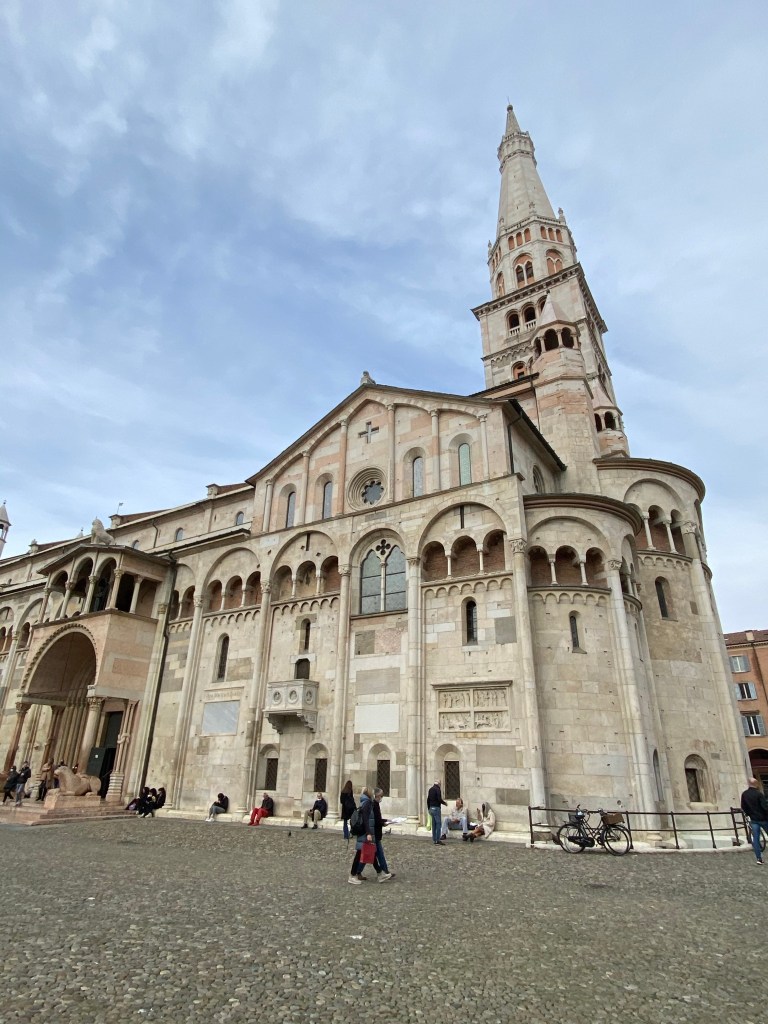
In the town of Modena stands the gorgeous Modena Cathedral, which features tons of beautiful sculptural art along its outside walls. On the northern side, near the Ghirlandina tower, is the Portadella Pescheria or “gate of the fish market”, named so because it was the entrance to the church in which pilgrims entered and was also, lo and behold, next-door to a fish market. Because this entrance was so accessible to the public, it’s the side that held some of its most beautiful and diverse artworks, both pagan and Christian, and internationally-inspired– one of which is the very first sculptural depiction of King Arthur in history!
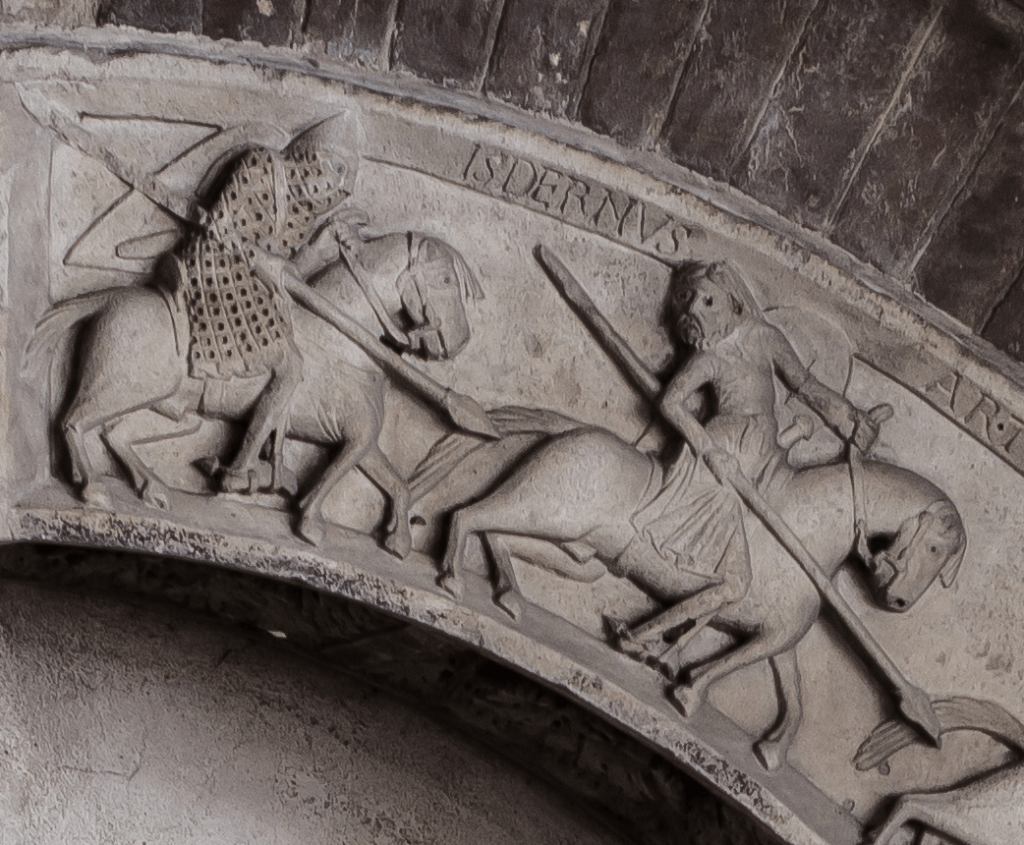
On the arch is a lovely frieze sculpture. Here, Mardoc is shown holding Guinevere captive, while Arthur and his knights try to free her. Interestingly, some of their names are vastly different than the ones we know. For example, Guinevere is called “Winlogee” here (which offers a small resemblance; “Guin-” could easily become “Win-“) and “Isdernus” is the name given for who we assume to be Lancelot, since he is Winlogee’s lover. And the story matches up. The caption also reads “It is the story of the Arthurian legend,” and includes characters named Artus Britani (Arthur of the Britons), Isdernus (Lancelot), Carrado, Winlogee (Guinevere), Galvagin (Gawain), Che (Kay), Galvariun, Yder, Caradoc and Galeshin. There’s also a man serving Mardoc named Burmalt, who may correspond with Durmart, the King of Gaul whose adventures are apparently told in an early 13th-century Old French romance called Durmart le Galois. (I’ve got some reading to do!) There’s even one unnamed knight whose identity is still unknown after all these years. Perhaps he’s the Italian counterpart of Beaufils, the Fair Unknown? AKA Percival? The identity is up to the viewer!
Modena Cathedral has now become one of the most important Romanesque churches in Europe, and one of Italy’s biggest Arthurian locations. It’s also officially a UNESCO World Heritage site. And it ought to be; it’s a huge piece of evidence that the tale of Guinevere’s abduction, and of Arthur in general, was circulating Italy even before it was penned to paper. The Porta della Pescharia and its Arthurian frieze sculpture was built between 1120-1140. Chretiéns Knight of the Cart story wasn’t written until the 1180s! It’s so cool to have physical, visual proof of the Arthurian oral tradition all the way in Italy. ❤
If you’re wanting to visit the cathedral, opening hours are (typical Italian) business hours: 7:30 a.m-12:30 p.m. and 3:30 p.m.-7:30 p.m. Make it a stop if you’re visiting the north!
Otranto Mosaic – Otranto, Puglia
Otranto Cathedral, Puglia. Photo: Internet
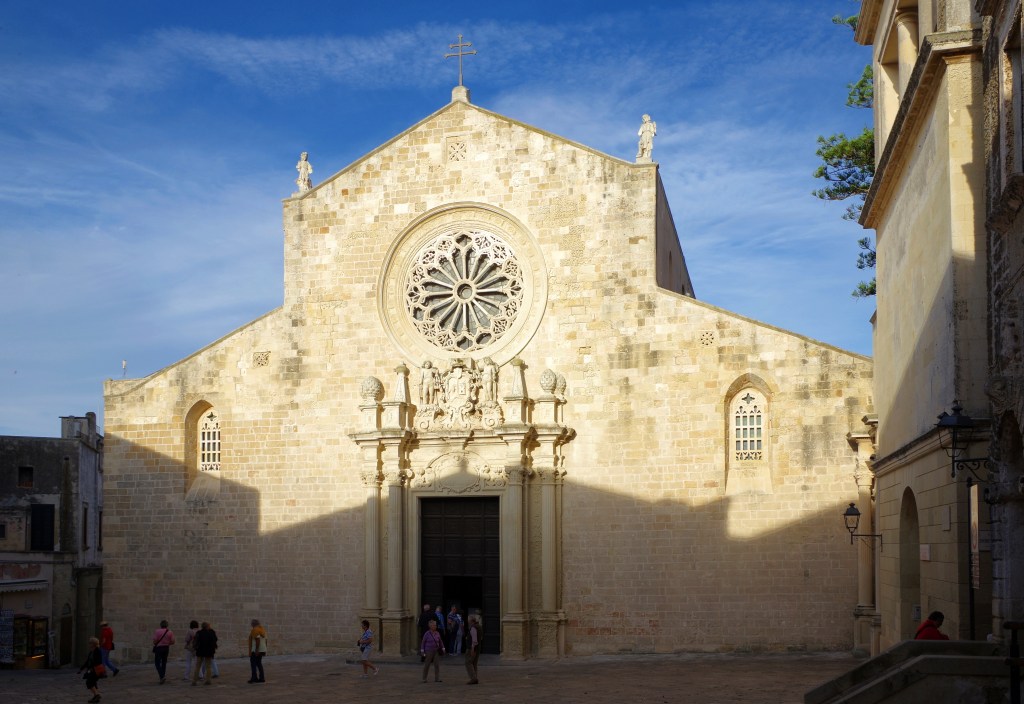
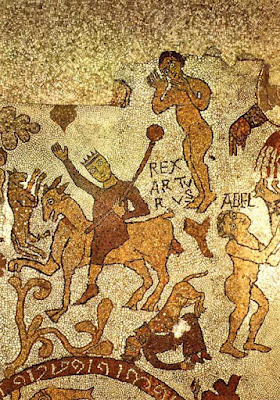
All the way down south in Puglia is the town of Otranto, where stands Cattedrale di Santa Maria Annunziata, or Otranto Cathedral. It’s a cathedral that has been through a lot, but its most precious artifact is still preserved. This would be the Otranto Mosaic– the largest mosaic in Europe! It was commissioned in 1163 by the archbishop Gionata, painted by a group of artists supervised by Pantaleone, a Basilian monk from the monastery of San Nicola di Casole. He wanted a Tree of Life as the centerpiece, in which was also enwrapped several different tales depicting the forces of good and evil. Some of these are the tales of Adam and Eve, Cain and Able, Diana the Huntress and our beloved King Arthur.
King Arthur on the Otranto Mosaic. Photo: clasmerdin.blogspot.com
Edward Watson, author of Arthuriana blog “Clas Merdin” (check out his work here!) writes a lovely detailed description of Arthur’s portion of the Otranto mosaic, and its significance to the Italian idea of the Legend:
On the Otranto mosaic King Arthur is clearly identified by the inscription ‘Rex Arturus’ and shown wearing a crown (added in the 19th century), holding a sceptre or (doubtfully) a long club. Arthur appears with Cain and Abel in what has been described as an allegory of the Fall of Mankind. He is depicted riding on what is clearly a goat-like creature, horned with cloven hoofs, and confronting a giant cat. The Celtic scholar Roger Sherman Loomis has described the goat-riding figure as a representation of Arthur as a supernatural lord of the Otherworld, a fairy king; as such an element of the ‘immortal Arthur’ based on the many cave legends that tell of him sleeping in a magical subterranean kingdom entered through a cave, such as Mount Etna in Sicily, Mount Snowdon in Wales or Alderley Edge in Cheshire, England. According to a 14th century Majorcan poet the wounded Arthur dwelt in a Mediterranean island and was kept alive by an annual ministration of the Holy Grail. Certainly legends of the immortal Arthur dwelling in a subterranean kingdom were established in Sicily by 1190. Loomis argues that among the Welsh and Bretons, at least one conception of the Otherworld was an underground region peopled by a race of noble dwarfs whose supreme king is portrayed as riding on a goat; it should not be surprising to find Arthur astride a goat in the Otranto mosaic of 1165. It would appear probable that the tale of Arthur as ruler of a subterranean Otherworld realm depicted riding a goat was brought to Italy by the Normans. But when considered with the goat-riding king fighting a monstrous cat it becomes almost certain. Beneath the depiction on the Otranto mosaic of King Arthur riding the goat toward a monstrous cat rearing up in front of him, is a similar big cat mauling a similarly dressed man about the neck. This fearsome creature has been described as the Chapulu or Palug’s Cat (Cath Pulac in Welsh). In one French version of the Chapalu tale Arthur engages in combat with the cat at a swamp where he is killed by the creature, which then invades England and becomes king.
I had no idea there was a version of the Legend in which Arthur is literally killed by a cat. But hey, whatever floats their boat over there in the Mediterranean, right? Regardless, this cathedral is yet another beautiful piece of proof that the Legend was told orally before it became popularized written literature. It was built after Geoffrey of Monmouth’s History of the Kings of Britain (written in 1138)– so there was one piece of Arthurian literature– but before Chretién’s romances, which caused the Legend to explode. So that makes it another significant Arthuriana location, in my book! If you’re headed down south on your next Italy trip, enjoy Puglia’s beautiful seaside town of Otranto, savor some delicious orecchiette for lunch with a glass of vino, and head over to this historic mosaic!
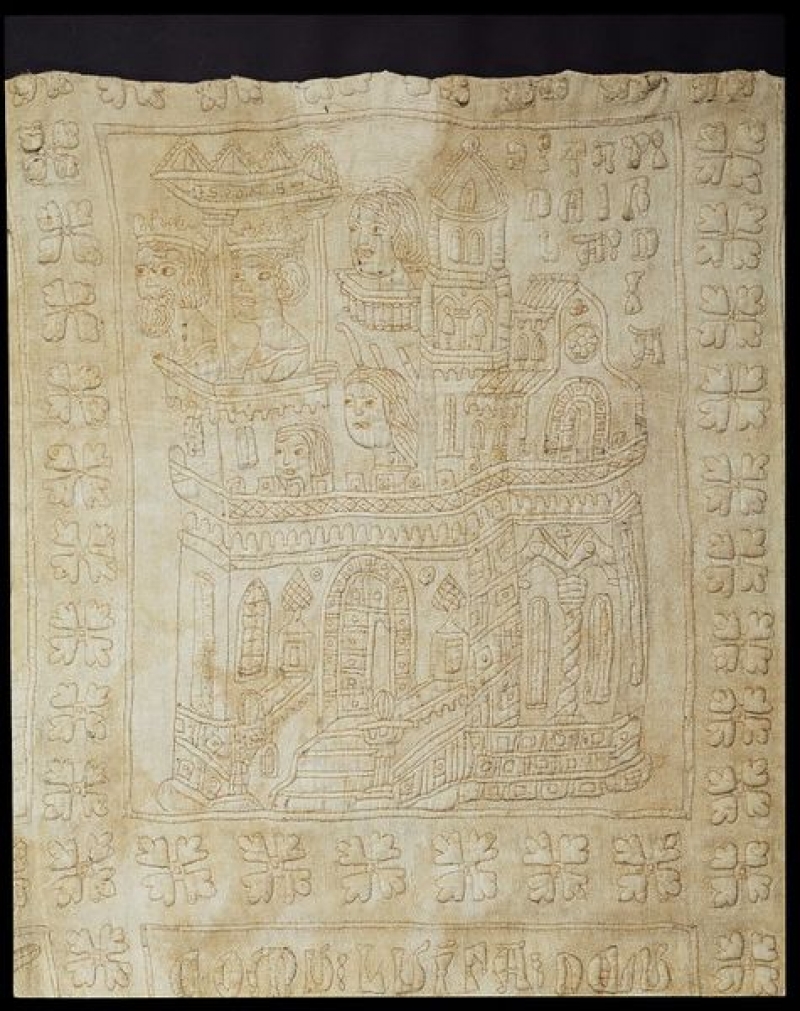
Tristan Quilt – Bargello Museum, Florence
The Tristan Quilt, Bargello Museum, Florence. Photo: Internet
The Bargello Museum is a lesser known museum in Florence but with some great finds! One of them is a late 14th century quilt depicting story of Tristan and Isolde. It’s also the oldest quilt in Europe!
Y’all, I was studying in Florence for a whole month. And I found about this place the week after I left. It was an 8 minute walk from my school. 8 minutes. Bro, my level of livid when I discovered this…lol… ANYWAY, it’s a Sicilian quilt exploring the oppressive rule over Cornwall by King Languis of Ireland, and the battle fought between Tristan and Languis’ champion, Morholt. It starts to explore Tristan’s love for Isolde– but the rest of the quilt is in London at the Victoria and Albert Museum.
If you’re heading to gorgeous Firenze,make a day out of it! Take in the view of the iconic Santa Maria del Fiore (the Duomo), walk the sand-colored city streets lit gold by the afternoon sun, indulge in a mouthwatering bowl of traditional cinghiale (wild boar) and Tuscan chianti for lunch (and gelato for dessert!) and go take in this historic piece of Arthuriana woven into Europes oldest quilt, right in the heart of one of Italy’s finest cities. Find more info here: https://trc-leiden.nl/trc-needles/individual-textiles-and-textile-types/secular-representations/sicilian-tristan-quilt
That’s about all I have for the biggest Arthurian locations in Italy– but there are a few other smaller ones that deserve a quick shoutout!
Palazzo Ducale, Mantua: Duke’s palace up between Milan and Bologna with frescoes depicting King Arthur. (Only 25 people allowed in to see it at a time, every 15 minutes!) Find more info here: https://dreamofitaly.com/2016/01/19/mantua-back-future/
I love looking at places in Europe outside of the UK that were impacted by the Legend because it shows us just how far the stories of King Arthur reached, and how much they inspired people worldwide. And the amazing thing is that they still do. ❤
Happy Valentine’s Day! The day of love is here and there are plenty of ways to celebrate it with an Arthurian flare! And just to clarify: Valentine’s Day may be popular among lovers but I’ve always loved it simply because it’s a day about love, in general. V-Day can and should be celebrated by showing your love not just to your lover/partner/spouse but to your friends and family, and simply to yourself. ❤ And I can already think of quite a few ways to enjoy it while simultaneously getting our Arthurian fix! (The Legend’s characters went through some wild stuff for each other, okay? There’s no way you can escape love while enjoying the tales of King Arthur.) While I’ll be spending the day working, I plan to spend the entire week spreading love to my friends, co-workers, family and to myself, babyyyy. This means enjoying an Arthurian kick as part of self-care, and being my nerdy-ass self, I’ve already compiled a list of fun Arthurian-themed Valentine’s Day activities to indulge in this year. I think you guys might enjoy them, too! Have fun!
ARTHURIAN-THEMED VALENTINE’S DAY ACTIVITIES
“Lancelot and Guinevere” by Ruth Sanderson
Read Arthurian romances
The Arthurian legend exploded when the stories told around fires and in great halls were finally penned to paper. Why not read some of the juiciest, romantic, heart-wrenching and heart-warming classical literature out there? Cozy up with a warm blanket and chocolate-covered strawberries and a glass of rosé, and dive into your favorite Arthurian book. Here’s a quick little list of some of my top-favorite classical Arthurian romances.
The Knight of the Cart by Chrétien de Troyes. The first story we have on record that was penned to paper about Lancelot and his love for Guinevere. Adventurous, daring, bold, dramatic, heartbreaking and magical, all at the same time. Sword-bridges and heated battles, declarations of love that pierce the heart, steamy love-making (or as close as you can get in a 12th century Christian author’s manuscript), damsels in towers, daring rescues and romantic gestures in grand tournaments. You can’t want for much else. A classic. ❤
The Knight of the Lion by Chrétien de Troyes. To me, it’s a story about intensely passionate love. Sir Yvain’s obsession with the Lady Laudine, which somehow turns into an obsession with knighthood and tourneys…is countered by Gawain’s obsession with Yvain. Whether Gawain and Yvain’s relationship a super intense “friendship”, or something more, is up to the reader– but the latter is an idea that Chrétien doesn’t exactly seem to shy away from. And of course, it’s a great romance about loyalty. And adventure. Tournaments, witches, lions, dragons, demons, giants, secret castles holding hundreds of working women, a magical well that causes massive thunderstorms. You can’t go wrong picking this one up. (And for my fellow LGBT+ friends, this is about as close as you’re gonna get to bisexual representation in classical Arthurian literature, aside from Launcelot and Galaheut’s relationship. So if you’re looking for a classical romantic fix, this is it. 🙂 )
Le Morte D’Arthur by Sir Thomas Malory. One of the foundations of the Legend. An absolute classic centering around not just the Knights of the Round Table but the to-the-death level of love between Launcelot and Gwynevere, and Trystram and Isolde. A love that in both cases wreaks havoc on the very foundation of Camelot while simultaneously remaining the thunderous and monumental, earth-shattering love that still has us talking about it centuries later in English classes. Also present is the unbreakable love between men-at-arms. The unspeakable and impenetrable bond between Arthur’s knights that stands the test of time. Again, here we are still talking about it centuries later. There’s a reason for that. ❤
2. Watch Arthurian romance movies
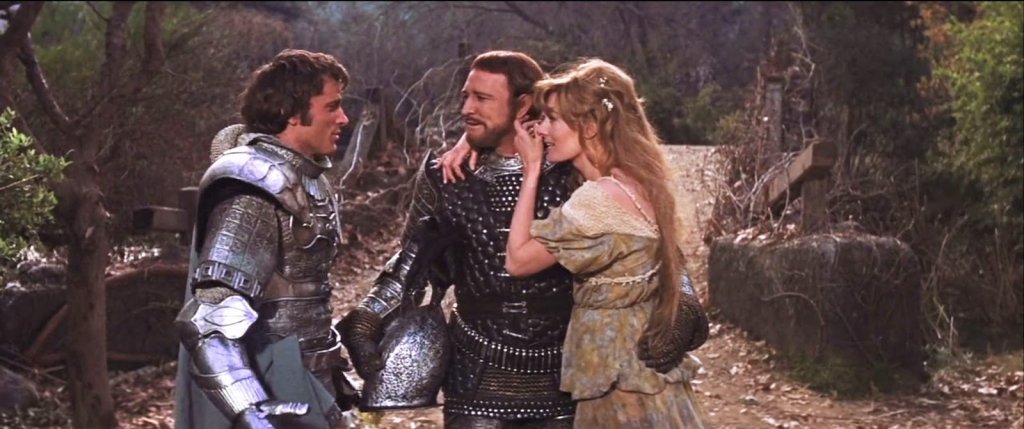
Lancelot, Arthur and Guinevere from “Camelot” film, 1967
There are many, though older some of them may be. They’re still great; they’re iconic and such a joy to watch. Here are a few Arthurian films that center around romance.
Camelot: ’60s musical about Arthur, Guinevere, Lancelot and their complicated relationships with each other. A classic. Great music from the golden age of musical theatre, great acting, and overall, a piece that hits the core of Arthurian legend in all aspects. The tragedy, the love, the beauty, the power, the hope. Hits all the notes. Literally. I might watch this when I get home from work tonight.
The First Knight: ’90s movie starring Richard Gere as Lancelot, focused on his relationship with Guinevere during a turbulent time in Camelot. Romantic, charming and popular amongst the Lance-fans.
Prince Valiant: One of the lesser known Arthurian films out there. The original was made in 1954, with a remake in 1997. Both are equally corny but with an interesting storyline. A Viking prince (apparently this story places Arthurian Britain in the 9th or 10th century) longs to become a knight of Arthur’s and gets wrapped up in a giant adventure. Gawain is a sort of mentor-figure to him and eventually, Valiant must not only must rescue him but gets romantically tangled up with the Princess Ilene. Romantic and intriguing. A good watch for something light-hearted.
A Knight’s Tale: Speaking of light-hearted, this one is extremely popular for a reason. Not entirely Arthurian through and through but it is a retelling of The Knight of the Cart‘s tournament scene. Inspired by Lancelot and Guinevere, this fun film recreates the idea of Guinevere expecting Lancelot to do her bidding in the one tournament that could boost his reputation as a knight forevermore. Also explores the concepts of chivalry, wooing women and love at first sight. With a slightly modern twist. Such a good one. ❤
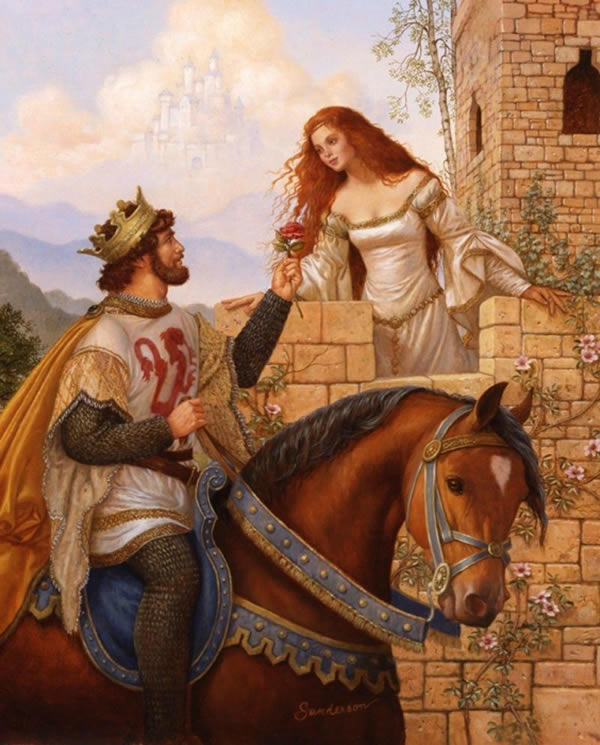
3. Give loved ones flowers
“Arthur and Guinevere” by Ruth Sanderson
Aside from reading books and watching movies, there are plenty of other small gestures you can do for your loved ones– like giving them flowers! In typical chivalric fashion, the giving of flowers is a classic and for the first-time lover, completely fool-proof. (Even Percival can do it without any repercussions.) It’s also just a sweet gesture for anyone that you love, be it friend or family member. Or yourself! I usually buy myself pink roses on V-Day. 🙂 (But I was lucky enough to be given some this year by a very special person. ❤ )
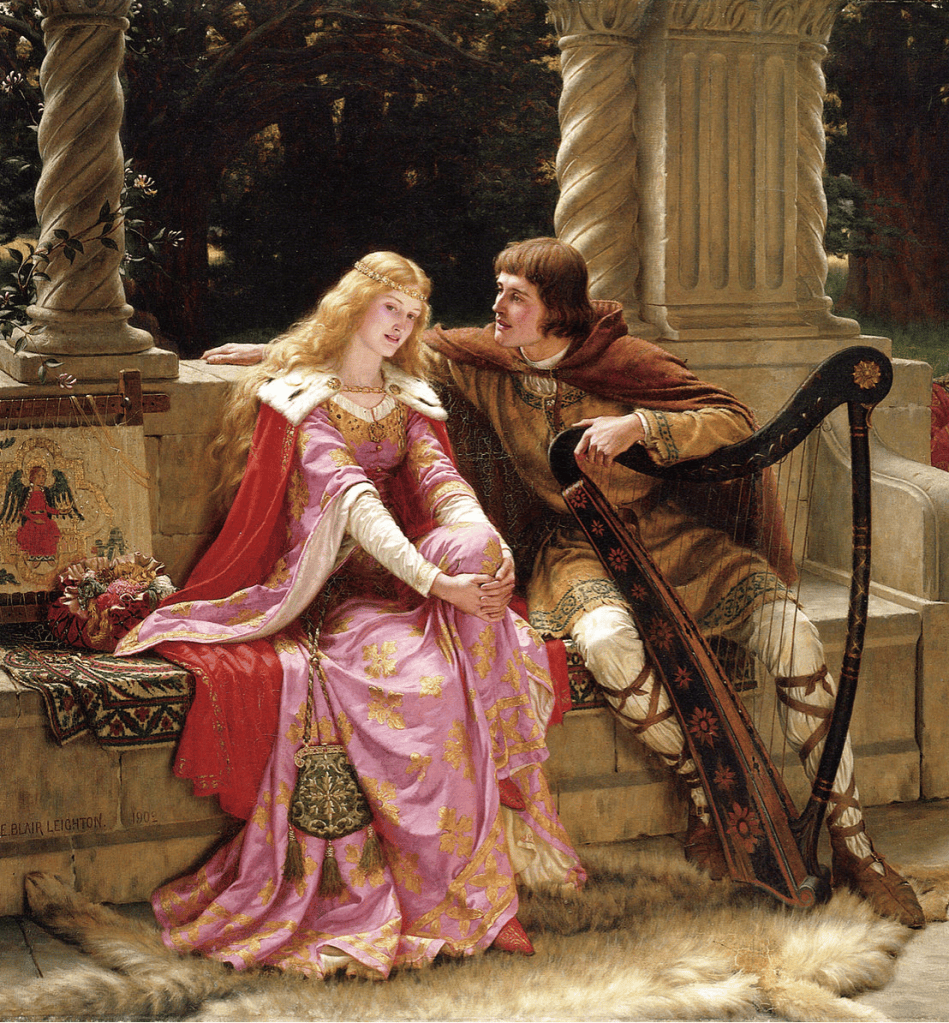
4. Give loved ones personalized items
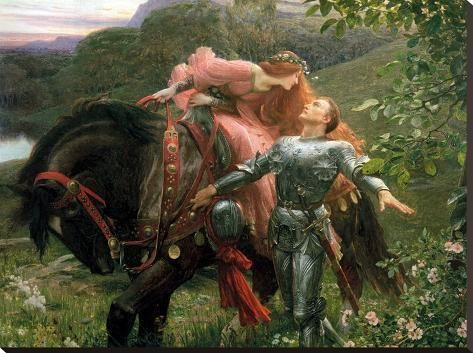
“Tristan and Isolde” by Edmund Blair Leighton
Now we get medieval. This usually happened in the form of clothing items. Lovers in Arthur’s time would have given each other beautiful brooches or pendants that meant something specific to that person. If Lancelot’s coat of arms was three red stripes over a white shield, perhaps Guinevere would have given him a heart-shaped pendant with three red stripes to fasten to his shirt or cloak when not wearing armor. Perhaps Lance would have given Guin a gorgeous silver brooch with a golden rose on it. And maybe Arthur would have given her a gold one with a crown on it, to remind her of her worth, both as an individual and as High Queen. Etsy and Armstreet have plenty of pendants and brooches you can give a loved one this time of year. Check out Armstreet’s brooches and fibulas!
Signet rings were also used daily, to mark the stamp of ones house on the back of letters and to fasten scrolls. When you sealed a letter with wax, you sealed it with the stamp of your signet ring. If not the symbol of your house, status or coat of arms, it would have been a symbol dearly important to you, so that the receiver always knew who the letter was from before they opened it. (The medieval version of the return address.) Perhaps Gawain would have given Ragnelle a signet ring with the symbol of a sage leaf for wisdom, since she was one of the wisest and wittiest women in all of Camelot. And perhaps she would have given Gawain a ring with either a pentangle (for the Green Knight quest and his coat of arms) or a hawk (since his true name, “Gwalchmai” means “May-hawk” or “battle hawk”). You can find custom-made signet rings on Etsy! Make one for a fellow medieval-fan as a heartfelt Valentine’s gift.
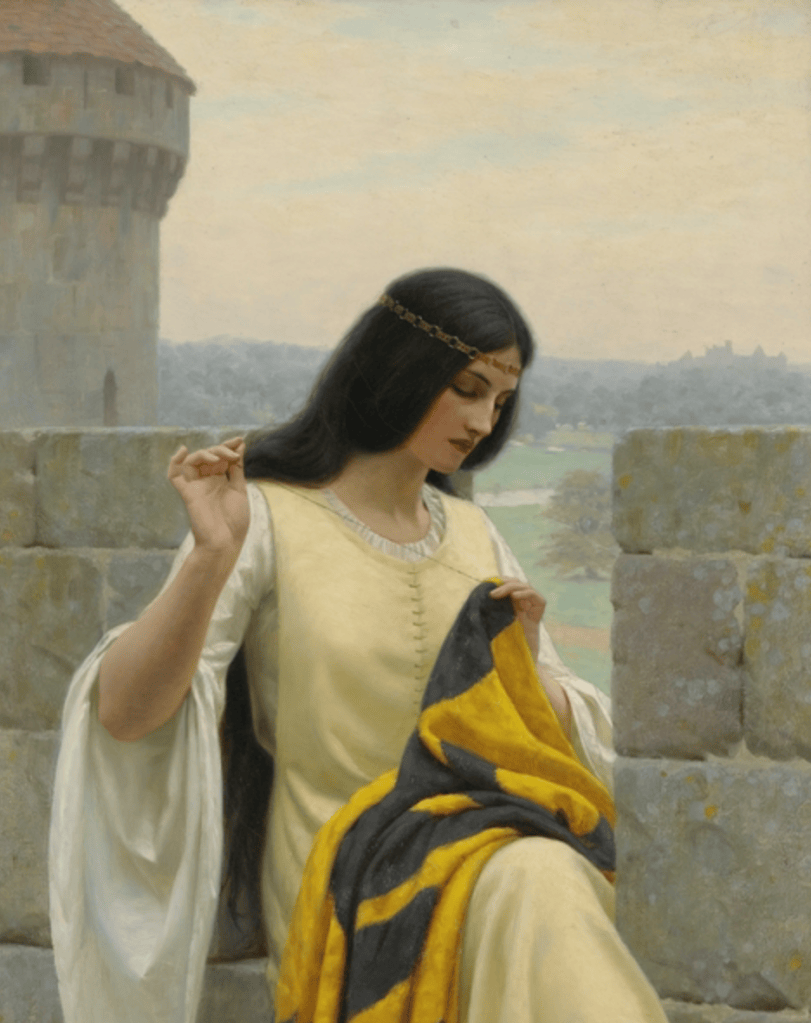
5. Sew hair into clothing
“Stitching the Standard” by Edmund Blair Leighton
Want to be a real Arthurianist this Valentine’s Day? Pull a Clíges and sew a small strand of your lover’s hair into your clothing. Poor young Clíges was so in love with the beautiful Fenice that he kept a strand of her hair and cried over it at night and, in the words of Chrétien de Troyes, “tossed and turned in his bed, and moaned and wept her name into the night, as he clutched the golden hair to his chest.” So. If you wanna go all out, sew a little of your lover’s hair into your shirt or favorite sweater and have them do the same. Extra spicy points if you sew a strand into any undergarments! (And hand-wash only from now on!!)
6. Give loved ones herbs of love
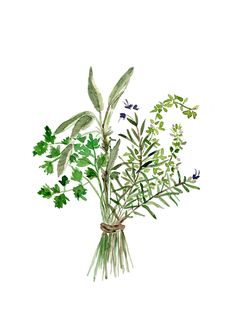
Herb bouquet, found online, artist unknown
My personal favorite, as is the favorite of many a pagan and witch I know, the herb bouquet is quite the thing of charm. Nothing says romance like giving your loved one a handpicked bouquet of magical love herbs. Morgan, Merlin, Morgause, Nimue and every other Arthurian character of the Old Ways would have treasured their very own gifted sprig of rosemary or thyme. If you have an earthy, plant-loving friend or lover, take some inspiration from a few of the main love herbs below and customize them into a lovely little bouquet you know your loved one will enjoy. Picked wild or from a garden is preferred, of course; part of the romance of this gift is that it was handpicked from the earth, from Mother Nature, herself, and infused with loving energy as you thought about the person you’re giving it to while you picked it. But of course, if necessary, herbs from the supermarket will do. It’s the thought that counts. ❤
Rosemary: Thought to be a popular plant representative of love in Celtic lands. (Besides flowers, of course.) Represents loyalty and remembrance of loved ones.
Thyme: Another herb associated with love in Celtic lands. Thought to promote affection and deep love between friends. An herb for platonic love. Parsley was thought to do the same!
Basil: Thought by the Romans to be the main herb of love. Smoked over potions, burned (leaves only) or used dried in love spells.
Bay Leaf: Considered a love plant by the Romans and Celts. Smoked over a fire, boiled in bathwater or carried in ones pocket to attract love.
Fennel: Associated with fertility by the Romans, Greeks and Celts. Used in love spells to attract love and encourage flattery and ease in relationships.
Anise: Thought to be useful for arousal. Anise seeds were often baked into wedding cakes to promote a very enjoyable evening for the bride and groom (and for the guests!) I bake some in my seed cake at Imbolc each year in honor of the Earth’s fertility for the light half of the year.
Lavender: Used to promote romance, gentle love and devotion. Burned in a fire to attract a mate or dried to attract eternal love.
Oregano: Associated with love and fertility by the Greeks. Considered the goddess Aphrodite’s herb. It’s an aphrodisiac and has soothing properties (as well as antiviral and antibacterial properties) so it’s perfect for relaxation and ease in love. Great for self-love, too. (I make oregano tea multiple times a week and it immediately relaxes and softens any agitation I have. Makes a woman feel sensual and confident, if I do say so myself. 😉 Tastes so good, too. Add a few leaves to your tea and boom, you’re in a great mood for most of the day!)
Saffron: Another aphrodisiac. Used by the Egyptian goddess, Cleopatra, as a love spice. Also tastes amazing and acts as an arousal. (Use it in cooking or use it in tea and pair it with dark chocolate! Chocolate does the same, so adding saffron tea would make it a double whammy!)
There are several more plants/herbs I could mention, especially spices which I find even more romantic. (Cinnamon, cardamom, paprika, ginger; they’re all associated with love!) Find which ones call to you and add those to your herb gift you give your loved one. 🙂
7. Make rose tea
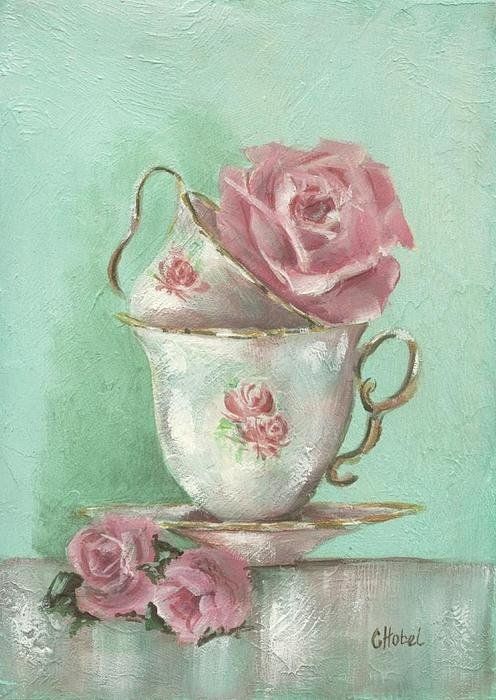
“Two Cup Rose” by Chris Hobel
Last but not least, as a tea enthusiast, I have to insist on rose tea. The rose is the flower of love and a flower long associated with Guinevere and even Lancelot. What better way to end a perfect Valentine’s Day than with a delicious rose petal tea? (Guinevere would highly approve!) If you have some dried rose buds or petals, or even a store-bought rose tea, steep them for a good five minutes with some soothing chamomile in boiling water. Then strain, add a spoonful of honey and enjoy. And if you’re a black tea fan, like myself, rose goes great with Ceylon. You can even add a few petals to a decaf black tea if you’re taking a cup in the evening. And if you don’t have any rose tea at all, there are plenty of places to find some!
I highly suggest Fortnum and Mason’s Rose Pouchong tea available on Amazon. It’s on the pricier side but it’s some of the best rose tea you will ever have in your life. I swear it. However, times are hard and wallets are hurting, so you can also find a decently priced one in Downton Abbey’s English rose tea. It’s herbal and is blended with hibiscus and raspberry. You can even find Whittard of Chelsea’s rose blend on Amazon. It’s fairly cheap and said to be the same brand served at Harrods’ tea room in London! Also, I can’t miss out on a shameless plug moment and remind you that you can buy a sophisticated Arthurian rose tea from me at my Etsy shop! There’s an herbal one for Guinevere blended with rose, Egyptian chamomile and French lavender, and a black tea for Lancelot with rose, bergamot and lemongrass. (Think Beltane-inspired Earl Grey.)
I hope some of these ideas spark some creative energy! There are so many possibilities in the ways of nerding up your Valentine’s Day in a perfectly Arthurian way! And of course, Of Swords and Magic wishes you a most happy and joyous Valentine’s Day. Sending you all lots of love. ❤
(To listen to this post as a podcast episode, click here.)
Happy New Year and Happy February, friends! I hope you’re having a fantastic start to 2023!
Just a little mid-winter thought for February:
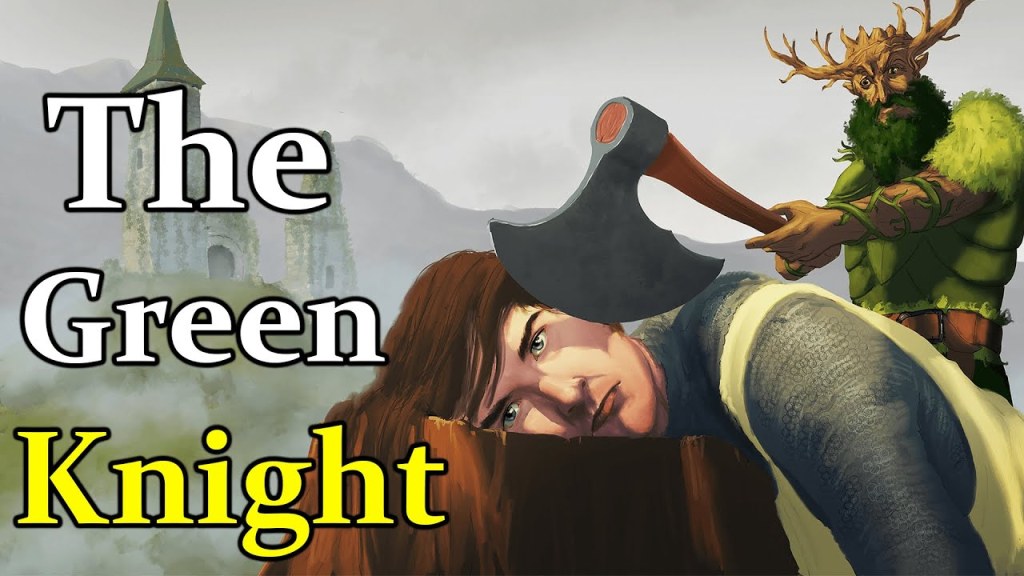
As some of you know, I love wintertime and tend to spend a lot of the winter season thinking about Gawain and the Green Knight. To me, the Green Knight was always more than just an antagonist-turned-protagonist for Gawain in that famous winter poem. He was a teacher, a warrior. A spirit. He forces Gawain out on a wild quest to test his mettle yet also teaches him the meaning of honor. He makes as if to kill Gawain, yet one year later, sends him home with a blessing. It always fascinated me. It also intrigued me that he was literally green and sends Gawain into the wilderness to learn his lesson– both signs that the Green Knight represents Nature and Celtic pagan themes. Yet he also teaches Gawain honor as a Christian knight, sending him out into the wild knowing he is a fairly new Christian and that he has no one but his horse and Mother Mary in his shield to protect him.
I think the Green Knight can be seen in both a Christian and a pagan light– and, in fact, shouldbe seen in both. As a pagan who also celebrates Christmas and other Christian holidays, I love thinking of him during the winter, especially around the New Year. He seems to embody both faiths in different ways. (And again, this is just my personal opinion. Everyone views him and the story differently! 🙂 )
As we know, the Green Knight disguises himself as a simple host, allowing Gawain to stay in his manor until New Year’s Day as he heals from his ruthless journey. The “exchange of winnings” game commences, and the host’s wife makes sexual advances toward Gawain during each of the three days he stays there. Of course, this is all a test created by the Green Knight, himself, and his wife (or so he calls her), aiming to see if Gawain will give in to sinful behavior on this holy quest. (And to see if a magical green silk belt rumored to keep its wearer safe from harm will tempt Gawain to cheat out of his quest.) Finally, Gawain sets out to meet the Green Knight in the Green Chapel, ready to bow his head before the Knight’s axe. But he wears the belt. And when the Green Knight asks him where he got it, Gawain lies about it. (A failed last chance given by the GK for Gawain to come clean about what it is and the fact that he got it during a rather scandalous moment with someone else’s wife.)
From Wondrium Mythology, YouTube video discussing Sir Gawain and the Green Knight
However, after two “misses” with the axe, the GK puts it down and reveals that he was the host, all along. Of course, Gawain is overcome with shame, admits everything and apologizes profusely. He’s so mortified that he feels unable to ever return home to Camelot. But the Green Knight says that this apology and admission of shame is enough. He explains that the entire quest was all a test to see if Gawain truly understood the meaning of honor– for only then, could he ever truly be a worthy knight. The GK sends Gawain home with a warm-hearted farewell and the green belt, as a symbol of his lesson learned. (Even though Gawain is guilt-ridden the entire journey home.) Luckily, Arthur and Guinevere are simply so pleased that he’s back alive, that they have everyone wear green belts in his honor.
To me, the Green Knight had two motives for this test. One was as he said, to test Gawain’s honor. The other, in my opinion, was to test Gawain’s bravery on the journey there and to measure his respect of things he doesn’t understand. The honor aspect seems to embody Christian morals while the bravery and respect-of-another-being aspects seem to embody pagan ideals.
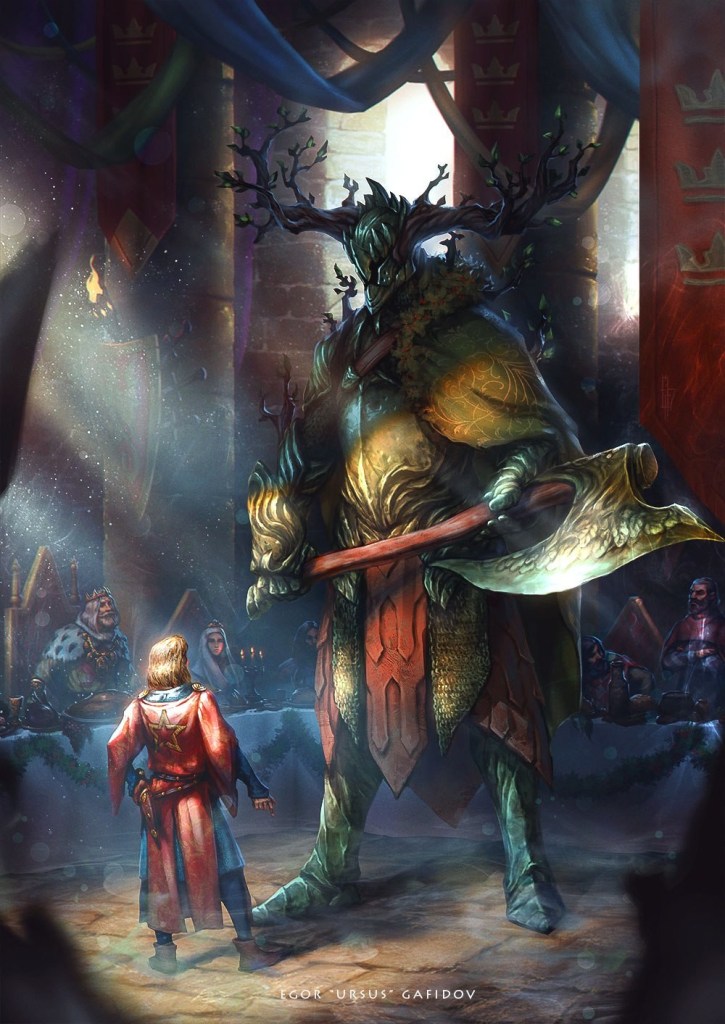
Art by Egor Gafidov
On the Christian side, honor comes in with the “exchange of winnings” game and Gawain’s truthfulness (or lack thereof) about the gifts he received in the GK’s house. Of course, had he declined to take the green belt from the wife, he would have passed the test. Even if he hadn’t, had he simply come clean and been truthful to the GK, he still would have passed. In this way, to me, the GK appears as a Christian figure. His “game” with the axe, and Gawain’s end of the bargain, represent death and ascension to Heaven. The idea of coming clean could represent the confessing of ones sins, which Gawain didn’t do. He also was planning to cheat his way out of the game by wearing the belt, which can represent cheating ones way through life. A Christian knight would have been expected to live a life of purity– not to say that it should be lived without pleasure or desire, but that the knight’s intentions was expected to always be out of pure heart and noble cause. A life of lies and selfish gain (not to mention the whole sexual-intimacy-out-of-wedlock thing, which would have been hugely dishonorable at the time) would have been no life for a knight of King Arthur’s.
But once the GK reveals himself and explains his holiday “game” to Gawain, who is ashamed, the GK is merciful and kind, and gives him the belt to remind him of his lesson, inspiring him to do right always. This to me seems like the kind of lesson Christ would teach his followers; the kind that God might teach those who once had Him in their heart but lost themselves and made mistakes. He seems like He would send them off with a lesson learned and a reminder that He is always there to guide them. The Green Knight does the same here for Gawain.
On a more general note, the idea of faith seems really prevalent in this story. Gawain mentions many, many times throughout the whole first half that he’s not afraid of what awaits him simply because he knows God is with him on this journey. He has faith that God will save him from death’s icy blow and that things will work out in the end. (At least that’s how he feels at first.) And it’s true; he did survive and he did return home, and all the better for it. But his faith begins to dwindle as New Year’s Day grows closer, which leads him to make the mistake of turning to the green belt for safety and lying his way through a challenge of honor. This, I find to be very human and something probably all of us would have done. But to be the kind of worthy knight the Green Knight expected– and that even Arthur expected of his men–would have required more than that. It would have required the highest levels of courage and honor. So the whole moment of the GK explaining that if Gawain had steeled his heart, things would have been a lot easier, seems very much like a lesson in faith. Not just in oneself but in God.
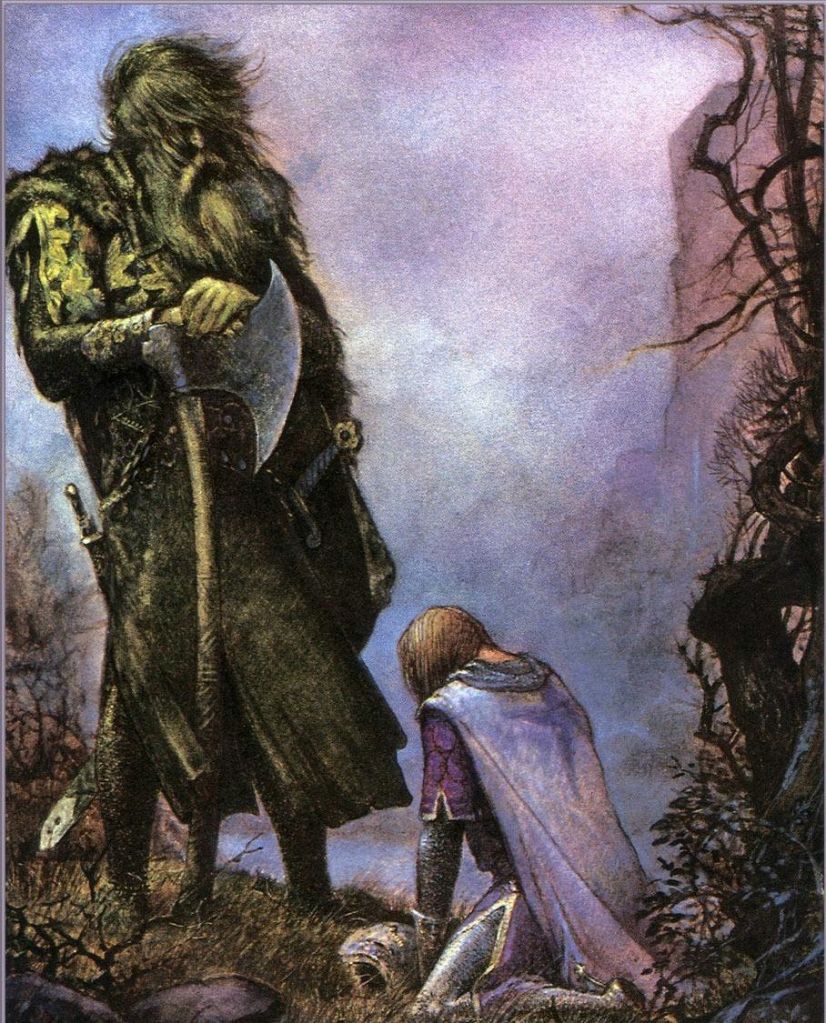
Art by Julek Heller
On the pagan side of things, the entire idea of the Green Knight’s “game” can be argued to have derived from the lore of the Green Man. In modern pagan and Wiccan culture, the Green Man has been associated with Pan, the Greek god of mischief, and the Celtic figure of the Horned God, amongst others. In modern pagan practices, the Horned One has become more and more popular as a spirit able to be worked with and honored during springtime. But in ancient times, he was known by the Celtic peoples as Cernunnos; the wild fertility god of nature and abundance, celebrated playfully in the spring but feared in the winter. He was thought to come knocking on the hall door of great warriors on Yule Night or New Year’s Eve, inviting only the best warriors out on a dangerous, frigid-cold adventure to test their mettle. Whether we call him Cernunnos or the Green Man, he made it his mission to find the greatest men in the land and prepare them to be the best they could be; to be brave at all costs, stronger than the northern winds, smarter than the fae creatures lurking in the shadows of dark mountains and frozen lakes. And respectful of heart. All qualities typically expected of a pre-Christian Celtic warrior.
Art by Jacob Turner on DeviantArt
Similarly to the Green Knight, Cernunnos is also seen in various forms. He’s a teacher; a gentle caretaker of all forest creatures, teaching them the ways of the wood and of Nature, herself. He is also a god of the hunt. Since he knows the forests so well, he was often called upon by the Celtic peoples to aid them in hunts, especially during the winter when food was scarce. He was also said to be a wild creature, himself, and sometimes appeared not at all in the form of a human body but an animal’s. Most often, he is thought to appear as a stag (or a human man with a stag’s antlers), though he was often thought to have also taken the form of a serpent or other horned creature. (This is why I imagine A24’s The Green Knight film depicted the GK as an earthly creature, made entirely out of tree bark and greenery, with two edges of tree bark sort of crowning his head, like antlers.)
From A24’s The Green Knight filmArt by Des Hanley
All of these variations of his character could have easily inspired the character of the Green Knight who was also, at once, a teacher, hunter and shape-shifter. Dark and terrifying in the beginning, when he first appears at Arthur’s court (a Cernunnos-figure calling the great warrior to a quest), he later takes on the guise of a rowdy but humble host. (A nod to Cernunnos’ shapeshifting gifts.) During this, he even spends his part of the exchange of winnings game going on a hunt each day (another nod to Cernunnos as a god of the hunt). Then, at the Green Chapel, he once again resumes his role as a terrifying god-like creature until Gawain learns his lesson. Then he falls into his final (and seemingly truest) form; the gentle teacher. (A parallel to Cernunnos as wisdom-keeper and Father of the Forests.) Then of course, there’s his last quality that’s perhaps the most popular one today; fertility. As well as he is known today as a god of the forest, he is also known as a god of Divine Masculine energy and fertility. How ironic that desire and fertility were the Green Knight’s main idea for catching Gawain off guard at the house and testing the trueness of his heart.
Art by Montjart on DeviantArt
And then there’s the man vs. nature trope that is so very prevalent in this story. So prevalent, that Nature feels like a character in itself. For much of the story, Gawain sees no other humans. Only animals and giants and snowstorms and dangerous mountain passes. Perhaps the Green Knight wanted to see if Gawain would not only survive the journey to the Chapel but to see if he would work with Nature to get there. To see if he wouldn’t slay giants or dragons but work with them to find his way to the Chapel. And of course, there’s the idea of respect.
When I first read this in high school, my first thought was that the GK wanted to teach Gawain, who scorned the pagan faith and feared “unholy” creatures, that holding respect for all creatures was a quality expected of a true knight, even if Arthur never taught such a thing. The scene that brings this idea to mind the most is when Gawain finally appears at the Green Chapel and realizes it’s not a chapel at all, but a chasm. A mossy, green chasm in the side of a mountain that belongs not to man but to the Otherworld. Gawain’s first reaction is that this place “belongs to Satan”. He says, “For certain, this is a soulless spot, a ghostly cathedral overgrown with grass, the kind of kirk where that camouflaged man might deal in devilment and all things dark. My five senses inform me that Satan himself has tricked me into this tryst, intending to destroy me. This is a haunted house –may it go to hell. I never came across a church so cursed.” And then, the GK starts to sharpen his axe. And Gawain can see nothing, only dark mossy shadows, as he hears the grinding of the axe’s blade on stone. It scares the bejesus out of him (and it did the same to me when I first read it…but I don’t blame the GK for purposely scaring him just a little after those comments.)
Art by GoblinHood on DeviantArt
Perhaps this was yet another failure of Gawain’s in the Green Knight’s opinion; the failure to recognize his chapel as a different sort of chapel and one that deserves the same amount of respect as a Christian one. Perhaps the green belt is also given to Gawain to take home in hopes of serving as a reminder that good and mercy and honor can also come from the Old Ways. (You would think Gawain would know that being from a pagan family. But he did have an evil witch for a mother and a poor excuse for a man for a father, and wacko brothers…so I guess I get it.) Perhaps this theory can even be supported by the fact that in many versions, Morgan le Fey reveals herself as the GK’s “wife”, and says that she, too, was using magic all along to disguise herself. What reason did she have to do such a thing unless she hoped for Gawain to find good in the Old Ways, too? As a witch/priestess and follower of pre-Christian faith, I’m sure she would have wanted to ensure that Arthur’s knights knew of the good that can come from pagan folk. Perhaps she knew all along that Gawain would be sent home with a blessing from the Green Knight.
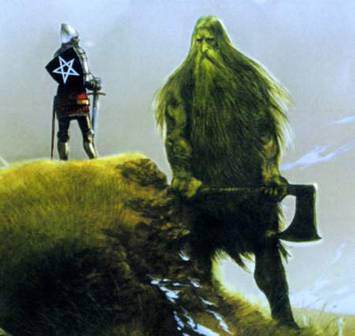
Art by John Howe for J.R.R. Tolkien’s Sir Gawain and the Green Knight
ANYWAY, that was much longer of a rambling thought than I expected to write, but I just think all the multiple dimensions to this story are fascinating. I’m sure I missed some Christian parallels, or even some pagan ones, so if any come to mind for you, feel free to let me know in the comments! I’d love to know your thoughts.
All in all, there are several ways to look at this epic poem and I feel like each one is equally relevant and valid. It’s so much more complex than a simple adventure poem. Not to mention how beautiful and shimmering and visceral and dark the language can be. Simon Armitage’s translation is my favorite version, so if you ever end up reading it anytime soon, I highly recommend his verse! I think he captures not only the beauty and wretchedness of the story but the multifaceted views the story can take. I took away from his version that he allows you to view it from a Christian lens as well as a pagan. And that makes the story all the more rich, wild and inspirational. ❤
[To hear this post as a podcast episode, click here!]
Greetings, lords and ladies! And happy holidays! Apologies for the lack of posts lately– things have been super busy but I plan on making more time for these posts! I missed this blog dearly. ❤
Since last I wrote, things have finally opened again and are safe for travel! I know a bunch of my fellow Arthurianists are excited to explore more of the U.K. in the near future. What better thing for us Camelot nerds to dream of for the coming new year than Arthurian travel destinations, right? We covered some of England last time– and still have much more of her to cover– but we haven’t yet mentioned her next-door neighbor.
While England has the reputation of being a hub for tons of Arthurian spots, Wales is honestly the true goldmine. Most Arthurian fans know that Wales is argued by many to even be the birthplace of the legend. The first written accounts of King Arthur were by Geoffrey of Monmouth in his Historia regum Brittanniea, or The History of the Kings of Britain. Not only did he write accounts of Arthur in Wales but he wrote most of his work in his hometown of Monmouth (south Wales.) And Geoffrey wrote about the land and legends that he knew. Some people believe his work to be connected to The Dream of Rhonabwy, another early Arthurian tale that dates back to the 12th century and whose author is unknown. Whether written/inspired by Geoffrey or not, this author told the Welsh tale of how Rhonabwy saw in a prophetic dream the red and white dragon in heated battle. In many newer tales, Merlin is the one who has this vision, telling King Uther of the red dragon’s victory over the white, representing Camelot’s victory over their enemy. Henceforth, the red dragon becomes the symbol of Camelot, accompanying the name, Pendragon (“head dragon”). This is thought by some to be the reason why the red dragon is the symbol on the Welsh flag today!
There are so many other Welsh ties to Arthurian legend. And their locations make excellent travel destinations! I had the honor of visiting south Wales with my dad a few years ago and it was easily one of the most magical experiences of my life. You can feel how old and mythical the land is. It’s in the air; in the quiet hush of the village at dusk, in the fields of summery bluebells. It’s in the dark stone of old pubs, the smell of strange flowers and the taste of fresh salmon. There’s something magical about traveling past endless fields of sheep and castle ruins. And there’s an inescapable presence of something legendary that hangs in the air, like a rainy mist.
Let’s take a look at a few locations in the south (we’ll cover the north next time), so that when next you go exploring, you can check off some of these beautiful sites!
Caerleon
Caerleon Roman Amphitheater. Photo credit: Unknown/Internet
Caerleon is mentioned several times in older texts, as a town where Arthur often held court. Some even say that Caerleon was Camelot and that this was where the Round Table was kept. If Arthur was an actual historical figure, this is a maaajor possibility because of the ruins of its Iron Age hill fort, and the Roman amphitheater that’s now part of the National Roman Legion Museum. As far as the Round Table goes, many claim that it wasn’t actually a “table”, at all. Rather, it was Caerleon’s Roman amphitheater, used for holding larger council meetings. It’s perfect when you think about it: lots of space for everyone at court, a speaking place in the round (where there is no head and everyone is equal), good acoustics for giving speeches, instructions and reports, good visuals, and it’s outside where Arthur might feel closer to God, or gods.
The fort and amphitheater even have Roman baths nearby (which might still be available for tours today!) If we’re thinking in the style of the Romans, the king’s royal bathhouse would be close by to his public place of business (AKA the Round Table/ampitheatre). So it makes perfect sense. Also, Arthur’s rule was not long after the Romans left Britain– and in many versions, he’s Romano-British, himself– so he would have made great use of Caerleon.
Hanbury Arms Alehouse, beside ruins of Roman watchtower, Caerleon. Photo credit: Unknown/Internet
Hanbury Arms Inn
Also in Caerleon is what could very well be the remains of a “real” Camelot! Nestled in the heart of the town, right alongside the Hanbury Arms Inn, is what remains of a castle– a few feet of a Roman watchtower. Although it’s believed that the castle was added to by Normans in 1085 and attacked by the Welsh in 1217, the castle is still thought by some to be a Romano-British castle from before the 10th century. Geoffrey of Monmouth, himself, said Caerleon Castle was one of Arthur’s and even grew to rival Camelot! Nearby is also a site of one of Arthur’s twelve great battles. And the Hanbury Arms is also where Alfred, Lord Tennyson often came to write poetry and his Idylls of the King, which includes a good chunk of classic Arthurian literature. An Arthurian hotspot, for sure!
Those who visit Caerleon for its Arthurian roots tend to visit the Roman Legion Museum, including the amphitheater. But when I go one day, I’m taking a lunch break at the Hanbury Arms…it’s the closest thing Caerleon has to where Arthur may have lived!
Chepstow Castle
Front of Chepstow Castle, Monmouthshire. Photo credit: Self
Chepstow is a beautiful, quaint little village. But its castle is nothing short of gigantic. Chepstow Castle is thought to be the resting place for Arthur and his Round Table pals. Some tales say that it was one of his home castles. Others say that after the battle of Camlann, while Excalibur was thrown into the Lake of Avalon, Arthur and his knights were brought to Chepstow to be buried…but they’re not dead. Only sleeping. And one day, when the land’s need is greatest, Arthur will rise again. ❤
Until that day, it’s believed by some that he and his men rest beneath the castle, in the caverns below, just above the water of the River Wye. One staff member even claimed to have seen Arthur’s ghost once, along with the ghosts of his knights while he was on night parol. He fled the castle and never returned, warning people never to visit there after dark. I, personally, would be overjoyed and honored to witness King Arthur’s ghost!? But to each their own, I guess. (I also would like to add that I literally had a dream that Arthur’s ghost came to walk with me around Monmouthshire and told me that Monmouth Castle was the real Camelot. But he also said that the place where he held all the lavish parties– the place that best matches our idea of Camelot– is Chepstow Castle. So. Just throwing that out there.)
My dad and I loved our time there. It’s absolutely massive for a ruins and the energy there feels…large, if that makes sense. “Large” as in larger than life, full of vibrance. It still echoes of a giant court, large dinner parties, secrets never told that remain within the walls, stories and lives and vicious battles that whisper their truths in the chilly breeze blowing in the open corridors. While I felt very at peace there, I wouldn’t be surprised if some spirit still remains there of a great king and his knights, who did much for Wales and the land of Britain. Definitely a must if you’re visiting Monmouthshire.
Chepstow Castle’s caverns on the River Wye. Photo credit: Unknown/Internet
Dinas PowysCastle
Dinas Powys Castle Ruins entrance, Vale of Glamorgan. Photo credit: Olympus Digital Camera
Almost all the way to the southernmost part of Wales, Dinas Powys Castle lies at the eastern end of the Vale of Glamorgan. This ruins was a castle that had been conquered by many and was originally a home for the Norman de Somery family in the 1100s. But some believe that before then, it was originally a castle of King Arthur’s that was destroyed by invaders in the Dark Ages. (I feel like every castle in Wales claims theirs to be one of Arthur’s castles. On every Welsh castle’s website, it lists the history and then below it: “Birthplace of King Arthur!” or “Home of King Arthur!” But also, like…who’s to say it’s not true? Who’s to say each one of them wasn’t a place some historical Arthur-figure has been? He was the High King, it’s very possible he touched base at every one of these locations! Anyway, I digress.) Today, you can check out Dinas Powys for free, so long as you don’t mind the thorn bushes and overgrowth. 🙂
Wyndcliff Woods
Bluebell fields in Wyndcliff Woods, Chepstow. Photo credit: Self
This one isn’t high on most people’s radar but I went with my dad and it did not disappoint. It’s thought by some to have a connection to Sir Percival and/or Merlin. Merlin has an association with the River Severn, which is right downhill (the river separating Wales from England). It’s also thought to have been The Waste Forest; the forest in which Percival was raised by his mother and kept sheltered from civilization. (Which is funny because only a twenty-minute walk away is Tintern, which in medieval times, was a busy village and home to a fully functioning and very popular Tintern Abbey.) Some modern Arthurian stories also place Percival’s forest here– including one of my favorite stories, the Pendragon’s Heir series by Suzannah Rowntree. In The Door to Camelot, Percival even hides out in Tintern Abbey after running away from home, before going to Camelot. In that case, Percy’s first introduction to civilization was through Tintern Abbey, which makes sense given his Christian heart and pure soul. (I guess you could make Tintern Abbey an Arthurian location, too!) But even after all his wild quests, a part of himself always stayed in the forest. In my Percival-based novel, I, too, placed his home here in the Wyndcliff Woods. It just made so much sense for him to look out across the River Severn at England; at Camelot’s towers just beyond the horizon, as he dreams of a life of knighthood.
Going there with my dad and actually stepping foot in the place was a truly magical experience. The forest feels as ancient as it does mystical. It was so quiet, filled only with the sounds of birdsong and cold, early-spring wind shivering through the pine trees. I felt like an intruder. We were so pleased to hike there. It’s so easy to imagine a young Percival there, climbing the forest’s steep paths, sitting in silence with the ancient stones and tree stumps, hunting for food…bombarding passing travelers with questions about the world. But who can blame him? If I had a cottage here, I’d probably have a hard time leaving, too.
Hiking path in Wyndcliffe Woods. Photo credit: Self
Anyway, the Wyndcliff Woods is now officially an Outstanding Area of Natural Beauty and is a popular place for hikers. It has a beautiful viewpoint called the “Eagle’s Nest”, for hikers to stop and look out at the view of the two rivers below; the River Wye and the River Severn just beyond. As an Arthurianist who enjoys the Welsh tradition, I’ve decided to call this little area of south Wales “Percival’s Perch”. Because I’m that person. And yes, that’s me in the picture below, standing at the Eagle’s Nest, drunk on my happiness.
Eagle’s Nest Viewpoint. Photo credit: my dad
St. Govan’s Chapel
St. Govan’s Chapel, Pembrokeshire. Photo credit: David Skinner
Last but not least, this little chapel is nestled in the rocks, near the cliffside caves of Pembrokeshire. It’s named after St. Govan the Hermit, who secluded himself in this chapel for shelter from pirates– and in some stories, from a long, merciless winter– saving his own life in doing so. But many believe the name “Govan” to be derived from “Gawain”. And after all, in some versions of Arthuriana, Gawain becomes a hermit after Camelot falls and lives out the rest of his life among the wilderness and the fae. So this little chapel could very well be Gawain’s. If we know one thing about Gawain, we know his association with chapels, especially during his Green Knight quest. We also know, of course, that the Green Chapel was a mossy cavern and not at all an actual chapel. But he certainly did spend a good deal of time in real chapels throughout his quest, taking respite from the cold and praying to the Virgin Mary, who lay painted faithfully in his shield. If this isn’t the chapel he called home later in life, it could certainly be one in which he sheltered himself from that harsh blizzard during his fateful quest.
I like to think he would have liked it there. It’s on the cliffside right by the water. And as someone raised in the Orkney Islands, he probably would have felt a little closer to home in a place where he could smell the saltwater on the crisp, sea wind and watch the sun glint on the waves. Today, you can visit there in person, so long as you don’t mind the steep climb!
These are just a few of the Welsh wonders that hold Arthurian myth and legend within their walls and branches. Here’s to Cymru and all the legend-filled treasures she holds within her beautiful land!
(Listen to this blog post as a podcast episode here.)
Happy St. Patrick’s Day! I want to preface this by saying I’m not at all much of a drinker– and am also one of those people who celebrates today for Irish heritage and not so much for the idea of getting drunk. That said. We all love to get at least a little lit for St. Patrick’s Day, right? 🙂
My friend, Maddy, a fellow Arthurian fan (follow her on Instagram at @maddytamms!) has a much broader knowledge of cocktails than I do. So the two of us got rather tipsy on champagne one night and had a BLAST coming up with some fun Arthurian character-themed drinks to enjoy on everyone’s favorite drinking day! Now these drinks aren’t necessarily Irish, nor are they medieval. If you really want to enjoy some drinks Arthurian-style, you might wanna stop by your nearest pub and enjoy some nice, cold ale. But if you’re looking for something a little more creative that you can make at home for friends, here are some fun recipe ideas!
King Arthur: Hot Toddy
Photo: Pinterest
Let’s start with our High King, yeah? He’s a man of the winter and would enjoy something that warms the body after a long battle, or even just a long day. Seeing as it’s still quite cold in many areas this March, brew yourself a hot toddy to warm up! It’s such a simple drink: all you need is whisky, hot water, lemon and honey. Just boil the water, add the whisky (you can get your Irish touch in, after all), and add lemon and honey to taste. But if you wanna change it up a bit, here’s a recipe with a more flavorful twist!
Ingredients:
½ cup boiling water
2 tablespoons lemon juice freshly squeezed
4 tablespoons bourbon
2 to 3 drops aromatic bitters
2 to 3 teaspoons honey
1 tsp whole cloves optional for garnish
1 slice lemon optional
1 cinnamon stick optional
1 star anise optional
Directions:
Pour ½ cup of boiling water into a mug.
Add lemon juice, bourbon, bitters, and honey into the ½ cup of water. Stir until honey is dissolved.
Poke whole cloves into the peel of a thick slice of lemon. Drop lemon slice into the mug.
Add a cinnamon stick and/or star anise for garnish. Done and done!
Note from recipe: Glass mugs are a beautiful way to show off the beautiful amber color of this drink, but regular mugs work just as well (and add more of a rustic/medieval feel, especially if you’ve got any sort of Celtic-style mug.)
We might as well name this “The Guinevere”, right? It just sounds like her. While the essence of our High Queen could easily be found in a simple, elegant glass of champagne, I think this drink really highlights the strength and complexity in her. Grab a pretty coupe glass and let’s get to brewing!
Ingredients:
For the pink peppercorn syrup:
1/2 cup cane sugar
1/2 cup water
2 tablespoons pink peppercorns (you can buy them online or at your nearest Whole Foods)
For the cocktail:
24 ounces rosé wine (the recipe suggests Bridge Lane)
3 ounces cranberry liqueur (the recipe suggests Leopold Bros.)
3 ounces pink peppercorn syrup (recipe below)
12 ounces chilled tonic, to taste (the recipe suggests Fever Tree)
Ice
Edible rose for garnish (you can use other edible flowers if you prefer; I just love the idea of a rose for Guinevere ❤ )
Directions:
For the peppercorn syrup:
In a small saucepan, combine the cane sugar, water, and pink peppercorns. Bring to a slow boil over medium-high heat and then lower the heat to a slow simmer, until sugar is dissolved. Remove from heat, steep for 20 minutes, discard solids, and let cool completely.
In a large pitcher or punch bowl, combine the rosé, gin, white grape juice, cranberry liqueur, and pink peppercorn syrup. Stir until incorporated and chill in the refrigerator until you’re ready to enjoy. You can make this portion of the cocktail a day ahead and store it in the refrigerator; just give the mixture a good stir before serving.
For the cocktail:
When you’re ready to serve the cocktail, fill your pitcher or punch bowl with ice, and add the chilled cocktail mixture. Quickly top with the tonic water, taste for balance, and give the mixture a gentle stir. Prep individual cocktail glasses and place one edible rose in each.
Note from the recipe: Leopold Bros. New England Tart Cranberry liqueur might be tough to find, but like their Rocky Mountain Blackberry liqueur, it’s worth it if you can score some. You can substitute Chambord black raspberry liqueur, but the flavor profile of the cocktail will shift slightly sweeter.
Sir Lancelot: Kir Mead Cocktail
Recipe inspiration from Meadist. Photo from Pixie’s Pocket.
Our French knight, the brave and charming Sir Lancelot, would enjoy something reminiscent of home. The Kir, a traditional French cocktail of white wine and créme de cassis (blackcurrant liqueur), sounds delish. But we can put a medieval spin on it and swap the white wine for mead! I think he’d enjoy sipping on this refined treat after a long day out in the jousting field.
Just pour the mead into a wine glass and add crème de cassis. Et viola! Enjoy a little piece of history and French culture.
Morgan le Fey: Black Widow Martini
Recipe inspiration and photo from Aimee Mars
Our favorite dark sorceress of the British Isles deserves a drink that encompasses her great power (and often dark magic.) This devilish martini does exactly that. A typical Black Widow is made with black rum and crème de cacao– but we found a recipe with blackcurrant liqueur that’s a little more creative and much more suitable for Morgan!
Ingredients:
2 ounces vodka
3 ounces crème de cassis
1 ounce kahlua
1/2 teaspoon activated charcoal: A fine odorless and tasteless powder made from selected natural hardwood trees that have been exposed to very high temperatures in an airless environment. It’s pure carbon specially processed to make it highly absorbent of particles and gases in the body’s digestive system. Basically, it gives the cocktail the deep black color as well as helps you detoxify. You can buy your activated charcoal on Amazon.
1 ounce ginger beer: Just a splash gives the cocktail a tiny sparkle and extra sweet taste.
Blackberries or apple slices for garnish
Directions:
Shake: Pour the vodka, cream de cassis, activated charcoal, and Kahlua into a cocktail shaker filled with ice. Shake vigorously for 1 minute and strain into a martini glass.
Garnish: Splash the top of the cocktail with ginger beer and garnish with blackberries. (You can also garnish with apple to give Avalon vibes and add flavor!)
Sir Gawain: Absinthe or Emerald Isle Cocktail
Absinthe
That’s it. Just absinthe. Its eerie green hue makes for a perfect representation of the Green Knight, and Gawain would have probably craved something like this after his Green Knight quest. Said to give hallucinatory affects that can often be pleasurable, absinthe with a cube or two of brown sugar might be just what you need if you’re on a trying quest of your own this month. Maybe you’ll even see the Green Faerie!
Pour 3/4 of a full shot of absinthe in a sundae glass.
Put a brown sugar cube on a spoon with holes in it and rest it on the rim of the sundae glass.
Pour the remaining 1/4 of the shot of absinthe onto the brown sugar cube, light the brown sugar on fire (put the flame under the spoon).
Let the flame burn for a minute while the brown sugar drips into the glass and caramelizes. Stir the caramelized sugar into the glass.
Add the water to the glass, stir again, and serve.
Emerald Isle Cocktail
Recipe inspiration and photo from The Spruce Eats
Now seeing as absinthe can be hard to find and it’s not for everybody, you might instead get really into the St. Patrick’s Day Irish spirit and try the Emerald Isle Cocktail, named after Ireland, herself. It’s just as green as absinthe, perfect for Gawain’s famous belt, and packs a hard punch. It’s a strong minty drink I find quite befitting for an Orkney warrior like Gawain.
Ingredients:
1 1/2 ounces gin
1 teaspoon crème de menthe liqueur
2 dashes bitters
Directions:
In a cocktail shaker, pour the gin, crème de menthe, and bitters. Fill with ice cubes.
Shake well.
Strain into a cocktail glass. Serve and enjoy.
Note from the recipe: Be careful not to add too much crème de menthe! It could overpower the gin and knock the whole drink off balance.
Lady of the Lake: Witch’s Brew Lemonade
Recipe inspiration and photo from Delish.com
Minus the straws and the fact that lemonade wasn’t around in the Iron Age, I could totally see Nimue sipping from this after a long day of spellwork. The dark blue represents the depths of the Lake from which she lifted Excalibur and gifted it to Arthur. The purple, I feel, represents her personality so well. And rosemary is an ancient Celtic symbol of wisdom and remembrance. Pretty befitting for our Lady of the Lake, I think. ❤
Ingredients:
Ice
2 ounces Empress 1908 Gin
2 ounces sparkling lemonade
2 ounces Blue Curacao
1 rosemary sprig
Directions:
Fill a tall glass with ice. Pour the Empress 1908 Gin and top with sparkling lemonade.
Very carefully and slowly pour the curacao into the glass, letting it settle on the bottom.
Garnish with a rosemary sprig. Enjoy!
Sir Percival: Sidecar
Recipe inspiration and photo from MasterClassPhoto from Pinterest
This boozy cocktail pretty much sums up Sir Percival in a drink. Its bursting citrus flavor from both the lemon juice and orange liqueur remind one of our Grail knight’s bright, summery personality. It’s so cheerful and light and sweet, with a hint of tartness. ❤ If you want to go one step further, you can also substitute blood orange juice instead of lemon juice, which will give it a deeper red hue (pictured up top) that’s reminiscent of Percival’s famous red armor. (And in many adaptations, including mine, his red hair. 🙂 )
Ingredients:
2 ounces Cognac
3/4 ounces orange liqueur (Cointreau or Triple sec)
3/4 ounces lemon juice or blood orange juice
Directions:
Rim the glass with sugar. It’ll help bring out the sweet tart flavor even more.
Shake in a cocktail shaker.Take the brandy, Cointreau and lemon juice and shake it together in a cocktail shaker with ice.
Strain into a glass and add ice cubes. Strain the drink into a cocktail glass. Serve with a lemon twist or orange twist. Some people like to squeeze the orange twist into the drink so the oils add a perfume.
Lady Blanchefleur: French 75 Royale
Recipe inspiration and photo from The Alchemist
I’m a sucker for Blanchefleur and as she’s a lead protagonist in my stories, I figured I’d include a drink for her. ❤ This cocktail is so fitting for her; it’s sophisticated, classy, seemingly simple and yet beautifully complex, just as she is. While it’s made with gin, the dry sparkling wine adds elegance. And the lemon juice and orange bitters add a lovely flavor that pairs nicely with floral tones, which the lavender gives. (I also tend to associate Blanchefleur with lavender for some reason, so the lavender syrup and the drink’s overall color make me think of her immediately.)
Ingredients:
2 cups Victoria Spirits Empress Gin
1 cup freshly squeezed lemon juice
3/4 cup lavender syrup (see note)
1 1/2 teaspoon orange bitters
4 cups dry sparkling wine
Directions:
Combine all ingredients in a large pitcher. Stir gently, then bottle, seal and refrigerate or stash in ice.
To serve: Pour into a chilled champagne flute or drink it straight from the bottle. Makes 8 cups or about 10 servings. It can be bottled into 6 ounce bottles and stored in the fridge for 1-2 days.
Note from the recipe: To make lavender syrup, bring 2 cups of sugar and 2 cups of water to a boil in a saucepan over medium-high heat. Add 4 tablespoons of dried food-safe lavender and reduce to simmer for 10 minutes. Remove from heat and let cool. Strain out lavender. Bottle, seal, label and refrigerate for up to two weeks.
I hope you enjoy some of these delicious boozy treats! Have a wonderful St. Patrick’s Day! And to all my fellow Irish peeps– Lá Fhéile Pádraig sona duit. ❤
If you find anything you’ve read worthy of a tip, you can leave one with the button above! I’d greatly appreciate some help saving up for a flight to the UK, to explore Arthurian locations! 🙂 Or, y’know, a small chai latte at Starbucks would be nice. Thank you! ❤
Happy International Women’s Day! Arthurian Legend has a good deal of phenomenal women in it, does it not? I thought about this last night and compiled a list of fun activities to do in honor of Women’s Day (and all month!) inspired by some of the women of the Legend. ❤ Let’s get to celebrating!
Guinevere: Celebrate Women
As High Queen of Britain, Guinevere would have a vast and detailed knowledge of the queens that came before her. She would also make it her business to stay up to date on the struggles and successes of the women around her; in the castle, in town, in the markets of Camelot’s lesser known villages. So I think, if Guinevere were to celebrate Women’s Day, she would host a large gathering for the women of Camelot; for the noblewomen, perhaps for women of the kingdoms in alliance with Camelot, and probably provide something for all the working women of the kingdom.
Seeing as it’s already Women’s Day, it might be a bit late to put together an event for today (LOL, oops) but the whole month of March is International Women’s Month! So in honor of Guinevere, host your own women’s tea or dinner party this March! A few quick ideas:
Host a high tea: You can easily make little finger sandwiches (cucumber and cream cheese is all you need, unless you want to make some tuna or chicken), put out some cookies or biscuits (you can even buy them at the store if you don’t have the time to bake) and ready a pot of your favorite tea! Done and done. 🙂
Host a dinner party: It doesn’t have to be extravagant. (Of course, if you’re extra as hell, like me, go all the way, girl!) You can make your favorite dish– a meatloaf, pasta, a crockpot recipe, whatever floats your boat– set your table with some pretty napkins and maybe some fun-colored silverware (you can buy utensils at a Dollar Tree for $1.50 in any color imaginable), set up some candles and music for ambiance (Guinevere would approve), and invite some of your favorite women to dinner! You can also try inviting women you don’t necessarily know that well. A co-worker that you don’t exactly hang out with outside of work, a friend from church, etc. Getting acquainted with women outside of your “inner circle” can be refreshing and often educational. It expands our horizons a bit– and unites womankind just a little more, which is always important. ❤
Nimue: Take Action for Women
The Lady of the Lake, herself, is a symbol of action. She gifts Arthur Excalibur and bids him use it; to protect his people, to take up arms, to rise and fight. So for Women’s Day, I think she would want us to take action and play a more active role for women, even if in small ways.
Donate to women’s shelters: Find a shelter or resource center near you and ask what they may need.
Volunteer: See if any women-owned societies, any homeless shelters or resource centers are looking for volunteers. Nothing humbles one more than helping those in need. ❤
Promote other women: Promote women in your field, and those around you! Even promote women who make certain products you use. There’s a woman who makes amazing candles that I buy from often, and another who makes beautiful female-centered art, and I try to promote them as often as possible. Women should be lifting up other women. 🙂
Morgan: Empower Yourself
Morgan le Fey knows her worth, honey, and she won’t let you forget it. As a priestess of the Old Ways, she’s also very aware of the strong female energy around her, both earthly and spiritually. If you can, take today to resonate with that and empower yourself through spiritual centeredness. Do some things that make you happy, and that make you feel like the badass woman you are. 🙂
Workout/exercise: As we know, exercise is so important for our physical and mental health. If you’re actually good about working out, more power to ya. Pop your earphones in with a badass female artist playlist and make your body feel as strong and invincible as it is. 🙂 If you’re more like me and aren’t quite the gym-type, go for a run/walk outside in the fresh air. (Morgan would approve.) Enjoy Mother Nature and get yourself feeling healthy and motivated.
Meditate: Center yourself amidst any chaos happening in your life and carve out some time to meditate. It can be a guided one or something as simple as sitting outside in the grass. A lot of people think they’re not experienced in meditation, or aren’t good at it. But meditation can literally be as simple as lighting a candle in your room and just chilling for a minute. Put on some relaxing music, put on your comfy clothes and just vibe, baby. 🙂 Let your mind relax, let your muscles ease and your shoulders drop, and your jaw relax. That’s all you need. ❤ If you’re more experienced, take this time to center yourself and calm your spirit. Remind yourself that you are protected, you are safe, and that you are part of divine feminine energy, itself.
Honor the Sacred Feminine: This is more for pagans and people interested in deity work. Morgan would’ve been big on deity worship and honoring the Goddess. Fellow pagans and/or witches, take today to do a ritual for your favorite goddess. Light a candle for the female ancestors that have guided your path. Anoint your altar with some oil to honor the goddesses that have walked with you in your life. If you wanna go crazy, light a fire and dance around it like it’s Beltane, as you embrace the Sacred Feminine within. ❤ There are certainly plenty of Celtic goddesses who blend into Arthurian legend that you can call upon for various reasons; Brighid for healing and artistry, the Morrígan for ancestor guidance, Rhiannon for health and self-confidence, Blodeuwedd for love, Ceridwen for magickal arts and decision-making. Decorate your altar and give offerings to a divine feminine energy that has helped you move through the world. ❤
Elaine: Love Yourself
Elaine, or the Lady of Shalott, remains a symbol of love in the Legend (regarding her love for Lancelot, of course.) But we, as women, need to keep that same energy up for loving ourselves, as well as others. Take today (and all this month!) to take the time to pamper yourself. Carve some time out of your schedule to do the things your body and soul would love you for.
Take a bath: Not a shower. A bath. A lot of people don’t realize how important baths are! It’s so good for your body to actually sit in a tub of water and decompress for a minute. Drop some oil or bath gel in there to create an aromatic experience. Light a candle or two and let the warm water heal your muscles and calm your mind. ❤
Do a facial mask: Do your favorite face mask and enjoy a cup of tea (or a glass of wine) while the nutrients replenish your skin. If you don’t do face masks often, you can probably just buy one at a local grocery store in the beauty section. Target has some really nice ones, too, for a fairly cheap price!
Eat good food: Eat food that makes you feel good. If that means healthy eating, with good protein and vegetables and nutrients, do it. If that means pizza and a milkshake, do it. Treat yourself.
Do some spring cleaning: Clearing the area where you spend a lot of time makes our subconscious mind relax and feel refreshed. Even though it can be a pain to do, it’s so worth it in the long-run, when everything is tidy and spacious and clean. 🙂 Whether it’s your work space, your living room, your bedroom, your bathroom– clear your area of clutter and your subconscious brain will thank you for it!
Here’s a few more Arthurian women from my version of the Legend, that may hopefully give you some Women’s Day inspiration, too!
Lily: Educate Yourselfon Women
Blanchefleur (or Lily, as she’s nicknamed in my stories) was kept in her father’s manor most of her life, forbidden to leave for her safety. Even guests were very few. So her main form of access to the outside world was through books and stories. She would ask her father, and even the servants, to tell her stories of the world away from home. When she could get her hands on a book, whether romances or poetry or simple maps of Britain, she devoured them all. It was her way of educating herself about the world. If Lily could provide an activity for Women’s Day, I think she would advise us to educate ourselves about other women. Trail-blazers who have helped pave the way for women to have the rights we do today. Use today to learn about some of the amazing women who have helped shape our world!
Watch documentaries: There are so many documentaries out there about everything imaginable. Find some good ones on women who have helped make a difference!
Read books on women’s history: Just as there are tons of documentaries, there are so many cool books on brave, powerful women who have done such amazing things.
Watch female-centric movies/shows: There tons of cool movies and series now with badass female leads! From drama series, to the Sex and the City reboot, to Marvel films, to Disney movies, there are so many to choose from!
Read female-lead books: For all my fellow YA fantasy lovers out there, we’ve finally got a LOT of books out there about women, written by women! Just look at all the Arthurian books out right now! (I’m currently halfway through The Lost Queen by Signe Pike. It’s basically Merida (from Disney’s Brave) meets Arthurian legend. I’m pretty into it. I can’t wait to read all the others out there! The list keeps piling up!
Lunete:Inspire Yourself
Lunete, apprentice under Morgan in the mystic arts, learns a lesson I wish all girls would learn at a young age: that magic comes from within. There’s physical magic that a sorceress like Lunete, or Morgan, might be gifted with. But there is a magic within, that lives inside every woman, that we all eventually learn to tap into. It’s in manifestation, it’s in confidence, it’s in knowing our worth. It’s in setting boundaries, in releasing limitations, in loving ourselves first. Lunete discovers that sometimes, this sort of magic is a little harder to use. It feels lost sometimes, and we have to do a lot of self-healing to find it again. But when we do, we are unstoppable. Invincible. Untouchable. Powerful.
Lunete uses manifestation as part of this magic in her everyday life, and I think she would inspire other women to do the same during Women’s Day. These are just small forms of manifestation you can do as you go about your day. 🙂
When you wake up: Do some affirmations as you brush your hair, as you brush your teeth and look at yourself in the mirror. Today is going to be a great day. Even if it sounds silly saying it out loud (or even thinking it.) It works. 🙂
When you make food: This one is especially important. Everything has energy, including food, and as you prepare a meal, your energy becomes intertwined with the ingredients you’re using. Take advantage of it and manifest positivity. This food is going to nourish and fuel me, and help me accomplish what I need to today. Or, This food is going to heal my body and help me relax today. Manifest those affirmations as you prepare your meal. (I do it with tea every day.) Whether you’re cooking on the stove, or popping something into the microwave for a few seconds, it has the same effect.
When you go to work: Most people listen to music on their way to work. Play something that promotes positive energy. I’m going to have a successful, pleasant shift today. Manifest it to yourself as the music plays. Promise it to yourself. It works every single time. (For me, even if it’s not always pleasant, it usually always turns out to be successful. 🙂 And usually pleasant, too!)
When you go to sleep: Centering and calming yourself before you fall asleep is always so helpful. Whether it’s lighting a candle, dimming the lights, praying, reading, etc; finding a time for peace and quiet is so needed after a long day. When you’re getting in bed, manifest peaceful, replenishing energy: I’m going to have a peaceful nights’ sleep. Or even something as simple as, My mind is going to rest now. You’ll more than likely have peaceful dreams, or no dreams at all, and your subconscious will get some rest you didn’t even know it needed.
Gratitude: The most important thing of all. There can be no manifestation without gratitude. Part of manifesting is knowing that there is a roof over your head, food in your belly, and there are people somewhere that love you. You live the life you live now because of the women that have paved the way for you to do so. Remaining grateful in the back of your mind, always, is part of what helps the manifestation take flight. ❤
There are so many other affirmations and things to come that you can manifest into existence. But these are a few simple ones. Manifestation is for everyone, of course, but I feel women really can start to tap into their own “magic” through manifestation. It’s powerful. Like we are. ❤
Thanks for reading. I hope you can take some inspiration from some of these activities and use them to celebrate your divine feminine power. Have a wonderful International Women’s Day, and an even better Women’s Month!
Hello, friends! I know it’s been so very long since my last post– but I’m back and looking forward to being more active on here again!
As we end Black History Month, I wanted to share a few quick thoughts and some great names that deserve mentioning. 🙂
While the Arthurian Legend is rooted in Celtic history and lore, on an island that is assumed to have been inhabited by a predominantly white race, it’s safe to say that this iconic and beloved legend has felt tremendously inaccessible to people of color throughout the centuries (as has the entire fantasy genre, in general.) Not only have people of color rarely been represented over the centuries but monsters and “ugly people” in Arthurian legend have always shared a wondrous similarity to POC features. Evil witches and old hags have “large, wide noses” and a monster like the Moor (a man of color), in the words of Chrétien de Troyes, is “large, ugly and hideous in the extreme; with hair unkempt and his bare forehead more than two spans wide, his ears hairy and huge as an elephant, his eyebrows heavy and his face flat.” Sometimes I read these things in my favorite stories and as a woman of color, feel an anger like a burning coal in the bottom of my stomach, and a hurt like I’ve been betrayed by a friend. I love this world and these characters so much– and then I remember how my people have been portrayed in this world over and over again and I can’t help but feel ashamed for loving a genre that has been so cruel to people of non-European descent.
But as we’ve seen, over the last few decades, that’s thankfully begun to change. Especially in the Arthurian genre! This is thanks to several portrayals of POC Arthurian characters in film and TV (including BBC’s Merlin, ABC’s Once Upon a Time, Netflix’s Cursed and A24’s The Green Knight) as well as main characters in Arthurian books that are specifically POC. It’s always been important to me that people of color, especially black folks, are represented beautifully in Arthurian legend when possible. (And before we start with the whole “black people in medieval Britain is historically inaccurate” thing, the Arthurian age is set in post-Roman Britain, right after the Romans brought people from Africa and the Middle East with them to England, Wales and France as slaves, soldiers and lovers.) This obviously doesn’t mean that every main character in every Arthurian tale must be POC, of course. Much of my own Arthurian cast that lives in my head are white. But I find it important to challenge what we’ve always known or seen, for the sake of inclusion– without going out of our way to include something we know nothing about, of course. There’s a fine line and I think many new artists telling Arthurian stories are finding that balance beautifully. I have several black friends that love Arthurian legend and that have always felt a sense of imposter syndrome while enjoying it…until now. ❤
Those warm winds of change are thanks to a lot of amazing artists, including these two powerful women, and the beautiful work they’ve contributed!
Tracy Deonn, author of Legendborn
Tracy Deonn
Tracy Deonn is…am I really saying this?…the first black author of an Arthurian novel. I may be incorrect and I hope I am!! But to my knowledge, she is the only known black Arthurian novelist, thanks to her riveting book, Legendborn. Her main character is a black, sixteen-year-old girl named Bree who lives in the American south and discovers a secret historically white magic society that may have something to do with her mother’s death. And the Knights of the Round Table. I’ve yet to read this book but I’m BEYOND excited to start it soon. Here’s a quick review from Instagram book-lover @alexysreads:
“As a 30-year-old Black Woman and having spent most of my life North Carolina. I’ve NEVER…I mean NEVER felt so SEEN in a fantasy book as much as I have with #Legendborn. ❤ I felt utterly engulfed in this story. The world was vivid and felt real! It went deep and didn’t gloss over the everyday things many Black folks go through daily, especially in PWI (Predominantly White Institution) space. I loved Tracy’s mixture of Black History, Southern Blackness, ancestral magic, erasure, resilience, survival and grief. There were several parts I needed to sit with just to soak it all in. It’s the deep and every day for me, from talking about feeling cheated when it comes to knowing one’s family history, eating Bo-Berry biscuits and joy of wash day for our hair. I loved Bree and rooted for her during the entire story. Even at the age of 30, I felt connected with Bree on many levels, especially with grief. Also, I have no idea which team I’m on. I always go for the bad boy exterior but a complete teddy bear on the inside type. But oh man, I am leaning towards #TeamNick. TRACYY HONEY!!! You had me going to bed at 2am multiple nights and waking up exhausted for work. I blame you for my lack of sleep these few days!! Make sure to read LEGENDBORN by @tracydeonn.”
If that doesn’t rouse you enough to want to stop everything and read Ms. Deonn’s work right this second, I’m not sure what will. Don’t forget to check out the sequel, Bloodmarked, releasing soon!
Zetna Fuentes, director of Cursed
Zetna FuentesArthur and Nimue of Cursed
I’ve mentioned Netflix’s Cursed series before but it deserves another mention and so many more! Cursed centers around a young Nimue, or Lady of the Lake, who’s in the midst of a fight to protect her people. It’s a very refreshing new take on the Legend, with inclusion interwoven seamlessly throughout. The book series it’s based on was written by Thomas Wheeler and Frank Miller, who decided to make Nimue a woman of color. In the Netflix series, while Nimue may be caucasian, the actors who play Arthur, Morgana and several other supporting characters are POC– and Morgana even has a female relationship! Seeing black and black queer representation in the Legend had never been done before– and for that, we have Latina-American director Zetna Fuentes to thank.
Ms. Fuentes has done work on How to Get Away with Murder, Scandal, Shameless, This Is Us, and several other classic bingeable shows. But her new twists on the Arthurian legend– not just in diverse casting but in directing and fleshing out a riveting plot– make this show a new stepping stone for the rest of us. She’s raised the bar on multiple levels, which I think was very much needed for the areas of our Legend that are growing tired. She’s taken those areas and revived them; breathed fresh life into them in a way that makes the Legend truly accessible in multiple ways. She even made sure to include the actors’ natural hair (which we’ve never seen before in Arthuriana), like one of the warrior women’s long dreads and Morgana’s beautiful cornrows. She mentioned in an interview that she wanted to create a fantasy world that she– and everyone– would want to live in. When asked how she felt the show resonated with the modern age, she said:
“It’s funny, we began work on this show before the pandemic, before this racial reckoning…and yet we knew– when we were working on it, it was layered in there, subtly, or not so subtly when you’re watching it– it was this fear of other. Oppression of other. And I think Nimue [embodies this] as a character because she’s different; because she doesn’t understand what makes her different or how the world sees her. It really is a tale of people trying to destroy what they don’t know, what they don’t understand, and that is the world we live in. It resonated with me as a woman of color, thinking about moving through this world. And if you’re different in any way, people often want to stop it, or to destroy it, to oppress it. And I think this speaks to that. This speaks to our hero, who is going to move forward and do what’s right.”
A look at Shalom Brune-Franklin as Morgana
Zetna Fuentes, Tracey Deonn and several other artists carrying on the Arthurian tradition are certainly raising the bar for all of us Round Table storytellers, and even just fantasy fans. It’s up to us to not only keep up, but to keep pushing the bar even further. To make space for all of us.
It’s what our High King fought for, after all. His Round Table was “round” because there was no head; everyone was equal. His knights came from all over Britain (even enemy lands) and from all over the Continent, and otherwise. Scotland, France, Germany, Greece, Iraq, Morocco. He kept both Christians and pagans in his court. Arthur was adamant about making his Camelot, his war band, his people, feel at home, no matter where they came from. Saxons were invading, northern kingdoms were waging war and nothing felt safe. So coming together at the heart of it all and being one at the Table, regardless of background, was imperative. And no matter which adaptation you prefer– the dark, action-packed dramas filled to the brim with political intrigue, or the lighter, romantic, kid-friendly comedies– I feel like Arthur’s roots and soul rest in what he stands for. His will to unite and stand together against darker tides. It’s literally the whole point of the Legend.
So as artists trying to carry on his tradition, I think it only right that we do the same, for this day and age. Let’s continue to unite under this umbrella of incredible stories that we all love, and continue the work to make space for all of us at the Table. It’s what Arthur would have wanted. ❤
Hope you’ve had a wonderful February. Sending blessings your way for a beautiful March!