(To listen to this post as a podcast episode, click here: https://open.spotify.com/episode/1HP8RKDVfiEAIaPayIG11a?si=Vcu8ya6yTyu-m6uJGzWkvg )
Greetings, friends! I’m back and very sorry for such a long hiatus! As some of you know, things got a bit hectic this spring and summer for personal reasons– one of which was because I was overseas for a while, earning a teaching certification! (If anyone needs help learning English as a second language, hit me up! Not joking at all lol. Email me at laurenbertini@me.com) But I finally have a bit more time to get back into the subject that makes me happiest.
The TEFL certification I earned had to be acquired through a month-long course…which happened to be in Italy! So, of course I had to do a little digging while I was there and discover what remnants of Arthuriana still lie in the ancient castles and chapels of Italia. After all, the biggest real link we have to an actual historical Arthur-figure is either through the Roman warrior, Lucius Arturius Castus or Romano-British military leader, Ambrosius Aurelianus– though I found practically nothing in Rome. (The locations associated with Ambrosius are all in north Wales.) Most of my finds were in Tuscany or up north, close to Austria. While I personally didn’t get to travel to too many of these places– and we know Arthur wasn’t very fond of visiting Italy for various reasons– there is certainly plenty of Arthurian art in Italy and an obvious huge impact of the legend on the Italians over the centuries! For any Arthurianists planning to visit Italy anytime soon, I highly suggest checking out some of these locations on your next trip!
The Sword of Galgano – Chiusdino, Tuscany
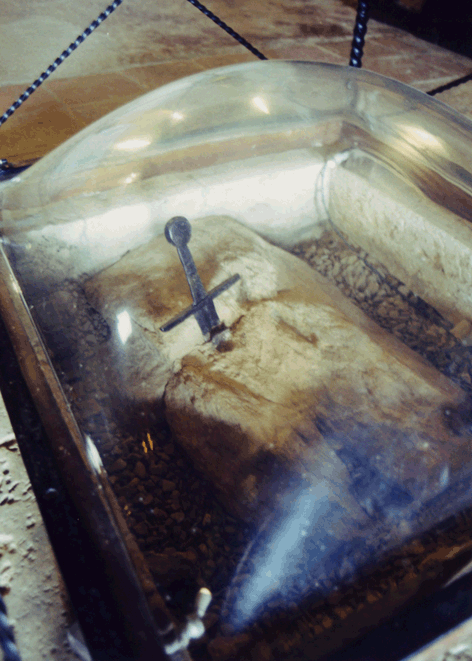
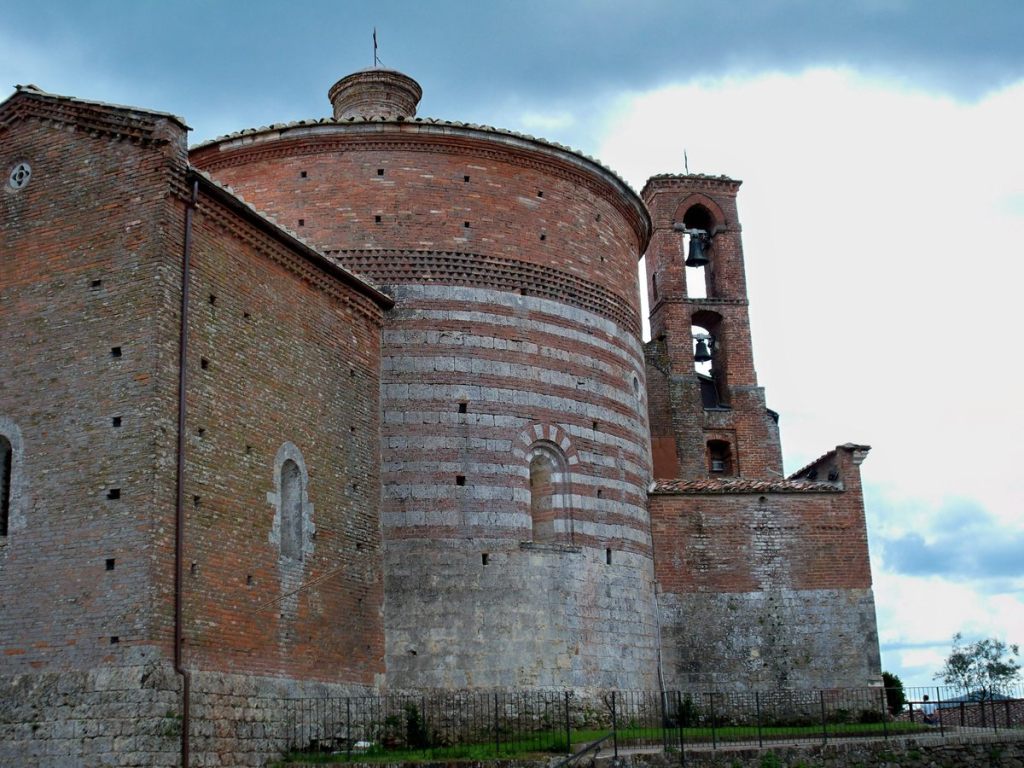
Did you know the real Excalibur is in Italy? Well, at least it’s the real one according to Tuscans. Either way, it’s a real sword that dates back to the 12th century, stuck in stone, okay? And the story comes with Sir Gawain’s Italian counterpart! Nestled in the hills of Tuscany is a sleepy, little medieval town called Chiusdino, wherein lies Montesiepi Chapel, part of the Rotonda di Montesiepi. In the late 12th century, a wealthy knight named Galgano Giudotti lived in this town and was known for his violent and merciless approach to both his work and personal life. He was an aggressive knight without a trace of kindness. But it’s believed that one night, the Archangel Michael visited him and insisted he change his ways. The visitation was so frightening that the very next morning, Galgano plunged himself into Christianity and turned away from violence forevermore. Despite the opposition of his family and friends, he became a hermit and lived out his days in peaceful solitude, devoted only to God.
It was shortly after he made this change that he was instructed by a mysterious voice to climb the hill of Montesiepi and bring his sword with him. There, he saw a round temple (the rotonda) where Christ stood, surrounded by Mary and all his disciples. (It’s giving “knights of the Round Table”, right?) He also found a large rock there and, in the name of God, officially gave up his life of violent knighthood by thrusting his sword into the rock to stay forevermore. Not only was it a sacrifice but once stuck in the stone, it became a sort of symbol of the cross. Exactly like Arthur’s sword in the stone. ❤
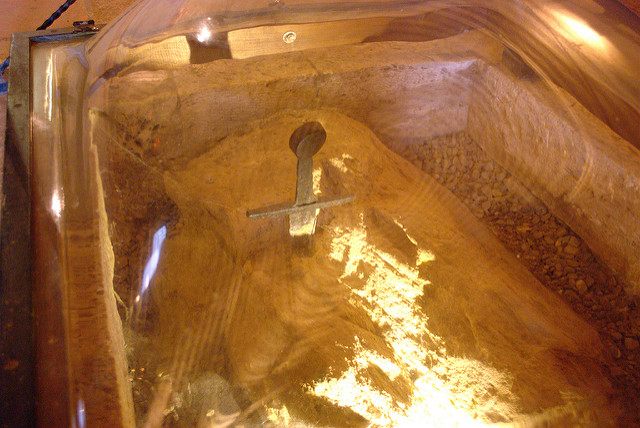
Some people (Tuscans, mostly) even say that the Sword of Galgano is thought to have been the first (valid) depiction/motif or story of a sword in a stone, and certainly one of the only few real ones that exist in the world. Ironically enough, the first written tales of a sword in the stone from Robert de Boron date back to the 12th century– the same time Galgano lived, seeing as we have records of his life in 1180! (What a giant surge of Arthuriana there was in the 12th century! Robert de Boron’s French Merlin poem– the first literature featuring the sword in the stone– also Geoffrey of Monmouth’s History of the Kings of Britain, Chretién de Troyes’ romances, this, other Italian sculptural additions to cathedrals and so much more! Anyway, I digress.)
Galgano is also thought to be Gawain’s Italian counterpart, seeing as Gawain’s name in Italian is “Galgan” or “Galganus”. Close enough to Galgano! It can definitely be argued that this could have been a source of inspiration for Gawain’s English/French name. Also, Gawain is a warrior known to be rather hot-headed; in some versions, he’s brash, crude and violent. Then, after the fall of Camelot, guess who becomes a hermit/saint, gives up his sword, and lives in a chapel forever, devoted solely to God? You guessed it. The similarities are there!
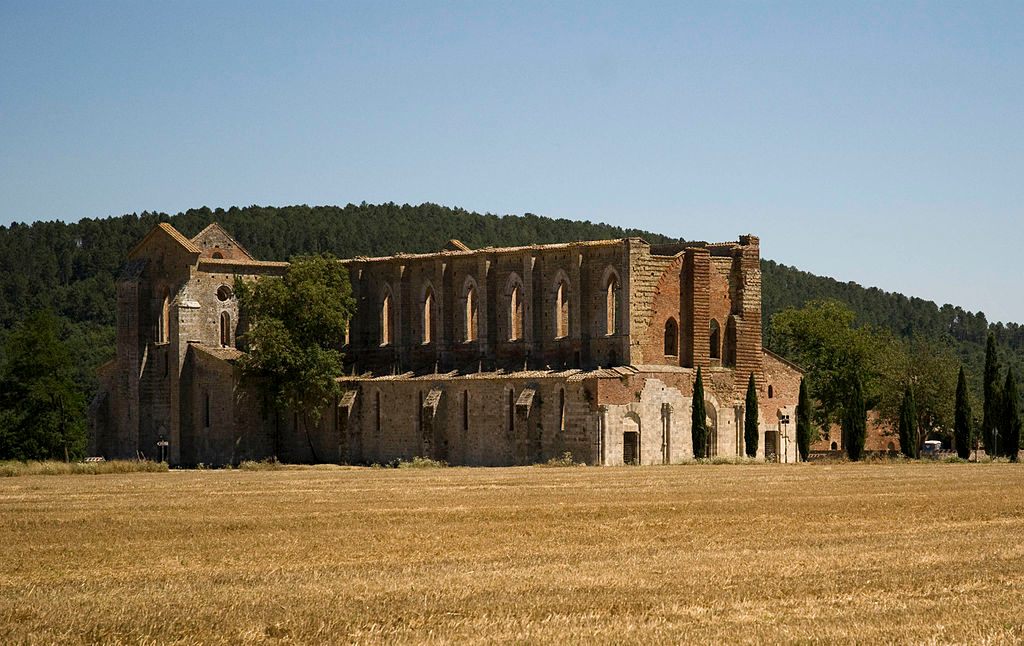
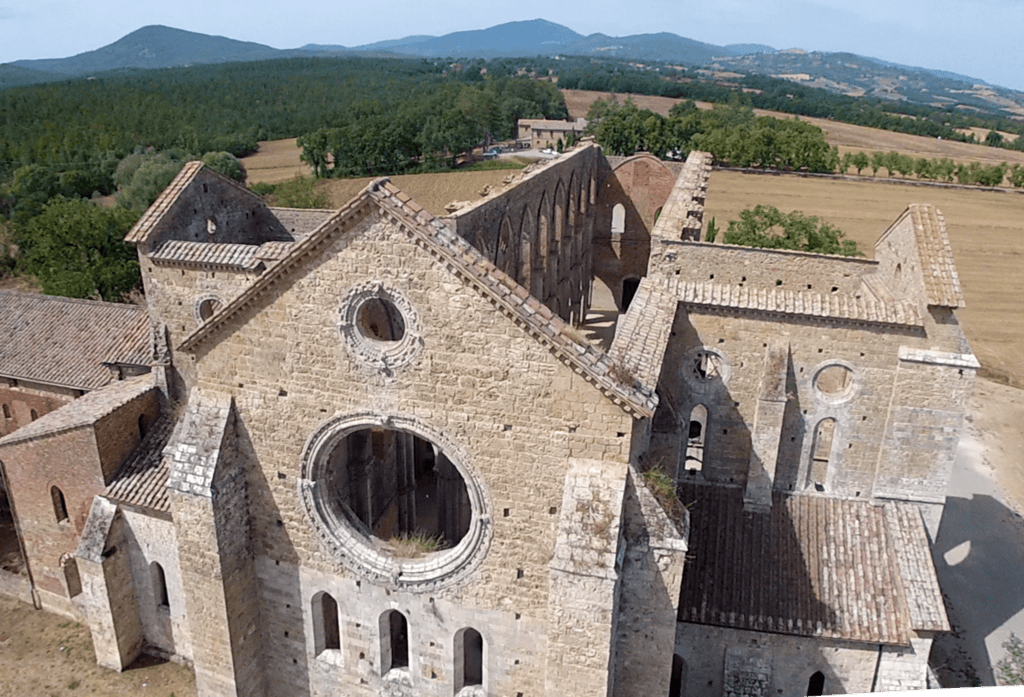
Today, you can still find the Sword of Galgano, who has earned the title of saint, in Montesiepi Chapel. While there, walk a few steps over through the massive and breathtaking San Galgano’s Abbey! It’s gorgeous and haunting and an icon in the world of the medievalist. It stands majestically in this same little area of Chiusdino, surrounded by the landscape of Siena’s mountains. If you’re headed to Tuscany, this one cannot be missed!
Modena Archivolt – Modena Cathedral, Modena
The Italians loved Lancelot. It’s no wonder. Just like the French, to suffer in the name of love was seen as the most romantic thing of all. Otherwise, what’s the point? They loved his confidence, ideals and adventures. Besides, what says “Italian man” more than insisting you’re the only man for your dream woman and claiming that you’ll literally die if you can’t lie with her again? Or fighting any man to the death that dares look at her the wrong way? Or fainting at the mere mention of her name? Well, okay, maybe that’s more of a medieval Frenchman thing but nonetheless– French and Italian passion go hand in hand!
So it’s no surprise that the Italians told his stories over and over again in the valleys of rolling hills and sun-warmed piazzas. And while they preferred short prose and poems, they loved best the story of Lancelot’s sword bridge adventure– which was circulating Europe even before Chretiéns Knight of the Cart! Soon, Italy put their own spin on the tale, having Arthur join Lancelot to save Guinevere from Dolorus Tower, where Mardoc (Melegeant) kept her captive. That’s why this very scene is featured on one of Italy’s more popular cathedrals.
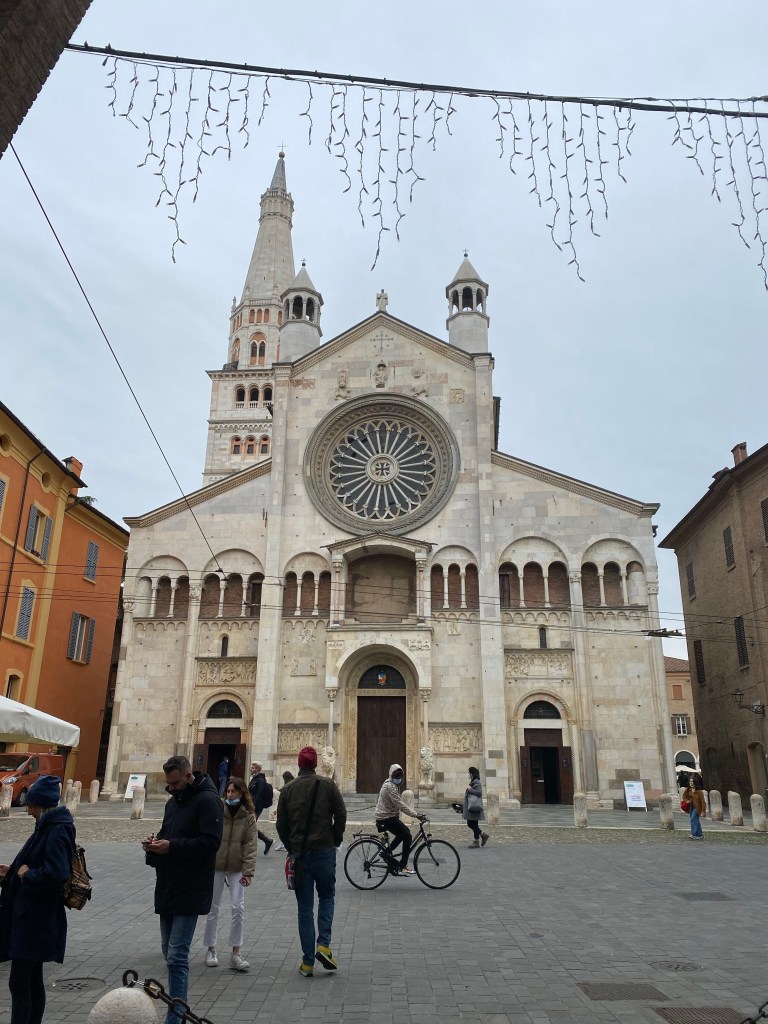
In the town of Modena stands the gorgeous Modena Cathedral, which features tons of beautiful sculptural art along its outside walls. On the northern side, near the Ghirlandina tower, is the Porta della Pescheria or “gate of the fish market”, named so because it was the entrance to the church in which pilgrims entered and was also, lo and behold, next-door to a fish market. Because this entrance was so accessible to the public, it’s the side that held some of its most beautiful and diverse artworks, both pagan and Christian, and internationally-inspired– one of which is the very first sculptural depiction of King Arthur in history!
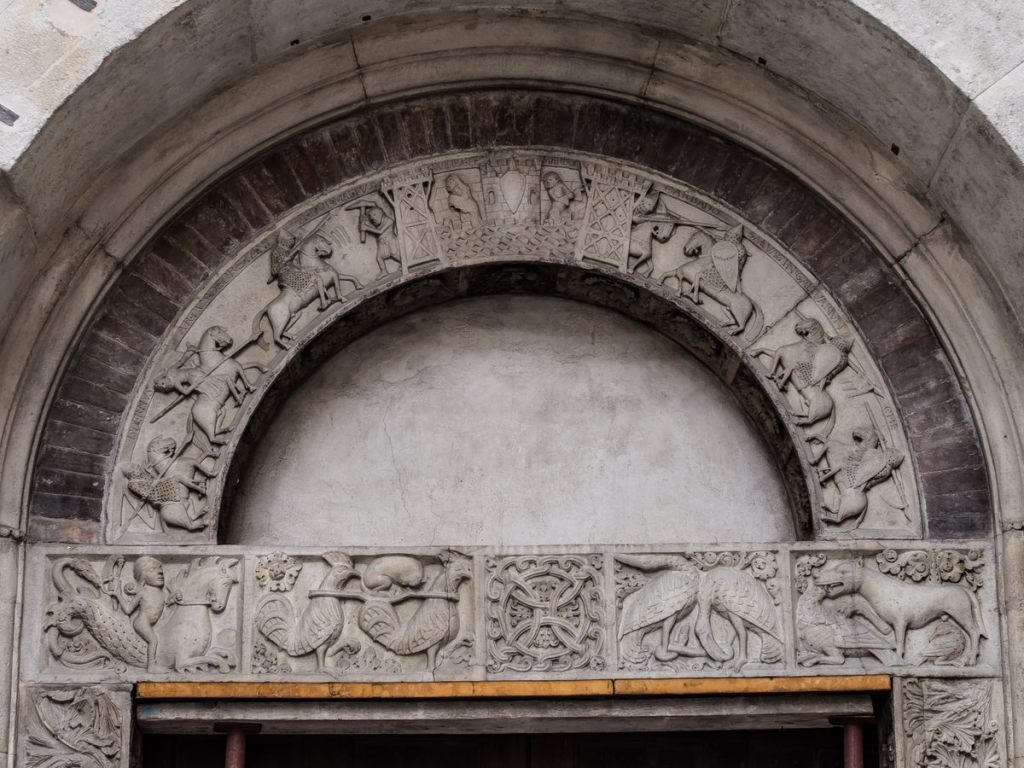
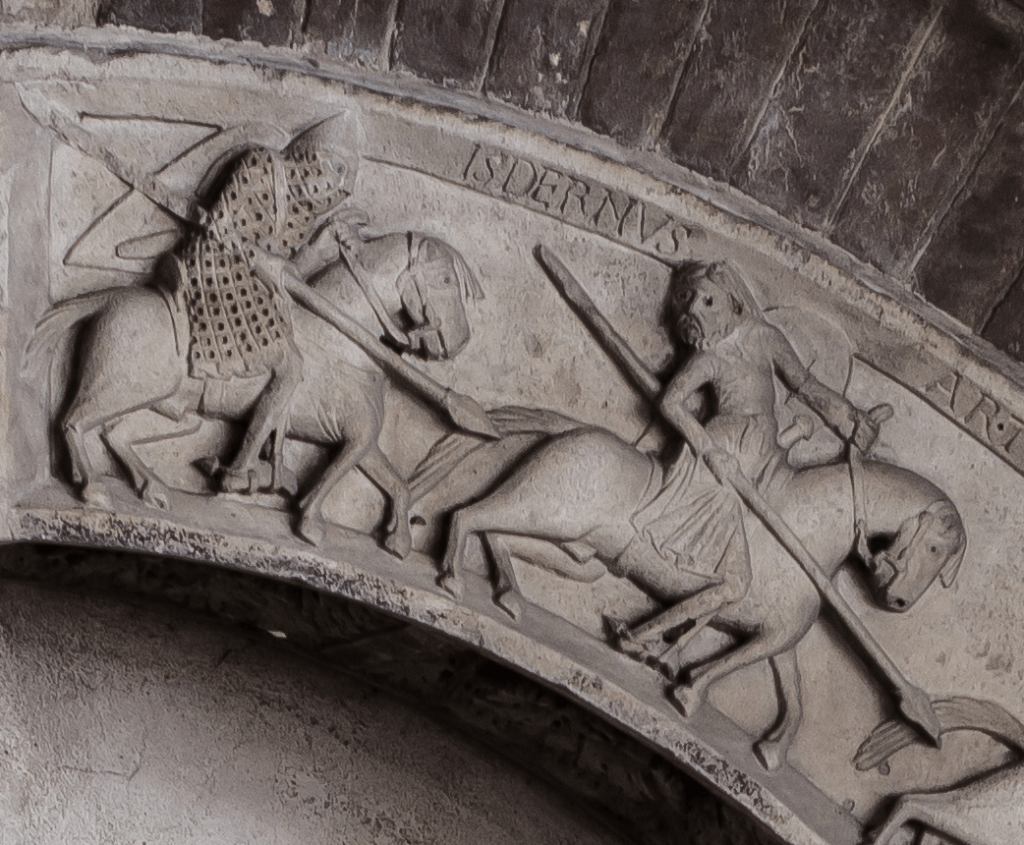
On the arch is a lovely frieze sculpture. Here, Mardoc is shown holding Guinevere captive, while Arthur and his knights try to free her. Interestingly, some of their names are vastly different than the ones we know. For example, Guinevere is called “Winlogee” here (which offers a small resemblance; “Guin-” could easily become “Win-“) and “Isdernus” is the name given for who we assume to be Lancelot, since he is Winlogee’s lover. And the story matches up. The caption also reads “It is the story of the Arthurian legend,” and includes characters named Artus Britani (Arthur of the Britons), Isdernus (Lancelot), Carrado, Winlogee (Guinevere), Galvagin (Gawain), Che (Kay), Galvariun, Yder, Caradoc and Galeshin. There’s also a man serving Mardoc named Burmalt, who may correspond with Durmart, the King of Gaul whose adventures are apparently told in an early 13th-century Old French romance called Durmart le Galois. (I’ve got some reading to do!) There’s even one unnamed knight whose identity is still unknown after all these years. Perhaps he’s the Italian counterpart of Beaufils, the Fair Unknown? AKA Percival? The identity is up to the viewer!
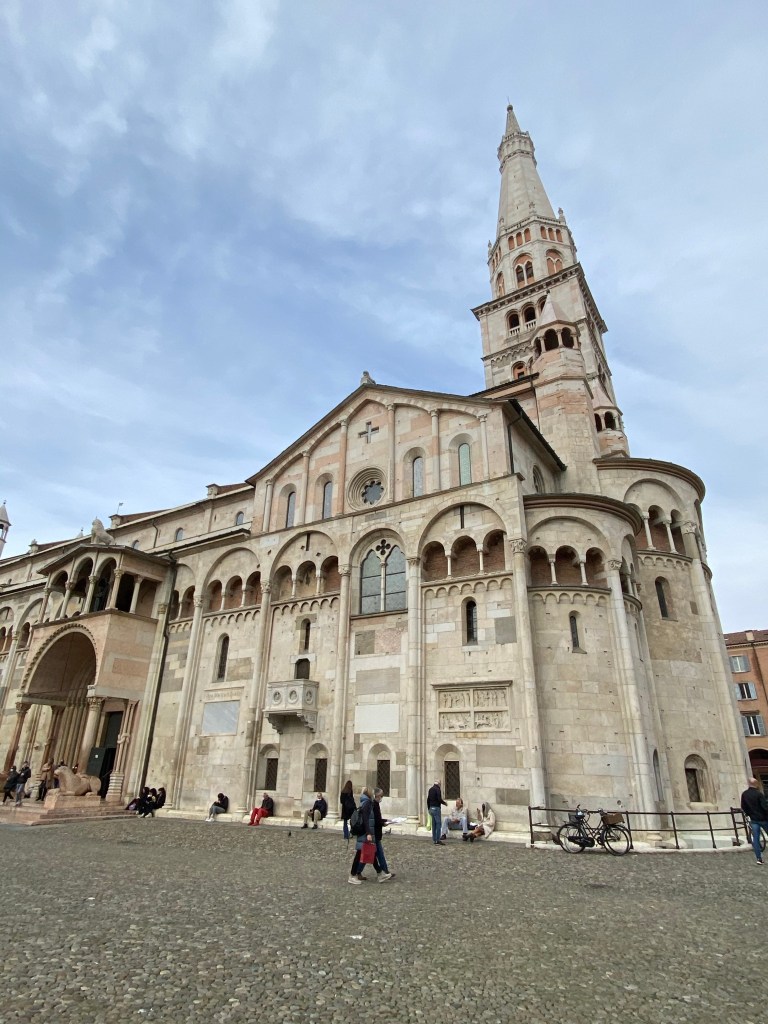
Modena Cathedral has now become one of the most important Romanesque churches in Europe, and one of Italy’s biggest Arthurian locations. It’s also officially a UNESCO World Heritage site. And it ought to be; it’s a huge piece of evidence that the tale of Guinevere’s abduction, and of Arthur in general, was circulating Italy even before it was penned to paper. The Porta della Pescharia and its Arthurian frieze sculpture was built between 1120-1140. Chretiéns Knight of the Cart story wasn’t written until the 1180s! It’s so cool to have physical, visual proof of the Arthurian oral tradition all the way in Italy. ❤
If you’re wanting to visit the cathedral, opening hours are (typical Italian) business hours: 7:30 a.m-12:30 p.m. and 3:30 p.m.-7:30 p.m. Make it a stop if you’re visiting the north!
Otranto Mosaic – Otranto, Puglia
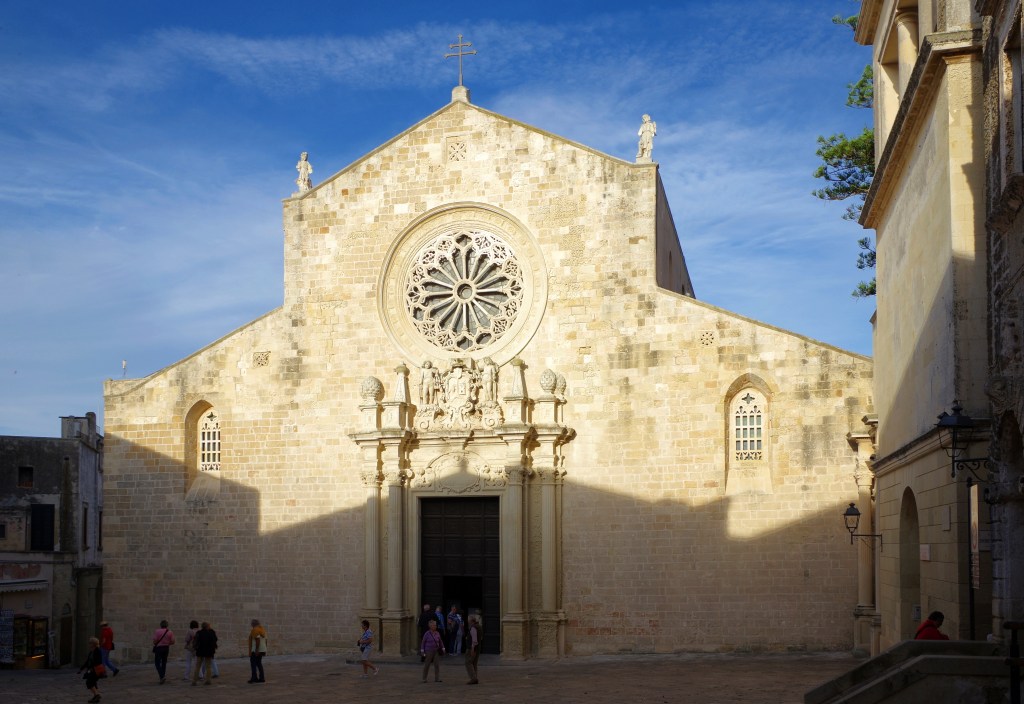
All the way down south in Puglia is the town of Otranto, where stands Cattedrale di Santa Maria Annunziata, or Otranto Cathedral. It’s a cathedral that has been through a lot, but its most precious artifact is still preserved. This would be the Otranto Mosaic– the largest mosaic in Europe! It was commissioned in 1163 by the archbishop Gionata, painted by a group of artists supervised by Pantaleone, a Basilian monk from the monastery of San Nicola di Casole. He wanted a Tree of Life as the centerpiece, in which was also enwrapped several different tales depicting the forces of good and evil. Some of these are the tales of Adam and Eve, Cain and Able, Diana the Huntress and our beloved King Arthur.
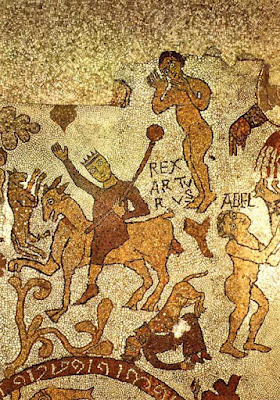
Edward Watson, author of Arthuriana blog “Clas Merdin” (check out his work here!) writes a lovely detailed description of Arthur’s portion of the Otranto mosaic, and its significance to the Italian idea of the Legend:
On the Otranto mosaic King Arthur is clearly identified by the inscription ‘Rex Arturus’ and shown wearing a crown (added in the 19th century), holding a sceptre or (doubtfully) a long club. Arthur appears with Cain and Abel in what has been described as an allegory of the Fall of Mankind. He is depicted riding on what is clearly a goat-like creature, horned with cloven hoofs, and confronting a giant cat. The Celtic scholar Roger Sherman Loomis has described the goat-riding figure as a representation of Arthur as a supernatural lord of the Otherworld, a fairy king; as such an element of the ‘immortal Arthur’ based on the many cave legends that tell of him sleeping in a magical subterranean kingdom entered through a cave, such as Mount Etna in Sicily, Mount Snowdon in Wales or Alderley Edge in Cheshire, England. According to a 14th century Majorcan poet the wounded Arthur dwelt in a Mediterranean island and was kept alive by an annual ministration of the Holy Grail. Certainly legends of the immortal Arthur dwelling in a subterranean kingdom were established in Sicily by 1190. Loomis argues that among the Welsh and Bretons, at least one conception of the Otherworld was an underground region peopled by a race of noble dwarfs whose supreme king is portrayed as riding on a goat; it should not be surprising to find Arthur astride a goat in the Otranto mosaic of 1165. It would appear probable that the tale of Arthur as ruler of a subterranean Otherworld realm depicted riding a goat was brought to Italy by the Normans. But when considered with the goat-riding king fighting a monstrous cat it becomes almost certain. Beneath the depiction on the Otranto mosaic of King Arthur riding the goat toward a monstrous cat rearing up in front of him, is a similar big cat mauling a similarly dressed man about the neck. This fearsome creature has been described as the Chapulu or Palug’s Cat (Cath Pulac in Welsh). In one French version of the Chapalu tale Arthur engages in combat with the cat at a swamp where he is killed by the creature, which then invades England and becomes king.
I had no idea there was a version of the Legend in which Arthur is literally killed by a cat. But hey, whatever floats their boat over there in the Mediterranean, right? Regardless, this cathedral is yet another beautiful piece of proof that the Legend was told orally before it became popularized written literature. It was built after Geoffrey of Monmouth’s History of the Kings of Britain (written in 1138)– so there was one piece of Arthurian literature– but before Chretién’s romances, which caused the Legend to explode. So that makes it another significant Arthuriana location, in my book! If you’re headed down south on your next Italy trip, enjoy Puglia’s beautiful seaside town of Otranto, savor some delicious orecchiette for lunch with a glass of vino, and head over to this historic mosaic!
Tristan Quilt – Bargello Museum, Florence
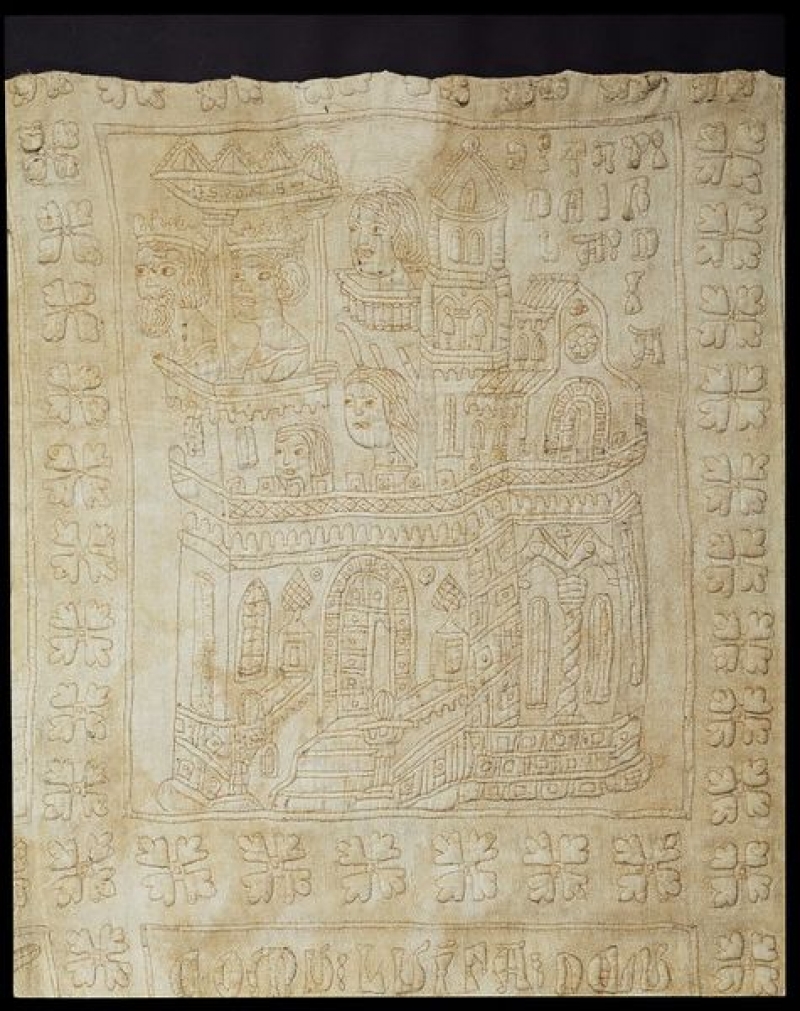
The Bargello Museum is a lesser known museum in Florence but with some great finds! One of them is a late 14th century quilt depicting story of Tristan and Isolde. It’s also the oldest quilt in Europe!
Y’all, I was studying in Florence for a whole month. And I found about this place the week after I left. It was an 8 minute walk from my school. 8 minutes. Bro, my level of livid when I discovered this…lol… ANYWAY, it’s a Sicilian quilt exploring the oppressive rule over Cornwall by King Languis of Ireland, and the battle fought between Tristan and Languis’ champion, Morholt. It starts to explore Tristan’s love for Isolde– but the rest of the quilt is in London at the Victoria and Albert Museum.
If you’re heading to gorgeous Firenze, make a day out of it! Take in the view of the iconic Santa Maria del Fiore (the Duomo), walk the sand-colored city streets lit gold by the afternoon sun, indulge in a mouthwatering bowl of traditional cinghiale (wild boar) and Tuscan chianti for lunch (and gelato for dessert!) and go take in this historic piece of Arthuriana woven into Europes oldest quilt, right in the heart of one of Italy’s finest cities. Find more info here: https://trc-leiden.nl/trc-needles/individual-textiles-and-textile-types/secular-representations/sicilian-tristan-quilt
That’s about all I have for the biggest Arthurian locations in Italy– but there are a few other smaller ones that deserve a quick shoutout!
- Castel Rodengo: Castle far up north near Austria and Lichtenstein with frescoes depicting Sir Iwein. Find more info here: https://www.suedtirolerland.it/en/highlights/castles-mansions/rodengo-castle/
- Castel Roncolo (or Runkelstein Castle): Castle up north by Austria with frescoes depicting Sir Parzival, Sir Gawain, Sir Ywain and 3 lovers including Tristan and Isolde. Find more info here: https://www.suedtirolerland.it/en/highlights/castles-mansions/roncolo-castle/
- Palazzo Ducale, Mantua: Duke’s palace up between Milan and Bologna with frescoes depicting King Arthur. (Only 25 people allowed in to see it at a time, every 15 minutes!) Find more info here: https://dreamofitaly.com/2016/01/19/mantua-back-future/
I love looking at places in Europe outside of the UK that were impacted by the Legend because it shows us just how far the stories of King Arthur reached, and how much they inspired people worldwide. And the amazing thing is that they still do. ❤

