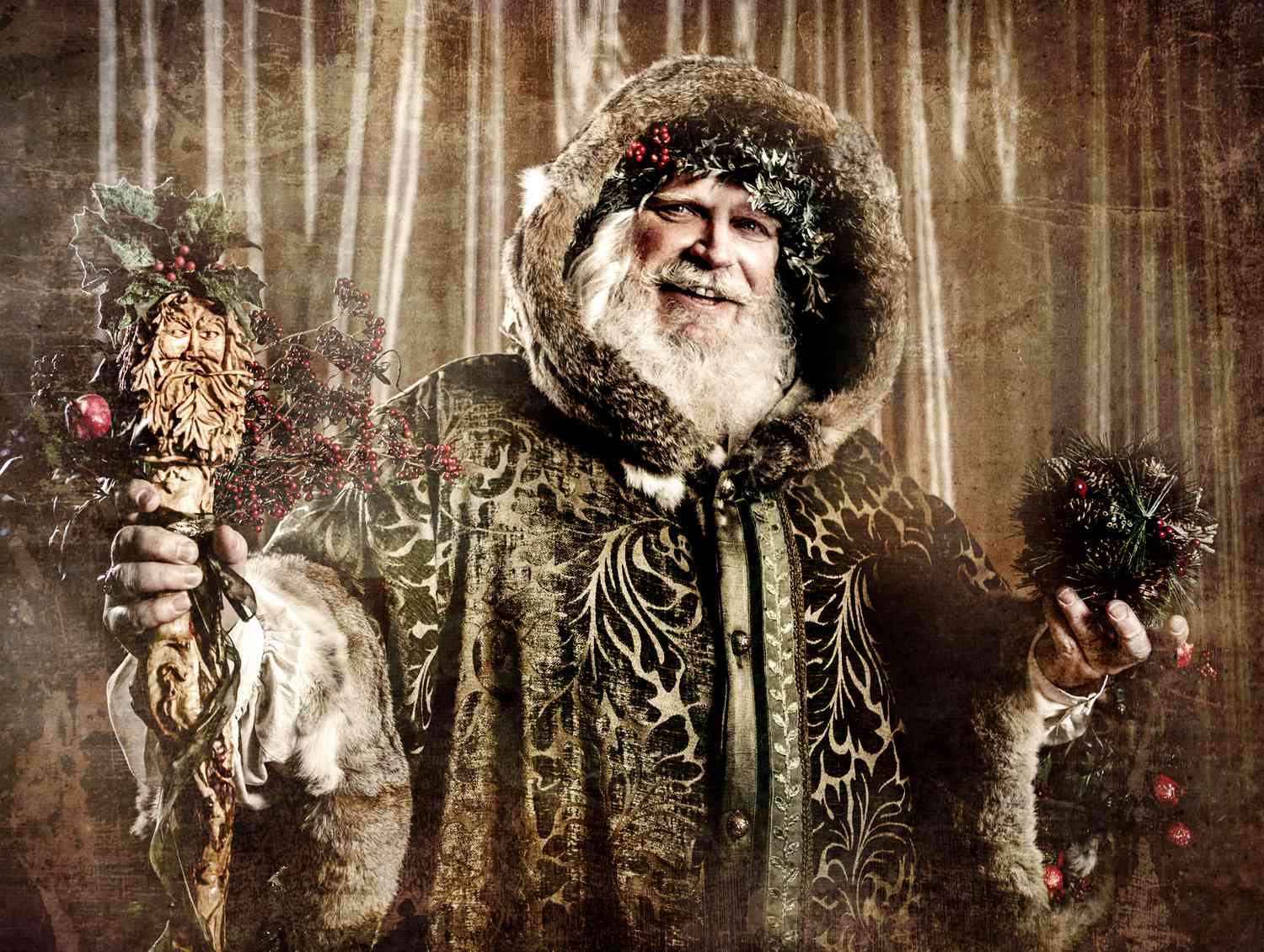
Have you ever thought about the connection between the Green Knight and Santa Claus? This is just a quick little thought that’s run through my mind many a Christmas now so I figured I’d share this year! 🙂
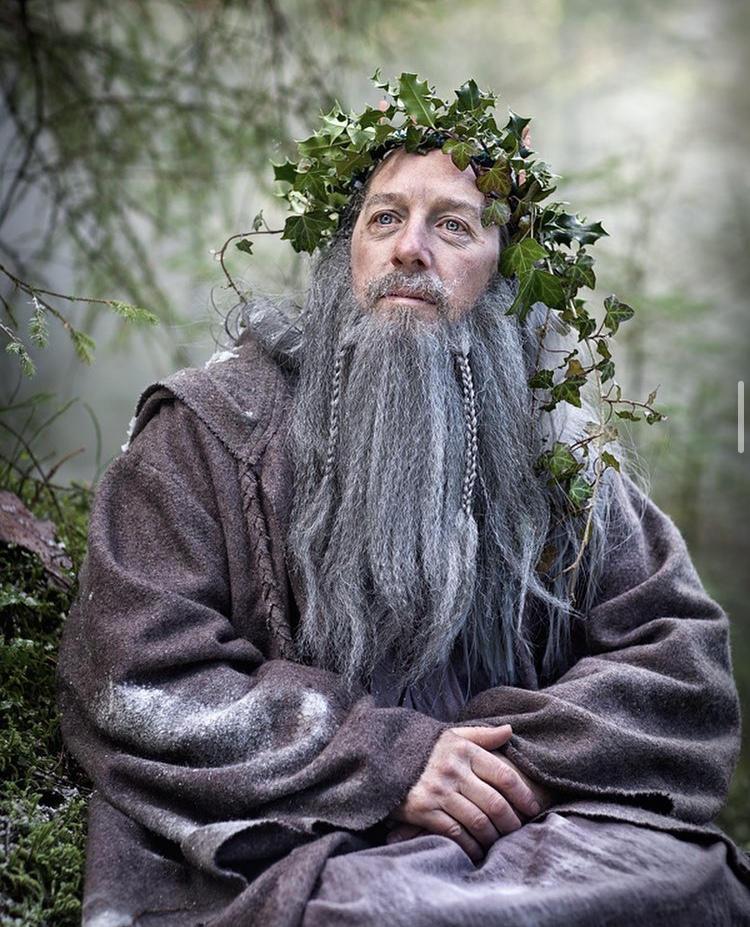
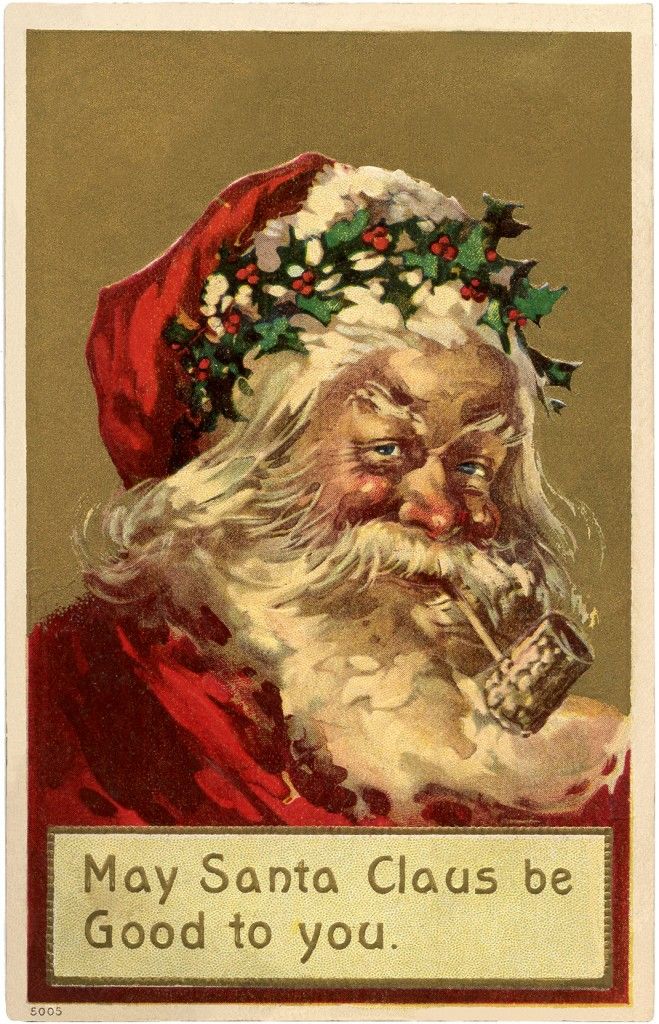
The Green Knight can be said to have connections to the Celtic figure of the Holly King, who has many similarities to Father Christmas and be even be his source of inspiration. The Holly King is thought to have been known by the ancient Celtic peoples, particularly in British lore, though he may have gone by a different name and is especially revered in modern neopagan traditions. Nonetheless, assumed to be an inspiration for the figure of Father Christmas (right along with Grandfather Frost in Russian traditions, Odin in Scandinavian traditions, Saturn in the Roman pantheon, Father Time, and other all-father winter figures), the Holly King was a sort of father figure, too. An older, wiser spirit representing the dying of the year. He was both mysterious and jolly of spirit, just like Father Christmas– and just like the Green Knight. (Yes, those of you who have only read Part 1 of Sir Gawain and the Green Knight and think he’s the villain, you would be incorrect; he can, in fact, be quite jolly!)
Mistletoe and Holly
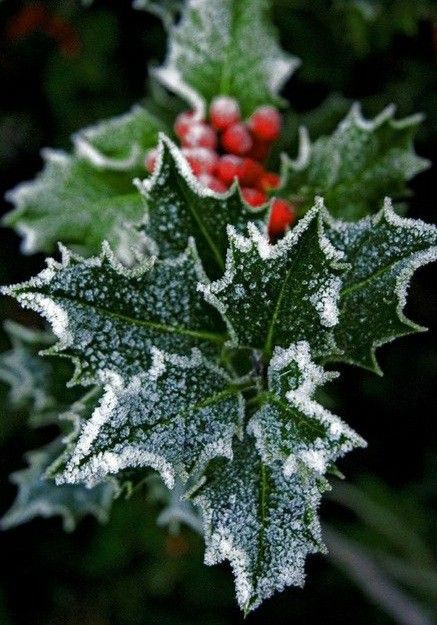
For a very simple parallel, the colors and what they represent are the same. (Christmas colors! There’s a reason for this other than festivity, though.) The Green Knight is not only entirely green, in addition to his green armor, but he also carries with him a sprig of mistletoe; a major symbol associated with Father Christmas, who wore a sprig of mistletoe in his cap. For the Celts, mistletoe offered protection from evil. People would place a sprig above their front doors and in windows to keep spirits with malicious intent at bay. In fact, the Green Knight says when he first barges into Camelot, “Be assured by this hollen stem here in my hand that I mean no menace,” and later, “I’m clothed for peace, not kitted out for conflict.” His mistletoe was, therefore, a symbol that he came in peace. (Sort of.) Mistletoe is also a symbol of peace in regards to Father Christmas’ symbology, so much so that it’s became a symbol of both Christmas and winter romance, inviting lovers to kiss underneath its deep green leaves.
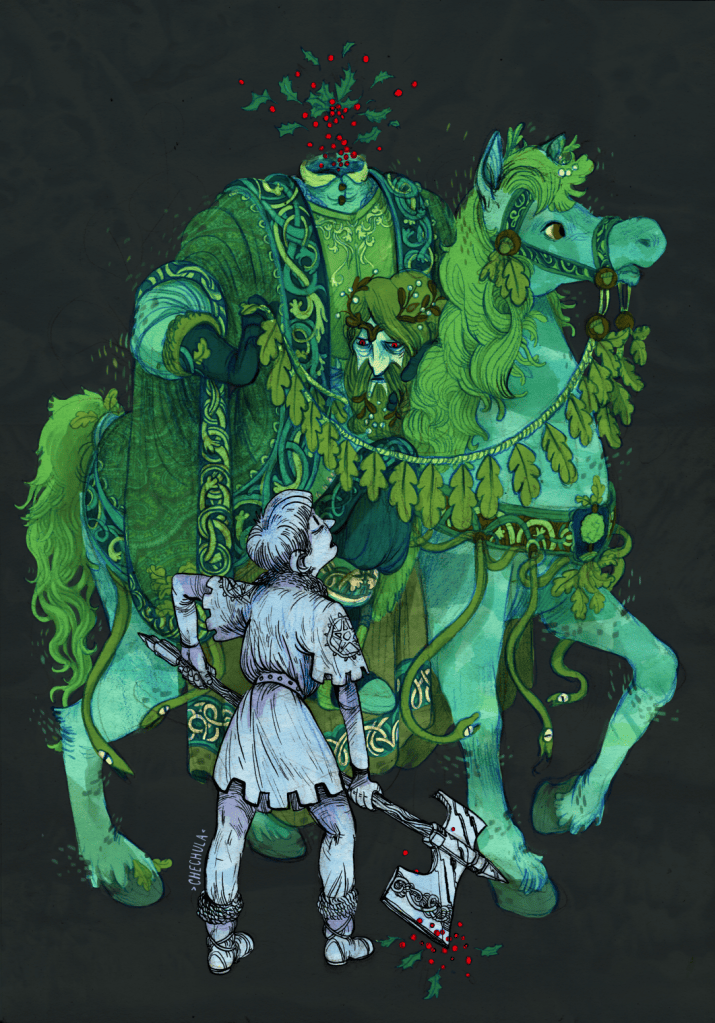
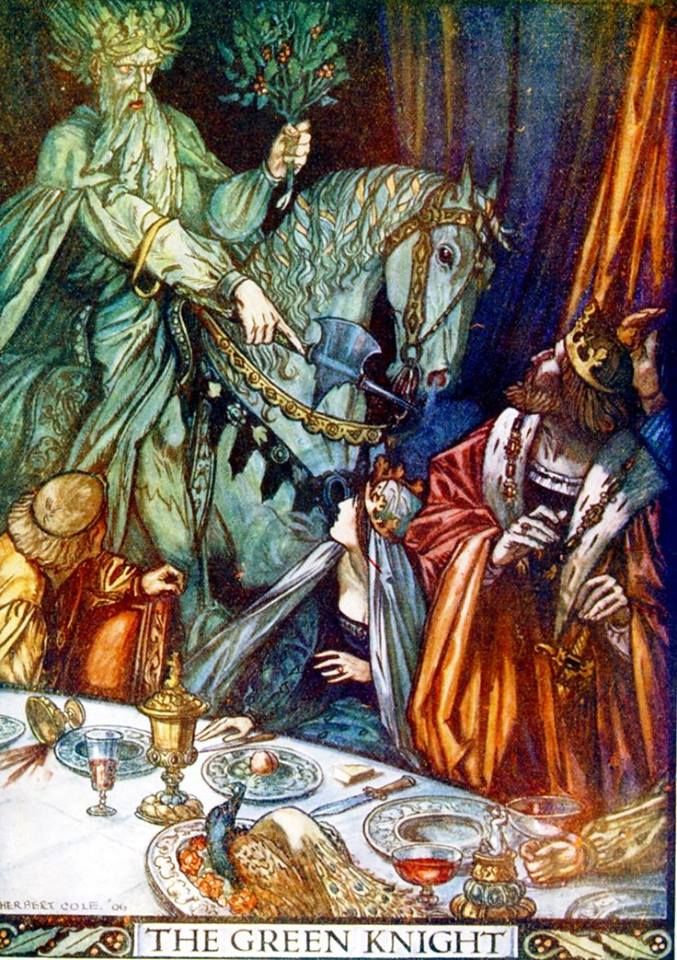
The color green also represents life and the natural world. At the time when Sir Gawain and the Green Knight was written, Britain was heavily Christian. A green man walking into anyone’s house in today’s time would be absolutely unbelievable but at least we could rack our brain trying to come up with some ridiculous scientific reason that made it possible. Back then, anything outside of society’s walls (AKA the woods, forests, wilderness) represented the unknown. That included scandalous affairs that happened within the trees beyond the sight of others, as well as faerie business beyond explanation. When the Green Knight entered Camelot, everyone immediately associated him with the Otherworld and faerie magic. This is perhaps part of the reason why greenery has become so associated with Christmas. Aside from the famous tradition of decorating the Yule tree, for which the idea was to bring “life” indoors in a time of death, winter was also a time of darkness and mystery. In addition to fear, there was still yet a sort of magic and wonder to this darkness, and in medieval times, it was probably the one time of year when magic and wilderness was revered instead of frowned upon or shunned. Thus, when Christianity adopted the Holly King (amongst other pre-Christian winter father-like figures) and made him Father Christmas, they kept his sense of mysterious magic by giving him mistletoe and holly as a few of his iconic symbols. Holly is also associated with the Green Knight, as in some versions, it states that he wears a “crown of holly”. He’s also painted wearing a holly wreath in several pieces of popular Arthurian art. And Santa often is, too!
Reindeer
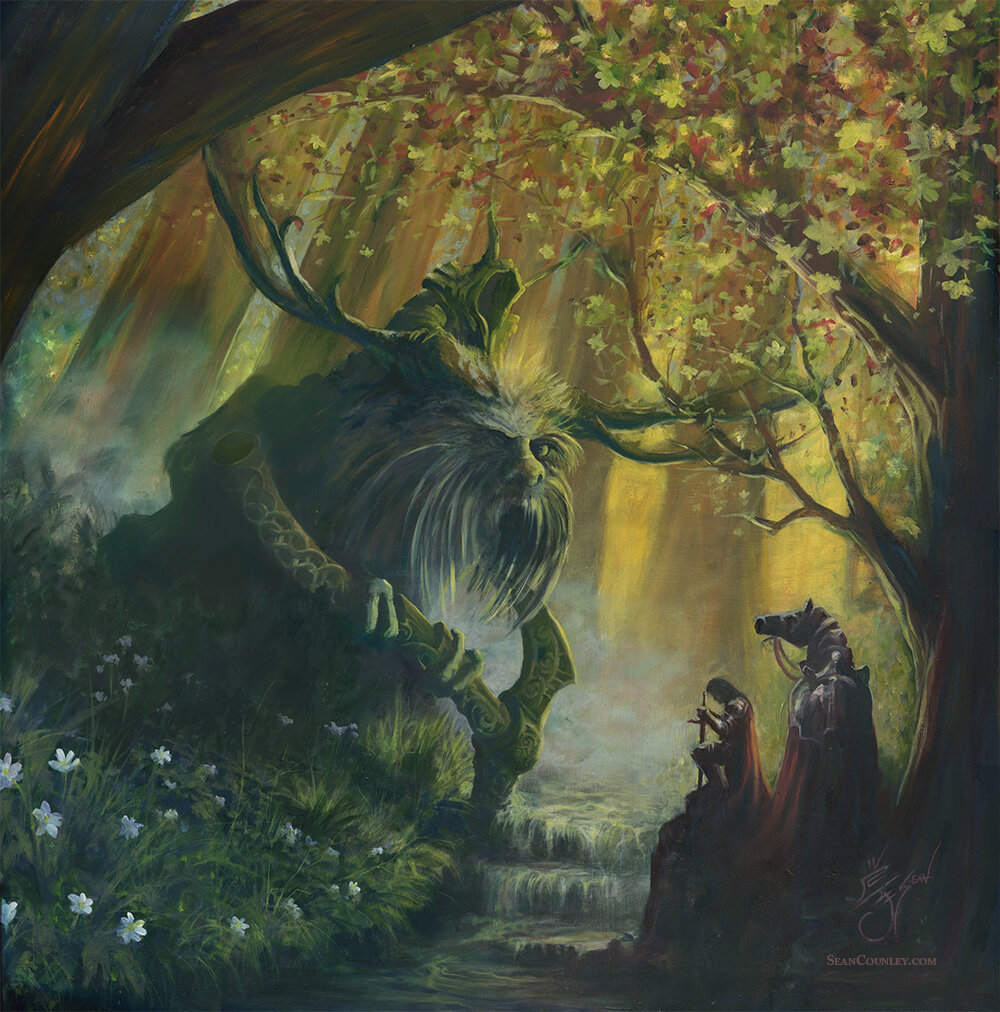
Santa Claus rides a sleigh of eight beautiful reindeer, right? Ironic that the deer was one of the most revered animals by the Celts, representing wisdom, integrity, spirituality and honor. (All things Santa Claus represents. Maybe not the spirituality part but belief in something magical, at least.) The deer, or the stag, was also the symbol of Herne or Cernunnos, Celtic god of forests and the hunt. Who else is often depicted with green skin and mistletoe, and antlers to represent the natural world? Cernunnos. And the Green Knight. And what does the Green Knight do in his “Christmas game” that he forces Gawain to play? Hunt. He may not fly a sleigh of reindeer but the connections are all there! (In fact, I think the Green Knight’s green horse (who never asked to be green) would get along swimmingly with Rudolph. Outcast buddy-bonding.) Anyway, the Holly King was also thought by some to pull a chariot of eight deer, similarly to how Odin rides an eight-legged horse, or Thor who pulls a chariot of goats. Or Santa who pulls a magic flying sleigh of reindeer. (Fun thought for fellow pagans: the fact that the Santa/the Holly King has eight deer can also represent the eight Wheel of the Year festivals!)
Gifts
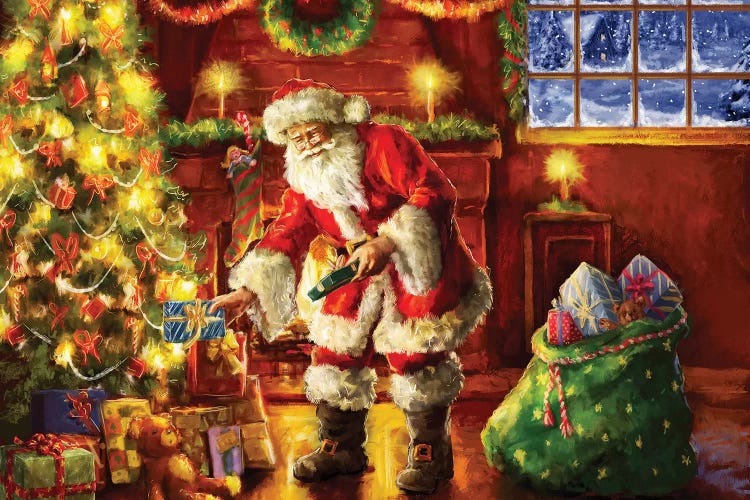
It’s also ironic that the deer represents integrity and honor, which the Green Knight is on a constant hunt to find in Britain’s warriors. As “Bertilak” (the Green Knight’s human form), he rewards Gawain’s courage and honorable behavior with gifts; a giant feast every night, the largest piece of game from the day’s hunt, the most comfortable guest bed in the manor, joyful company and of course, the famous axe. These are all gifts he gladly gives Gawain to reward his being brave enough to actually go out after him, amidst the harshest winter weather, simply for integrity and goodness’ sake. Father Christmas, too, rewards good behavior. He travels the entire world in search not only of children in need but good children he can reward with gifts for their good behavior. In SGGK, the theme of temptation also comes into play with the scandalous goings-on that take place (or almost do) between Gawain and the Green Knight’s “wife”. The Green Knight knew of this affair all along and even planned it with his wife, as a test of Gawain’s honor. The same goes with the magic green belt with which the wife tempted Gawain, vowing that it would save his life. But wearing the belt would mean cheating his way through a deal with the Green Knight. Cheating his way through life. Of course, he takes the belt anyway. And when Gawain admits to all of this, overcome with shame, the Green Knight blesses him and lets him go home to Camelot, safe and unharmed, knowing that the lesson he learned that Christmas was one that would last him a lifetime. He even gifts him the belt. In this way, the Green Knight truly represents truth, honor and goodness. The same way Father Christmas represents everything that is good and full of kindness and mercy.
Holly King vs. Oak King
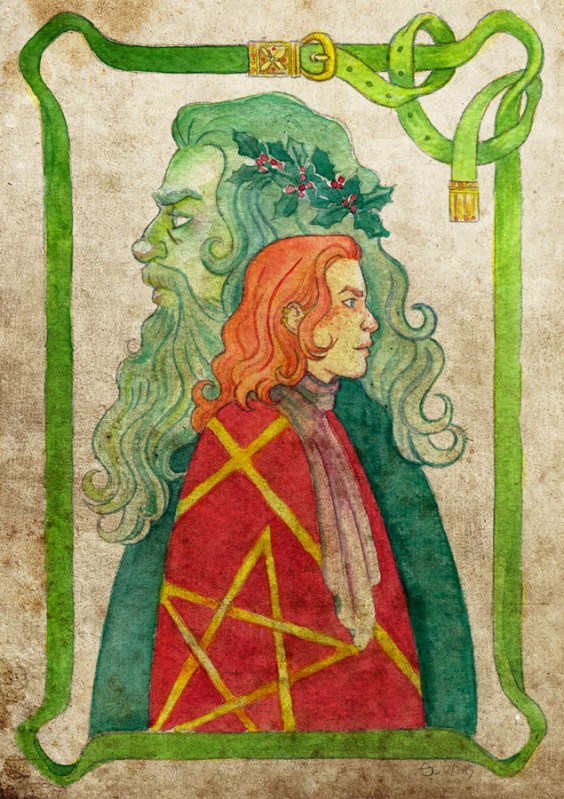
For a slightly more complex connection: As the lore goes, on Yule Night or the Winter Solstice, the Holly King searches for his brother, the Oak King, in want of battle. The two have a mighty duel and in the end, the Oak King wins, bringing with him the start of the light half of the year. (Spring and summer.) Likewise, on the Summer Solstice, they fight once more, and the Holly King wins, bringing about the start of autumn and winter; the dark half of the year. All this is to say that the Holly King spends Yuletide in search of battle or a challenge, to promote strength, integrity and honor. The Green Knight does the same on Christmas Eve, traveling far and wide in search of someone honorable enough to accept his challenge. Once again, Father Christmas also travels the world this time of year in search of good children he can reward with gifts for their kind and noble behavior. ❤️ Also, unrelated to Santa Claus but on this note, Gawain could represent the Oak King! (Bright, summery, full of ambition and optimism and youthfulness.) Makes sense that he would fight with the Holly King each Yule. Just a quick thought for any Arthurianists who enjoy the Oak King vs. Holly King lore!
Spirit
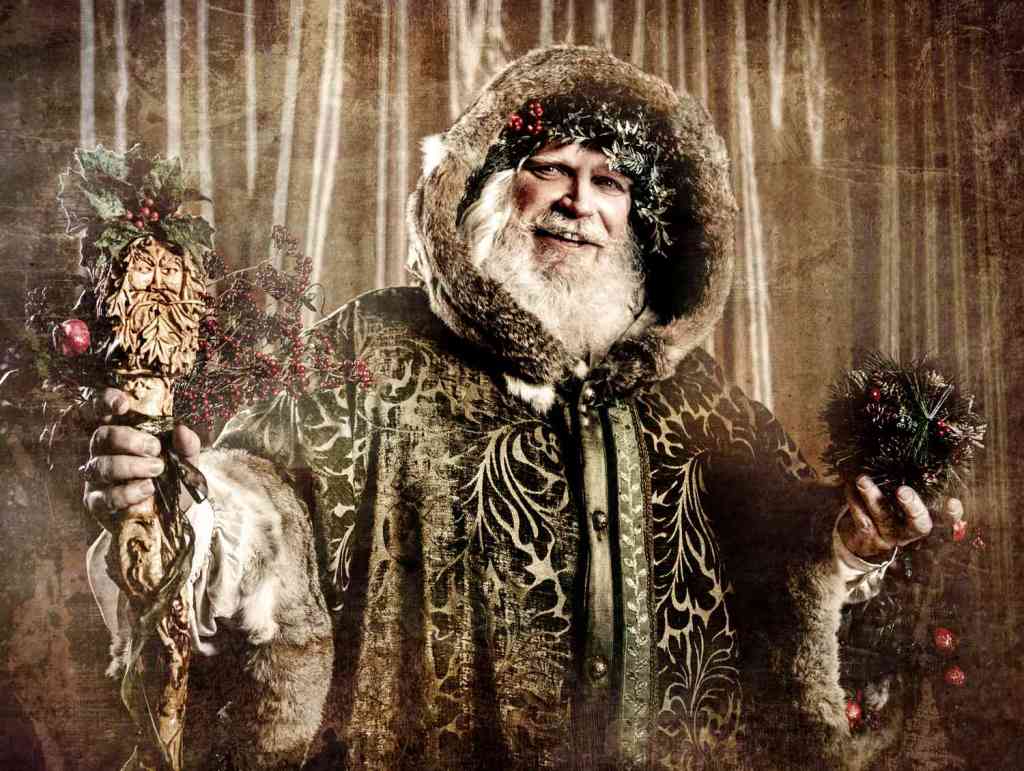
Last but nowhere near least, Santa Claus is known for his hearty laugh, his rosy red cheeks and jolly red nose, a winter white beard and his jolly spirit that’s powerful enough to make children believe in him. The Green Knight was known for this, too. In his human form as Bertilak, he is literally the epitome of ole St. Nick. Big, hearty laugh, warm smile to warm the soul, booming voice, giant presence, big belly that shakes with joy when he laughs, bushy white beard the color of snow, handsome features that makes him joyful to look at, and a mysterious twinkle in his eye. A twinkle that might hint there’s something more to him than what appears. He might not come down your chimney– he’ll barge through your front door instead and scare the living bejesus out of everyone– but he’ll do it for the spirit of the season! Even as the Green Knight, in his true wild form, he is larger than life, full of winter greenery and magic, prepared to pose a challenge of honor and reward the warrior if worthy enough.
All in all, the Santa Claus we know and love can be connected in some ways to the Green Knight, whom we also know and love, for different reasons. Though perhaps those reasons aren’t so different, after all. They both are father figures with Christmas magic. Santa Claus somehow visits every house in the entire world, all in one night. With a magic sleigh of flying reindeer, with whom he lives in the coldest place on earth. The Green Knight lives in the hardest place to find in all Britain, shapeshifts into any being of his choosing and is a wild, eternal spirit that cannot die. (At least not by beheading!) There’s certainly mystical winter magic between the both of them enough to enchant children (and adults) for all time. ❤️
Anyway, thank you for listening to my Yuletide rambling! If I don’t pop on here anymore before Christmas, I hope everyone has a most magical Christmas and a beautiful, blessed Yule and Solstice!
Seasons greetings and warm winter wishes,
LJ ❤️🎄❄️🌿


Well, this is just wonderful and delightful! I would never have made the connection myself. I’m so used to thinking about the Green Knight as a variation on the Green Man figure, comparisons to Santa / Father Christmas never entered my mind. You make a very good case. (I especially like the notion that Rudolph and the Green Knight’s horse would have become fast friends.) 🙂
How does the fact that the Green Knight comes to the court on New Year’s Day confirm or complicate these Santa connections? Granted, Christmas is, on the Western liturgical calendar, a 12-day feast, and January 1 is only the eighth day of Christmas – but that’s still well past time for Santa to show up! 🙂 Looking back at the poem (for the first time in a long time), I see Christmas described as a 15-day feast (Fitt 1, line 44) – I don’t remember how those 15 days were counted. Will have to lok into that.
Understand, I’m not picking a fight, just playing along! This really is a very nice piece and it puts the Green Knight in a whole new light for me. Thanks for it!
LikeLiked by 1 person
Thank you so much for your comment! So glad you enjoyed it! I, too, usually associate the Green Knight with the Green Man— but around this time of year, this thought always seems to cross my mind. You’re totally right about New Year’s Day! If I’m correct, Christmas feasts in the 12th century lasted, like you said, 15 days and ended with the first day of the New Year. I’m mostly only familiar with Simon Armitage’s translation of SGGK, in which he simply states in Fitt 1 that “It was Christmas at Camelot” and doesn’t specify much about the New Year in the beginning except that “the new year was young”. 😂 So in that regard, I’m honestly not too sure how the Green Knight fits into the Father Christmas figure when it comes to New Year’s Day, except in the sense that he’s a Yuletide figure that comes around this general time of year. 😂 Perhaps he comes right at the very end of Christmas instead of on Christmas Eve, as is sometimes portrayed in various new adaptations (mine included.) I’ll have to look into that further! Great point!
LikeLike